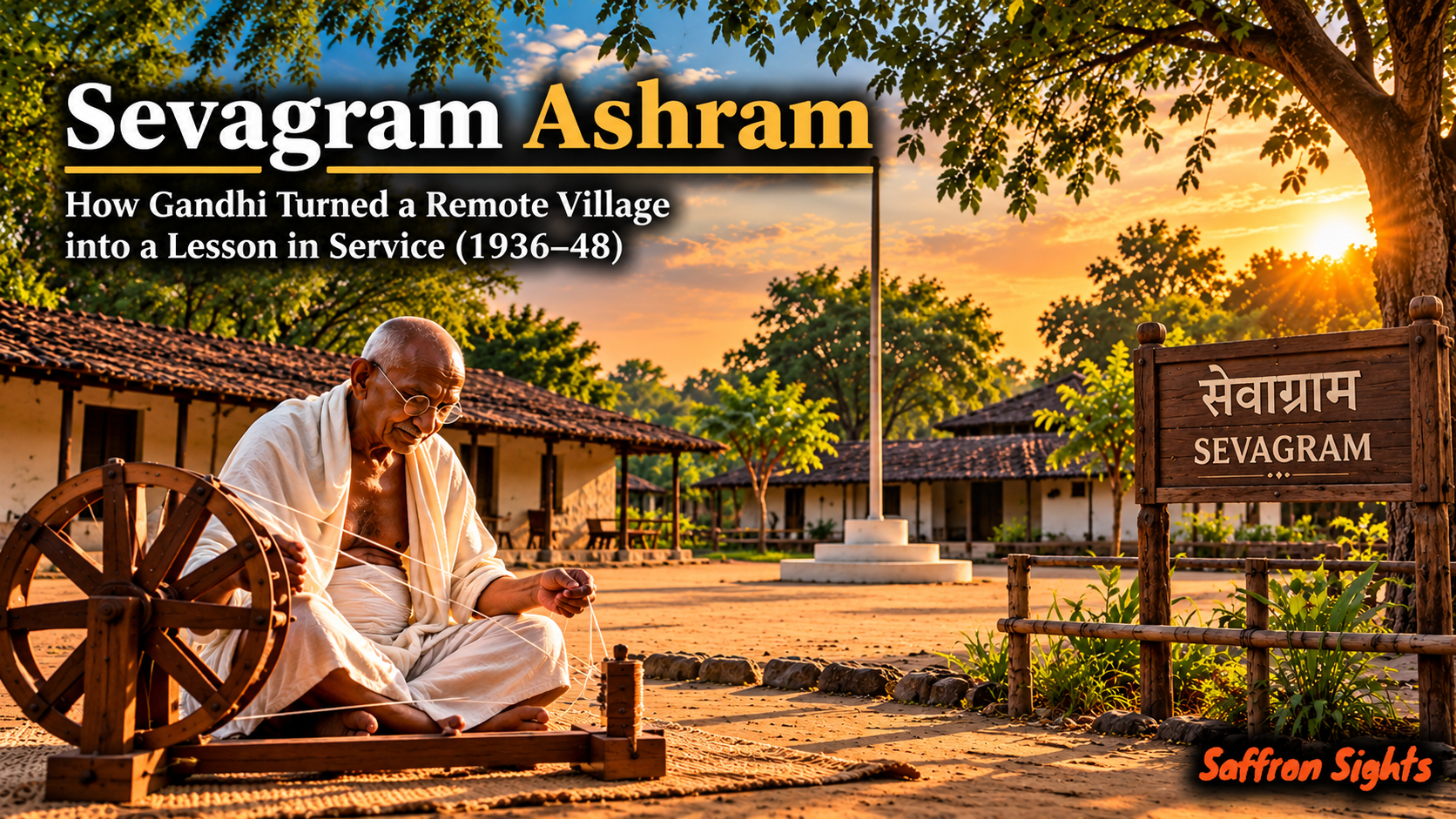

Sevagram Ashram in Wardha, Maharashtra, was Mahatma Gandhi’s home and workplace for the last years of his life in India. It is more than a memorial. It is a working experiment that shows how simple daily habits can build an honest, self-reliant and caring life. This guide explains how the ashram began, how people lived there, what is settled history and what is still debated, and what visitors can learn today.
What Is Sevagram Ashram?
Picture a few plain huts around an open, sandy prayer ground. There is no palace and no grand gate. Gandhi lived in simple cottages here, ground grain by hand and cleaned latrines alongside everyone else. This is Sevagram Ashram.
The ashram stands in the village of Sevagram, near Wardha in Maharashtra. The name means “village of service.” Gandhi made it his home and the base for his constructive work, which is why it is called a living lesson in service, simplicity and self-reliance.
Quick facts
- Location: Sevagram, near Wardha, Maharashtra (PIN 442102)
- Founded by: Mahatma Gandhi, who settled here on 30 April 1936
- Invited by: Jamnalal Bajaj
- Old name of the village: Segaon (also spelled Shegaon)
- Distance: about 8 km from Wardha and about 75 km from Nagpur
- Known for: Adi Niwas, Bapu Kuti, shared prayer, shramdan (labour for the community) and Nai Talim (Basic Education)
- Key event: Decisions linked to the Quit India movement were taken here in 1942
- Run today by: Sevagram Ashram Pratishthan
Origin: Why Did Gandhi Settle in Segaon?
Gandhi reached the village of Segaon on 30 April 1936, when he was 67 years old. Jamnalal Bajaj had invited him to make central India the base for his constructive-work programmes.
The ashram’s own history gives more background. In 1930 Gandhi set out on the Dandi march from Sabarmati Ashram and decided not to return to Sabarmati until India was free. Later he chose a village in central India as his headquarters and came to Wardha in 1934 at Bajaj’s invitation.
Segaon was remote and poor. Only a footpath and a bullock-cart track linked it to Wardha, and the village had no post or telegraph office. Letters had to be brought from Wardha. Gandhi chose it anyway. He wanted to live close to rural India, face poverty and caste exclusion directly, and show that India’s renewal had to begin in its villages.
A note on the name. Sources do not fully agree. Many accounts say Gandhi renamed Segaon as Sevagram when he settled in 1936. The ashram’s own site says the new name was decided in 1940, because letters meant for Gandhi kept going to another village called Shegaon, the home of Saint Gajanan Maharaj. The safe way to write it is: Gandhi settled in 1936, and the village was known as Sevagram by 1940.
Purpose: What Was the Ashram For?
Sevagram was not a retreat from public life. Gandhi built it as a working base for his constructive programme: village industries, cleanliness, education and political planning. It became the centre for several nation-building institutions, and many decisions on national matters were taken here. Important decisions linked to the Quit India movement were made at Sevagram in 1942.
It was also meant to be a model. The ashram was open to people of all castes and creeds. Its customs were designed to make sarvodaya, the welfare of all, visible in food, work, prayer and daily living.
The Daily Routine: Where Ideas Met Practice
The biggest lesson of Sevagram is that ideas about right and wrong are tested in daily routine. Gandhi’s day began around 4:00 a.m. with prayer. After that came study, walking, kitchen work, cleaning, letters, spinning and evening prayer.
The ashram routine today is similar. People wake at 4:30 a.m. and follow a day of morning prayer, study, cleaning and kitchen duty, farm or other manual work, group spinning at Bapu Kuti, more study, the evening meal and prayer. Prayer and meal times shift by half an hour with the seasons. Residents do about five to six hours of assigned work to become self-sufficient, and they follow Gandhi’s eleven vows as far as possible.
Each habit carries a lesson:
| Sevagram practice | Lesson for today |
| Early rising and fixed timings | A set schedule saves time and removes daily indecision |
| Cleaning, cooking, farming and spinning | No work is too small; dignity comes from taking part |
| Shared meals and prayer | Doing things together builds equality and belonging |
| Spinning khadi | Useful work can be calming, earn a living and carry a political message |
| A daily diary | Writing things down turns experience into learning |
Shramdan: Self-Reliance Through Labour
At Sevagram, shramdan, the offering of physical labour, was not a symbol. Everyone took part, including Gandhi and Kasturba. They ground grain, cooked, swept, cleaned utensils and latrines, cut vegetables and helped with the upkeep of the ashram.
This challenged a social system that treated some kinds of work as impure or low. When everyone did manual work, cleaning and service became practices of equality. The ashram also employed Dalits in its common kitchen, openly breaking caste barriers in daily life. For another Maharashtra story about caste and dignity, read our guide to Chaitya Bhoomi in Mumbai, the memorial of Dr. B.R. Ambedkar.
The deeper idea is not that everyone must farm or spin. It is that people should not depend completely on others for the basics of life. In Gandhian thought, self-reliance begins with being able to look after your own surroundings.
Simplicity: Adi Niwas and Bapu Kuti
Gandhi’s first hut, Adi Niwas, was built with a strict rule: it should cost no more than Rs. 500 and use only local materials. Gandhi lived in one corner of it, and the rest served the needs of the community. Its northern verandah worked as a dining hall, and the open sand-bed in front of it still hosts morning and evening prayers of many religions.
Bapu Kuti, his later home, is still very plain. It holds his everyday belongings, his massage table and his sleeping cot. Gandhi himself often slept outside on a wooden plank.
The lesson is not about suffering for its own sake. It is about telling needs from greed. The ashram’s guiding belief was that nature gives enough for everyone’s needs but not for everyone’s greed. That idea feels even more relevant in an age of overconsumption and environmental stress.
Truth and Accountability: The Diary and the Day of Silence
Life at Sevagram stressed honesty, punctuality, owning up to mistakes and putting society before self-interest. Gandhi encouraged residents to admit errors early, to practise what they preached before advising others, to read regularly and to keep a daily diary.
The diary is especially important. It turns each day into feedback. What did I do well? Where did I compromise? Which habit needs fixing? In today’s language, it is a regular self-audit, not a vague wish to improve.
Gandhi also kept one day of silence every week to finish pending work. For him, quiet and self-control did not slow work down. They made it possible.
Nai Talim: Education Through Work
Gandhi’s Nai Talim, or Basic Education, rejected the idea that education means memorising facts. He argued that literacy is only one tool of education, not education itself.
At Sevagram, learning was joined with gardening, farming, dairy work, spinning, weaving and other village crafts. The idea was simple. Working with the hands sharpens the mind, and productive work can help schools support themselves.
This is still a strong challenge to school systems that keep knowledge separate from real-life use. Nai Talim offers a complete model in which students grow in body, mind and character through useful work and service to the community. The ashram still has a Nai Talim Parisar, the area set aside for basic education.
Sarvodaya: A Laboratory, Not a Perfect Place
Sevagram was Gandhi’s last and longest effort to build a community around sarvodaya, the welfare of all. It was open to people of every caste and creed, and its customs were meant to make equality visible.
It also shows how complicated idealism can be. Gandhi’s social experiments were radical for their time, but some of them, especially those involving celibacy and personal discipline, are still debated. A thoughtful visitor should see Sevagram not as a place of perfection, but as a laboratory where Gandhi tested ideas, faced contradictions and changed his methods.
What is settled and what is debated?
| Point | Status |
| Gandhi settled at Segaon on 30 April 1936 | Well established |
| Decisions linked to Quit India taken here in 1942 | Widely reported |
| Date the village became “Sevagram” | Sources differ: 1936 in many accounts, 1940 on the ashram’s own site |
| Period of residence | Commonly given as 1936–48; the ashram’s own pages also say Gandhi left for Noakhali and never returned |
| Gandhi’s experiments with celibacy and personal discipline | Still debated |
Places to See at Sevagram
The ashram is small and easy to walk around. These are the main places listed on its own website:
- Adi Niwas and the prayer ground: the first hut and the open sand-bed where prayers of many faiths are held.
- Bapu Kuti: Gandhi’s home, with his daily belongings, massage table and sleeping cot. Morning prayers are still held on its verandah.
- Ba Kuti: the hut of Kasturba Gandhi.
- Gandhi’s secretariat: the room from which he kept in touch with the world by letter. A telephone brought by British officials is displayed here.
- Akhiri Nivas (the last residence): where Gandhi stayed before leaving for Noakhali. His weighing machine is kept here.
- Bapu’s kitchen: still used as a kitchen. A flour-grinding machine is kept here.
- Parchure Kuti, Mahadev Kuti and Kishore Nivas: huts and homes linked to people close to Gandhi, such as his secretary Mahadev Desai and the Sanskrit scholar Parchure, whom he cared for during illness.
- Rustam Bhavan: a four-room guest house, still used for ashram guests.
- Gandhi photo exhibition and Nai Talim Parisar: the exhibition on his life and work, set up in 1991, and the basic education premises.
- Yatri Nivas: the visitors’ residence, built by the government in 1982 and managed by the ashram.
Educational Value: Key Facts for Students
- Place: Sevagram, Wardha, Maharashtra
- Founder: Mahatma Gandhi
- Date of arrival: 30 April 1936
- Invited by: Jamnalal Bajaj
- Meaning of the name: “village of service”
- First hut: Adi Niwas (cost limit Rs. 500, local materials)
- Ashram code: the eleven vows
- Idea of labour: shramdan, the offering of physical labour
- Education model: Nai Talim (Basic Education)
- Guiding ideal: sarvodaya, the welfare of all
- Key event: decisions linked to the Quit India movement, 1942
Fun Facts
- The first hut had a spending limit of Rs. 500.
- Letters meant for Gandhi kept going to the wrong village, Shegaon, which is one reason the village was renamed Sevagram.
- A telephone brought here by British authorities for talks with Gandhi is still on display.
- Kishore Nivas is the only house at the ashram built with bricks and cement. Gandhi allowed it because its resident, Kishorilal Mashruwala, had asthma.
- Gandhi often slept outside on a wooden plank.
- Prayers of different religions are still held on the same open sand-bed.
Visitor Fact Box (Verify Before You Travel)
Checked on 29 October 2026 from the ashram’s website and other pages. Timings, fees and rules change, so confirm before you go.
| Item | Detail |
| Address | Sevagram Ashram Pratishthan, Sevagram, Wardha 442102, Maharashtra |
| Phone | +91-7152-284753 and 284754, as listed on the ashram’s website |
| Distance | About 8 km from Wardha and about 75 km from Nagpur |
| Getting there | Reach Wardha or Nagpur by train. Road transport to Sevagram is easily available from both |
| Best time | October to March |
| Timings and entry | The ashram’s official pages do not list timings or fees. Some travel sites say about 9:00 AM to 5:00 PM with free entry. Call to confirm |
| Stay | Yatri Nivas, the visitors’ residence managed by the ashram. Online booking is linked from the ashram’s website |
| Prayer | Morning prayers are still held on the verandah of Bapu Kuti |
What a Visitor Can Take Away
A visit to Sevagram is most meaningful when you treat it as a lesson in everyday ethics, not just sightseeing. The huts, the prayer ground, Bapu Kuti, Adi Niwas and the visitor residence together tell the story of a community built around service.
Some simple lessons you can take home:
- Start the day with a fixed, quiet routine.
- Do one manual or household task yourself every day.
- Spend less by separating real needs from wants.
- Write a short daily note about your actions, mistakes and plans.
- Make time for silence, reading and reflection.
- Treat service to others as part of your own growth.
- Learn by doing. Link what you study to a useful skill or a community task.
Key Takeaways
- Sevagram Ashram, near Wardha in Maharashtra, was Gandhi’s base from 1936 and the centre of his constructive work.
- Gandhi arrived on 30 April 1936 at Jamnalal Bajaj’s invitation. The date the village was renamed Sevagram varies by source (1936 or 1940).
- Daily life was built on shared labour, simple living, prayer, honesty and the eleven vows.
- Nai Talim linked education to useful work, and sarvodaya aimed at the welfare of all.
- Decisions linked to the Quit India movement were taken here in 1942.
- Some of Gandhi’s personal experiments are still debated, so Sevagram is best seen as a laboratory, not a perfect place.
- Confirm timings and entry details with the ashram before you travel.
Frequently Asked Questions
1. What is Sevagram Ashram famous for?
Sevagram Ashram is famous as the place where Mahatma Gandhi lived and worked from 1936. It was the base for his village development work, his Nai Talim experiment in education and key decisions linked to the Quit India movement. Visitors come to see Adi Niwas and Bapu Kuti and to understand his ideas of simple living.
2. Where is Sevagram Ashram?
It is in the village of Sevagram, near Wardha in Maharashtra. It is about 8 km from Wardha and about 75 km from Nagpur.
3. What are the opening hours of Sevagram Ashram in Wardha?
The ashram’s official pages list its address and phone number but not its timings. Some travel sites mention about 9:00 AM to 5:00 PM with free entry. Call +91-7152-284753 before you go. The best months to visit are October to March.
4. Why was Segaon renamed Sevagram?
The ashram’s site says letters meant for Gandhi kept reaching another village named Shegaon, so the village was renamed Sevagram, “village of service,” in 1940. Many other accounts place the renaming in 1936, when Gandhi settled there.
5. What are Gandhi’s eleven vows?
They are truth, non-violence, chastity (brahmacharya), non-possession, non-stealing, bread labour, control of the palate, fearlessness, equality of religions, swadeshi (use of home-produced goods) and removal of untouchability. Residents of Sevagram follow them as far as possible.
6. What is shramdan?
Shramdan means the offering of physical labour. At Sevagram, everyone, including Gandhi and Kasturba, did tasks such as grinding grain, cooking and cleaning. It was a way to remove the idea that some work is low.
7. What is Nai Talim?
Nai Talim, or Basic Education, is Gandhi’s model of learning through useful work. Students learn with crafts such as gardening, farming, spinning and weaving, so that mind, body and character grow together.
8. What lessons can we learn from Gandhi’s life at Sevagram?
Keep a steady routine, do your own basic work, separate needs from greed, review your own actions honestly and learn by doing. These are small habits, but Sevagram shows how they add up to a life that matches its values.
Related Topics
- Chaitya Bhoomi Mumbai: the memorial of Dr. B.R. Ambedkar
- Nehru’s Discovery of India: The Book He Wrote Inside Ahmednagar Fort: another story from the freedom struggle in Maharashtra
- Ashadhi Wari Pandharpur: why lakhs walk to Vitthal’s temple every monsoon