
Introduction
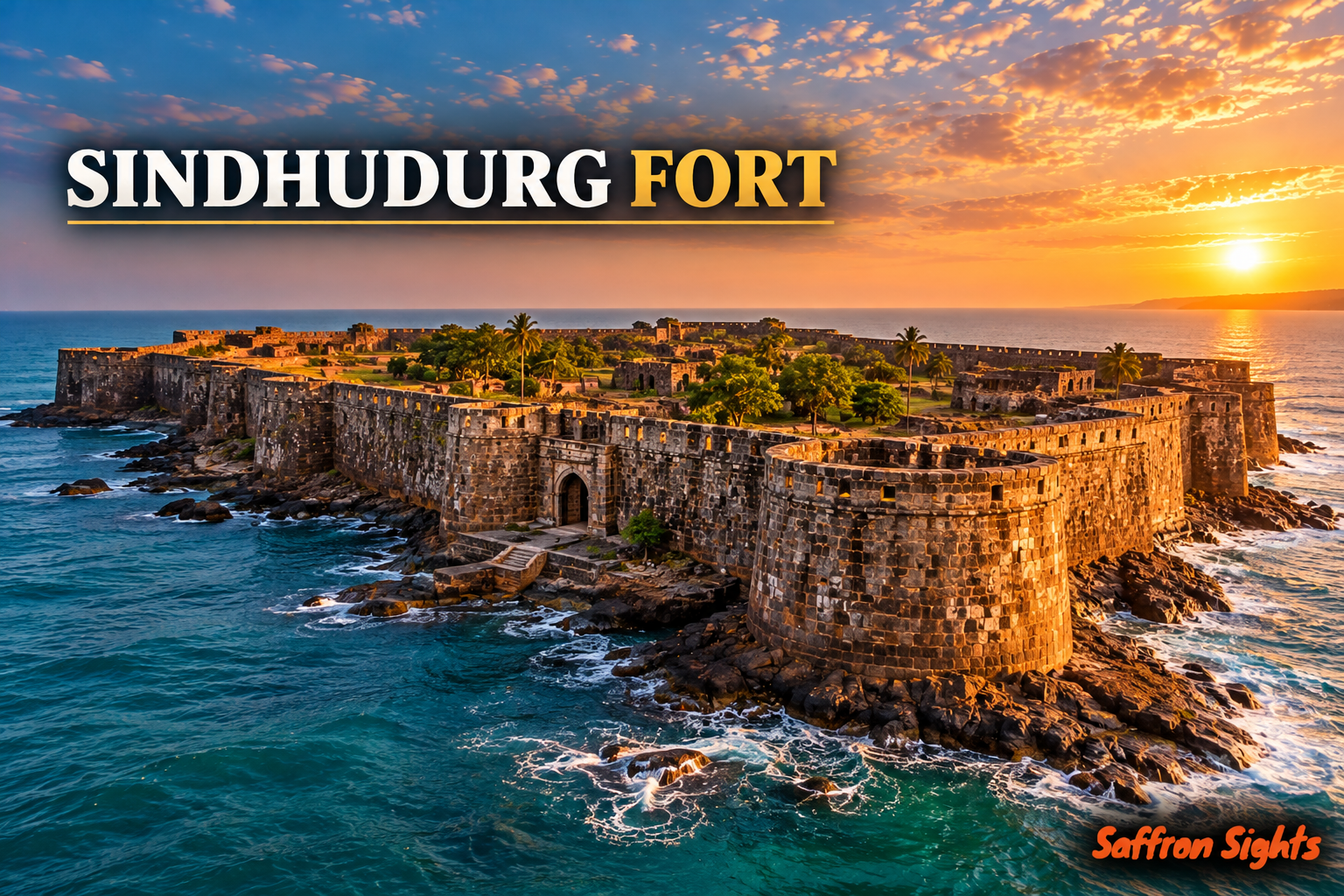
Sindhudurg Fort sits on a small rocky island called Kurte, about a kilometre off the coast of Malvan in Maharashtra’s Konkan region. Its name means “fort in the sea.” Chhatrapati Shivaji Maharaj ordered its construction in 1664, and his builders finished the job in 1667.
Sindhudurg Fort history begins with a practical problem. A kingdom with a long coastline cannot defend it with hill forts alone, because enemy ships can appear on any day. Shivaji’s answer was to build bases in the water itself.
This guide explains why he chose that path, how the fort rose, and what its walls and gate do. It also covers the Shivaji temple inside. Finally, it ends with a plan for a winter trip to Malvan.
Sindhudurg Fort at a Glance
| Detail | What the sources say |
|---|---|
| Location | Kurte island (also written Khurte), off Malvan, Sindhudurg district, Maharashtra |
| Built | Builders laid the foundation on 25 November 1664 and finished in 1667 |
| Patron | Chhatrapati Shivaji Maharaj |
| Supervision | Hiroji Indulkar (one account also names Govind Vishwanath Prabhu) |
| Size | About 48 acres; ramparts about 3 km; walls about 30 ft high and 12 ft thick |
| Status | The ASI protects it; UNESCO World Heritage component since 2025 |
| Access | Short ferry ride from Malvan jetty |
Why Did Shivaji Build Sea Forts?
Short answer: the sea was the one border his army could not walk to. In the 1660s, the Konkan coast was crowded. The Portuguese held Goa, while English, Dutch and French traders worked along the shore. Meanwhile, the Siddis ran a strong navy from their island fort of Janjira, near Murud.
As a result, Shivaji began building a navy and a chain of coastal forts. Some forts already existed, so he took them over and strengthened them. Vijaydurg, for example, dates to the 12th century, and the Marathas later expanded it. Khanderi near Mumbai, on the other hand, Shivaji developed himself in 1679. Sindhudurg differed from both because it started as a bare island. Many people call Shivaji the “Father of the Indian Navy,” although that is a popular title rather than an official one.
Popular account: many retellings say Shivaji chose to build his own island fortress after he failed to capture Janjira. People repeat this widely, but no firm record backs it up.
Reported fact: the Ministry of Culture’s CCRT and other sources say the January 1664 raid on Surat paid for the fort.
The Construction Story: 1664 to 1667
Why Kurte? Reefs guard the black, rocky island. In addition, it sits close enough to Malvan’s harbour for supplies, yet large ships struggle to approach it.
Foundation day was 25 November 1664. Some accounts add that workers first performed rituals to Ganesha and the sea, then offered a coconut to the water.
The builders. Most sources credit Hiroji Indulkar with the work. However, another account names Govind Vishwanath Prabhu as supervisor. Several sources also say Portuguese craftsmen from Goa helped, and CCRT puts their number at about 100.
The workforce. Most sources cite about 3,000 workers. Other accounts list stonecutters, blacksmiths and labourers separately, and one travel source claims over 6,000. So nobody has a firm count.
The foundation. Builders cut slots in the rock, then poured in molten lead to lock the foundation stones in place. This is the best-known engineering detail. Sources disagree on the amount, though: some give 4,000 pounds and others 40,000. Old records also use a weight unit called the khandi. Therefore, treat any exact figure with caution.
Local tradition: people say Shivaji worked on the fort with his own hands. This is tradition, not a dated record.
Finally, the fort stood complete in 1667, roughly three years after the first stone. A Maratha-era chronicle, the Chitragupta Bakhar, reportedly praises it as one of the kingdom’s great ornaments.
Fort Features: Walls, Bastions, Gate and Wells
The walls
The ramparts run about 3 km around 48 acres. They stand roughly 30 feet high and 12 feet thick. Because they follow the island’s edge in a zigzag line, the walls hug the rock below. Reports also say the builders used local stone, including rock from the island itself.
The bastions
Bastions are projecting towers that held cannons. Sources disagree on the count: modern counts say 42, while older accounts say 52 or 53. The zigzag layout also lets gunners cover neighbouring walls. Some writers add that it softens wave impact. However, we found no firm documentary support for that as a design goal.
The hidden gate
The main entrance, called Dilli Darwaja, sits between bastions and blends into the wall when seen from the water. A ship therefore had to pass the reefs, face the walls, and still find the door. One account places a small Hanuman shrine in front of the gate.
The three wells
Inside, three freshwater wells serve the island: Dudhbav, Dahibav and Sakharbav. Their names mean milk, curd and sugar wells. Accounts place them near the temple area. How fresh water exists so close to the sea remains undocumented for this site. In general, rainwater can float above saltier groundwater on small islands, but no study confirms that here. So do not assume the water is safe to drink today, and carry your own.
Did you know? Besides the main gate, accounts mention smaller hidden exits in some bastions, so the fort never worked as a one-door trap.
The Shivaji Temple and Local Beliefs
At the centre of the fort stands the Shivrajeshwar temple, which honours Shivaji himself. Accounts say his son Chhatrapati Rajaram built it in 1695, several years after Shivaji died in 1680. Many describe it as the only old temple to Shivaji, but such a claim is hard to verify.
The idol shows Shivaji beardless and wearing a cap, with clothes and a mask on top. The temple also displays a sword that tradition links to him. Worshippers offer flowers and coconuts here.
Local tradition: Shivaji’s hand and foot imprints rest in lime at the fort. One account says a 1763 letter ordered daily worship of them. Visitors treat the spot with great respect.
Other shrines in the fort include Bhavani, Mahadev and Jarimari temples. An inscription at the Jarimari shrine reportedly dates to 1881.
Etiquette: remove footwear where signs ask, dress modestly, keep voices low, and ask before you photograph people or the idol.
After Shivaji: Past, Present and Future
Past. One account says the fort passed to the Kolhapur state in 1713. Later, the British took control in the early nineteenth century, and sources give the year as 1817 or 1818.
Present. The ASI now protects Sindhudurg. In July 2025, UNESCO inscribed the Maratha Military Landscapes of India at the World Heritage Committee’s 47th session in Paris. The listing became India’s 44th World Heritage Site. It covers 12 forts: 11 in Maharashtra and one, Gingee, in Tamil Nadu. Sindhudurg, Suvarnadurg and Khanderi form the island forts in the group.
Outlook. Commentators expect more visitors after the listing. Meanwhile, salt, wind and monsoon rain keep ageing any sea-facing masonry, so careful visiting matters.
For students: Foundation 1664, finished 1667 • Patron: Shivaji • Hiroji Indulkar credited • Kurte island, Malvan • UNESCO inscription 2025, criteria (iv) and (vi) • One of three island forts in the series.
Planning a Malvan Trip in the Konkan Winter
Best time. Maharashtra Tourism advises against the June–September monsoon, because rough seas make boat rides unsafe. October to February generally works best, since the seas calm and the days dry out. A late shower is still possible early in the season. Also, the sun on the exposed ramparts feels strong, so bring water and a hat.
How to reach. Malvan lies about 450 km south of Mumbai. Sindhudurg (Chipi) Airport sits roughly 21 km from Malvan, but flights are limited, so check current schedules. Goa’s airports lie about 100–130 km away. By train, Kudal on the Konkan Railway is about 30 km from Malvan. Meanwhile, NH66 connects the region by road.
The boat ride. Ferries leave from Malvan jetty, and the crossing takes roughly 10–15 minutes. Operators usually allow around an hour on the island. Fares stay modest, and operators set them locally, so confirm at the jetty. Timings, tickets and ferry rules change with season and weather, so check with local authorities or the ASI before you go.
How long to spend. Plan two to three hours for the fort, including the crossing. If you want beaches too, add a day.
Beaches and sea. Tarkarli and Devbag beaches draw many visitors nearby, and the Malvan marine area offers snorkelling and scuba. However, check each operator’s safety standards first.
Seafood. Malvani cuisine shines with fish thalis, prawns and sol kadhi, a kokum-and-coconut drink. Vegetarians can also find Malvani meals easily.
Responsible tourism: do not climb on loose masonry, carry your litter off the island, and stay on marked paths.
Fun Facts
- The three wells carry the names milk, curd and sugar.
- Builders designed the gate so passing ships would miss it.
- Workers fixed the foundation stones with molten lead.
- Builders raised a fort of this scale in about three years.
- The Indian Navy chose Sindhudurg for its 2023 Navy Day demonstration.
Key Takeaways
- Shivaji planned Sindhudurg as a naval base, not just a coastal fort.
- Its design stacks defences, so reefs, walls, bastions and a hidden gate all work together.
- Many numbers (lead, workers, bastions) differ between sources, so treat them as approximate.
- The Shivaji temple and the imprints rest on tradition, and visitors should approach them with respect.
- Visit in winter, confirm ferry details locally, and leave time for Malvan’s coast.
Related Topics
- Murud-Janjira Fort and the Siddis
- Maratha Military Landscapes of India: all 12 forts
- Vijaydurg and Suvarnadurg sea forts
- Shivaji and the Maratha navy
- A Konkan coast itinerary: Malvan, Tarkarli, Ganpatipule
Frequently Asked Questions
1. When did builders construct Sindhudurg Fort?
Workers laid the foundation on 25 November 1664 and finished the fort in 1667.
2. Who built Sindhudurg Fort?
Chhatrapati Shivaji Maharaj commissioned it, and most sources credit Hiroji Indulkar with supervising the work.
3. How do you reach Sindhudurg Fort?
Take a ferry from Malvan jetty. The crossing takes about 10–15 minutes, but sea conditions can stop the ferries.
4. What is the best time to visit?
October to February usually works best. Avoid June to September, because rough seas often stop boats.
5. Is Sindhudurg Fort a UNESCO World Heritage Site?
Yes, but as part of a group. It is one of 12 components of the Maratha Military Landscapes of India, which UNESCO inscribed in 2025.