
Introduction
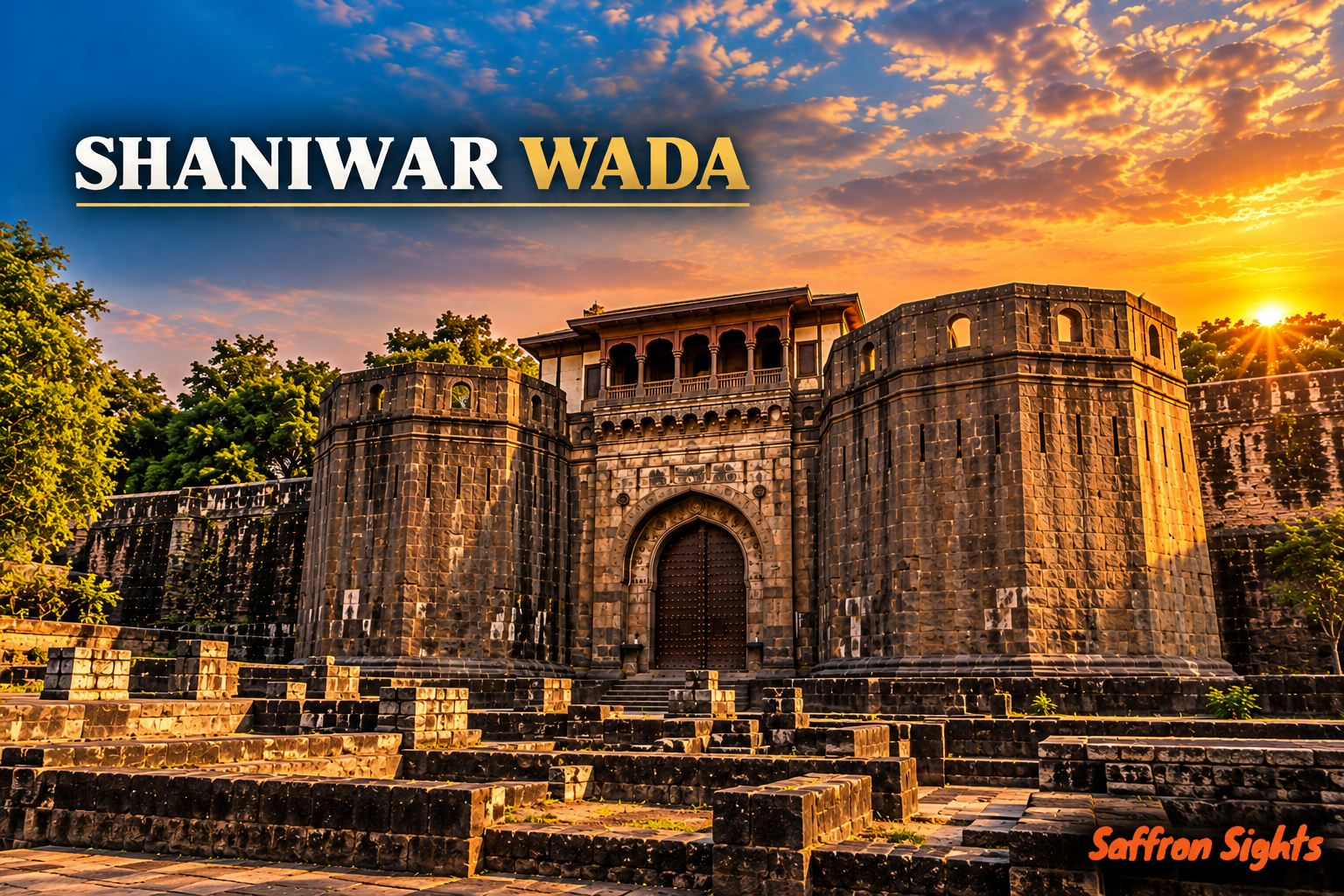
Shaniwar Wada is a ruined Peshwa fort-palace in Shaniwar Peth, in the old part of Pune, Maharashtra. Its stone walls, gates and bare foundations still stand in the middle of a busy city.
Most people first hear of it as “the haunted fort”. The better story is the real one. This was the seat of the Peshwas, the prime ministers who ran the Maratha state in the 18th century. A young ruler was killed here in 1773, and a legend grew around his death.
This guide covers Shaniwar Wada history in five parts: who built it, how Peshwa rule worked, the Narayanrao story, ghost belief versus fact, and the light and sound show. Where something is legend, we say so.
Who Built Shaniwar Wada and Why?
Peshwa Bajirao I built Shaniwar Wada. Records cited by Pune heritage sources say construction began on 10 January 1730, and the complex was completed in 1732.
The name tells you the start. Shaniwar means Saturday and wada means a large traditional residence. Work began on a Saturday.
Bajirao I came from Saswad and chose to base himself in Pune. The Wada gave the Peshwa a fortified home and an administrative centre in one place.
Local tradition: the stone question. A popular account says the Wada was meant to be built fully in stone, but Chhatrapati Shahu objected because stone palaces were a royal privilege. So the upper floors were made of brick and wood. This is widely repeated, but it is a tradition rather than a point confirmed by strong documents, so treat it with care.
Over time the Wada grew. Later Peshwas added courtyards, halls and gardens. The best known feature is the Hazari Karanje, a lotus-shaped fountain with sixteen petals.
Peshwa Rule in 5 Minutes
The Maratha state was headed by a Chhatrapati, a king based in Satara. In practice, real power moved to the Peshwa, the chief minister. The post became hereditary in the Bhat family.
To understand the wider history of the Maratha kingdom, explore the story of Raigad Fort and why Shivaji Maharaj chose it as his capital, a landmark that played a major role in the rise of Maratha power.
Here is the short version:
- Bajirao I (Peshwa from 1720) expanded Maratha power across central and northern India.
- Balaji Bajirao, his son, ruled during the Maratha peak and the Panipat defeat in 1761.
- Madhavrao I rebuilt Maratha strength and died young in 1772.
- Narayanrao, his younger brother, took over and was killed in 1773.
- Bajirao II, the last Peshwa, was defeated by the British East India Company in 1818.
After 1818, Pune came under British control. Shaniwar Wada passed out of Peshwa hands.
Why this matters: The Wada is where family rivalry, military power and court politics all met. That is why the 1773 killing was more than a palace crime. It shook the Peshwa government.
The Narayanrao Story: What Historians and Tradition Say
Narayanrao became Peshwa after Madhavrao I died in 1772. He was a teenager, around seventeen by most accounts.
His uncle Raghunathrao, known as Raghoba, wanted power. The two men distrusted each other, and the court was divided.
Historical record: Narayanrao was killed at Shaniwar Wada on 30 August 1773, during the Ganesh festival period. The attackers were Gardis, armed men from the palace forces, led by Sumer Singh Gardi. Raghunathrao’s role is the heart of the matter.
Later accounts add more. Popular retellings say:
- Raghunathrao wrote an order to “capture” Narayanrao (Narayanrao dhara).
- His wife Anandibai changed one letter, turning it into “kill” (Narayanrao maara).
- The frightened Narayanrao ran toward his uncle crying for help.
- His body was carried out in secret through a gate, which is why it is called the Narayan Darwaza.
These details come from bakhars (chronicles) and oral tradition. Historians treat the altered letter in particular with caution. It makes a gripping story, but it is not settled fact.
What happened next. According to tradition, Ramshastri Prabhune, the chief judge, found Raghunathrao morally and legally guilty. Raghunathrao did later hold power for a short time, but never with real acceptance.
Ghost Belief vs Historical Facts
Many people ask whether Shaniwar Wada is really haunted. The honest answer is that the murder is historical, but there is no verified evidence of a ghost.
| Claim | Category | Status |
| Narayanrao was killed here in 1773 | Historical fact | Well supported |
| Raghunathrao was involved | Historical record, details disputed | Widely accepted, specifics debated |
| Anandibai changed the letter | Popular claim | Not firmly established |
| His cry “Kaka, mala vachva” is heard on full moon nights | Local legend | Unverified |
| Footsteps, laughter, anklet sounds, shadows | Folklore | Unverified |
Kaka, mala vachva means “Uncle, save me” in Marathi. It is the best known line of the legend, and it works because it turns a political killing into a personal one.
Why the legend lasts:
- A young ruler died in his own home.
- The alleged betrayer was family.
- Folk belief holds that a violent, early death can leave a restless spirit.
- The ruins are dramatic after dark.
Ordinary explanations people offer:
- Stone walls and open courtyards reflect and distort sound. City noise, animals and wind can sound strange inside them.
- If you already know the phrase, your mind may fit ambiguous sounds to it.
- Stories repeated for generations shape what people expect to hear.
None of this proves that every reported experience has a simple cause. It only means the haunting cannot be called established fact. Treat it as folklore, and enjoy it as folklore.
What Happened in the 1828 Fire
In February 1828, a large fire burned through Shaniwar Wada. Accounts say it lasted several days. It destroyed the wooden upper floors, halls and much of the interior.
What remained was stone: the main walls, gateways and the foundations of the old buildings.
How the fire started is not known. Some stories blame a curse. Others hint at British involvement. There is no clear evidence for either, so it stays an open question.
There is also no firm link between the fire and the 1773 murder. They are decades apart. Joining them into one “cursed palace” story is part of the folklore, not a historical conclusion.
What You Can See Today
The surviving complex has five gateways and nine bastions. Visitors should look for these:
- Dilli Darwaza: the main gate, facing north toward Delhi, with large defensive spikes.
- Narayan Darwaza: the gate tradition links to the removal of Narayanrao’s body.
- Other gates: Mastani (also called Alibahadur), Khidki and Ganesh.
- Hazari Karanje: the lotus fountain in the grounds.
- Foundations and plinths: outlines of halls that no longer exist.
For more information about the palace’s architectural features and historical significance, explore the official Incredible India guide to Shaniwar Wada.
Imagine the Wada as a seven-storey palace, as some descriptions say, and the empty stone plinths make more sense.
Light and Sound Show: Timings and Tickets
The evening light and sound show tells the story of the Peshwas and the Wada. Several recent travel pages report these details:
- Marathi show: 7:15 pm to 8:10 pm
- English show: 8:15 pm to 9:10 pm
- Ticket: about ₹25 per person, bought at the counter, reportedly from about 6:30 pm
These figures come from secondary sources and may be out of date. Shows can change or be paused, and fees for Indian and foreign visitors differ between sources. Check with the Archaeological Survey of India, the Pune Municipal Corporation or the ticket counter before you plan around it.
The show is held in a seating area in the grounds. The monument itself is a daytime attraction.
Visiting Shaniwar Wada: Practical Tips
Location: Shaniwar Peth, Pune, Maharashtra. It is in the old city, close to Kasba Peth.
How long to spend: Most visitors take one to two hours for the monument. Add about an hour if you stay for the show.
Best time: Early morning or late afternoon gives softer light for photos and is more comfortable than midday heat. Pune is pleasant in the cooler months, but the site is open year-round.
Daytime hours: Reported timings vary by source, from an early morning start to a closing in the late afternoon or around 6:30 pm. Confirm locally.
Respectful visiting:
- Stay out of restricted areas.
- Don’t climb on old walls.
- Keep the ghost talk light. This is a place where a real person died.
For students: Useful points to remember are the Peshwa seat in Pune, the 1730 to 1732 construction, the 1773 murder of Narayanrao, the British takeover in 1818, and the 1828 fire.
Fun Facts
- The name literally means “Saturday mansion”.
- The Hazari Karanje fountain is said to have had a thousand jets in its design, which gives it its name.
- Wall paintings in the Wada reportedly showed scenes from the Ramayana and Mahabharata.
- A gate is named after a murdered Peshwa, which keeps his story alive in the building itself.
- Today’s “haunted” fame sits on top of a documented succession crisis.
Key Takeaways
- Bajirao I built Shaniwar Wada, started in 1730 and completed in 1732.
- The Peshwas held real power in the Maratha state, and the Wada was their base.
- Narayanrao’s murder in 1773 is historical. Some details, like the altered letter, are disputed.
- The ghost cry is local folklore with no verified evidence.
- Check official sources for current timings, tickets and show details.
Related Topics
- Peshwa dynasty explained: Bajirao I to Bajirao II
- Raghunathrao and the Peshwa succession crisis
- Aga Khan Palace and Pune’s colonial-era heritage
- Other forts and wadas around Pune
- The Third Anglo-Maratha War and the end of Peshwa rule
Frequently Asked Questions
1. Who built Shaniwar Wada?
Peshwa Bajirao I. Construction began in 1730 and the complex was completed in 1732.
2. Is Shaniwar Wada really haunted?
There is no verified evidence that it is. The murder of Narayanrao is historical, but the cry on full moon nights is local legend.
3. What does “Kaka, mala vachva” mean?
It means “Uncle, save me” in Marathi. It is the line tradition attributes to Narayanrao during the attack.
4. What happened to Shaniwar Wada in 1828?
A major fire destroyed most of the wooden palace. The stone walls, gates and foundations survived. The cause remains unknown.
5. What are the light and sound show timings?
Recent travel pages report a Marathi show at 7:15 pm and an English show at 8:15 pm, with tickets around ₹25. Confirm with official sources, as these can change.