
Introduction
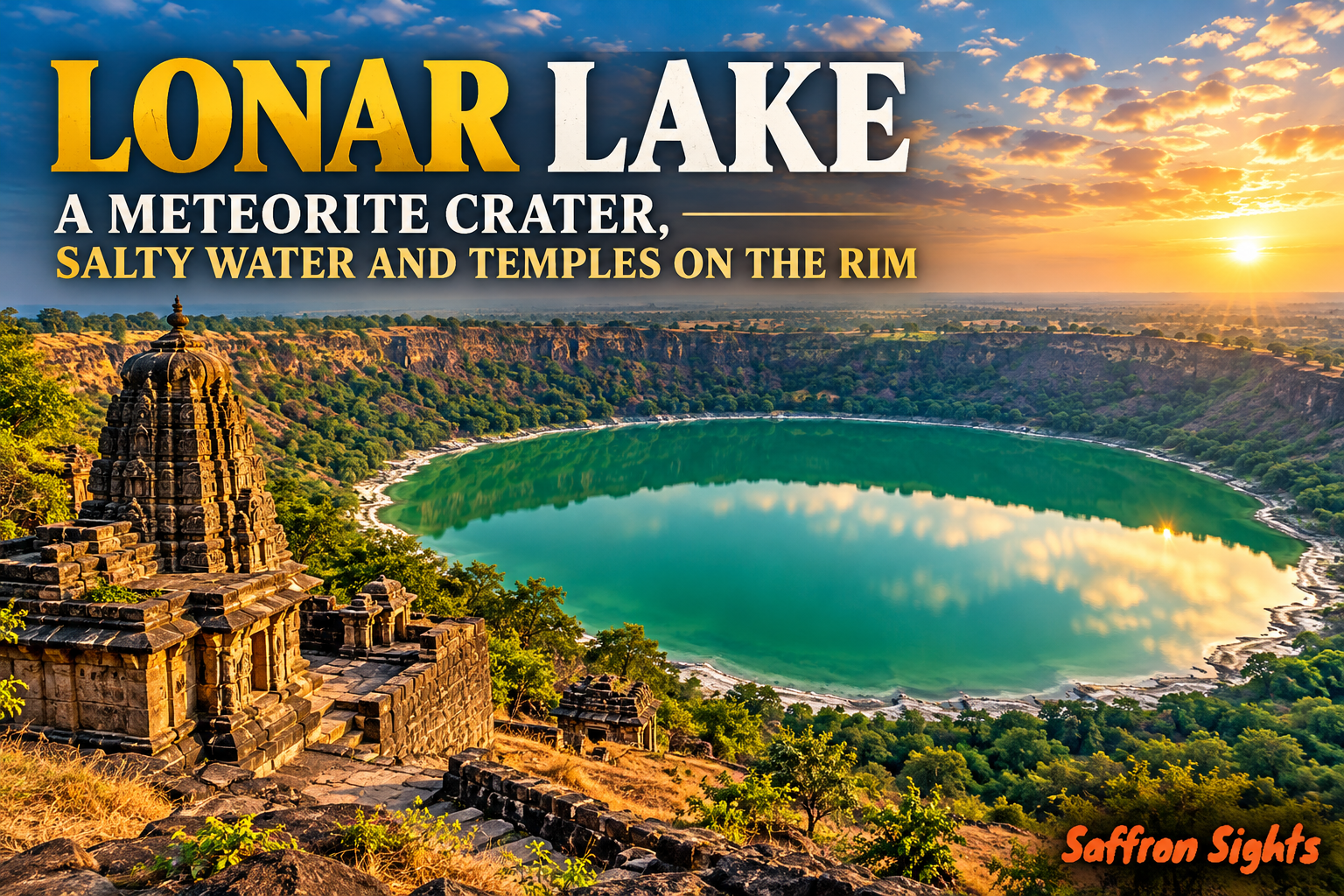
Lonar Lake is a salty, green crater lake in Maharashtra’s Buldhana district. It was not made by a river, a glacier or a volcano. It sits in a bowl that a space rock blasted into the Deccan Plateau tens of thousands of years ago, or possibly much longer.
The crater is about 1.8 km across. It was cut into basalt, the dark volcanic rock that covers much of western and central India. Very few impact craters on Earth formed in this kind of rock, so scientists study Lonar closely.
Around the rim and slopes stand old stone temples, some in ruins. Their stories mix geology, faith and folklore in one small place. This guide covers how the crater formed, why the water is so unusual, what the temples and legends say, and how to plan a safe visit.
Where Is Lonar Lake Located?
Lonar Lake was designated a Wetland of International Importance on 22 July 2020. You can read the official Ramsar information on Lonar Lake for details about its wetland status, ecology and conservation significance.
Lonar Lake is in the town of Lonar, in Buldhana district, Maharashtra. The town is about 79 km from Buldhana city. The lake lies inside the Lonar Wildlife Sanctuary.
The site carries three layers of recognition:
- It is a notified National Geo-heritage Monument.
- It is part of a wildlife sanctuary managed by the Maharashtra Forest Department.
- It was listed as a Ramsar wetland of international importance in 2020 (site no. 2441).
How the Crater Formed: The Impact Explained Simply
Short answer: A fast-moving object from space hit the basalt plateau, threw out rock and left a round bowl. Rain and springs later filled the bowl with water.
Think of dropping a stone into soft clay, but with enormous speed and energy. The impact crushed and melted rock in an instant and flung material outward. What was left was a deep, round depression with a raised rim.
The land itself is far older than the crater. The basalt came from huge volcanic eruptions around 65 million years ago, which built the Deccan Traps. The impact came much later, during the Pleistocene Epoch.
Why scientists say it was an impact, not a volcano
For a long time, people assumed Lonar was volcanic, since it sits in volcanic country. Rock studies changed that view. In 1973, a team led by K. Fredriksson published a paper in Science titled “Lonar Lake, India: An Impact Crater in Basalt.” The main clues are:
- Maskelynite. This is a glass-like material formed when a mineral called plagioclase feldspar is hit by extreme shock pressure. Normal volcanic activity does not produce it.
- Shatter cones. These are cone-shaped fracture patterns in rock, formed when a shock wave passes through.
- Impact breccia. This is a jumble of broken, angular rock fragments mixed by the collision.
- A near-circular crater with a rim of thrown-out material around it.
The missing meteorite
No confirmed chunk of the original object has been recovered. It may have mostly vaporised or melted on impact. Some geochemical research points to a stony (chondritic) impactor, but its exact size and path are not settled.
Some travel pages claim a huge iron meteorite still lies under the lake. There is no confirmed evidence for that, so treat it as a popular claim.
Why Lonar matters to science
Basalt also covers large areas of the Moon and Mars. Studying how an impact changed basalt at Lonar helps researchers read craters on those worlds. Lonar is not a perfect copy, since gravity and climate differ, but it is a rare natural example you can walk into.
Sources also describe Lonar as one of only a few such craters in basalt. Counts differ between sources, so “one of very few” is the safest wording.
How Old Is Lonar? An Open Question
Short answer: Nobody knows the exact age. Estimates range from tens of thousands to hundreds of thousands of years.
| Method | Reported age |
| Thermoluminescence dating | about 52,000 years (± 6,000) |
| Cosmogenic nuclide dating | about 37,500 years (± 5,000) |
| Argon-argon dating | about 570,000 years (± 47,000) |
Why the gap? Argon-argon dating can be thrown off if the melted rock still carried older argon from before the impact. A 2014 study by Nakamura and colleagues argued this could explain the high number. Many sources now favour a younger age, but the debate is not closed. If you quote a figure in school work, say it is an estimate.
Why Is the Water Salty and Alkaline?
Short answer: The lake has no outlet. Water comes in and only leaves by evaporating, so salts and minerals stay behind and concentrate.
Here is the process in plain steps:
- Rain, runoff and springs bring water into the crater.
- The surrounding basalt slowly weathers and releases dissolved minerals.
- The sun evaporates the water. The minerals stay.
- Over thousands of years, the lake becomes a “soda lake”: salty and strongly alkaline.
The Ramsar record notes that springs around the crater also supply fresher water. So fresh and salty water exist close together, though scientists are still working out how they behave in the lake itself.
Life in extreme water
The lake hosts microbes that tolerate high salt and high alkalinity. In June 2020, the lake turned pink-red within days, and NASA’s Earth Observatory showed it in Landsat images from 25 May and 10 June 2020. Researchers suggest salt-loving microbes, including haloarchaea and possibly the alga Dunaliella, produced red pigments after salinity rose. The exact mix is still being studied. Lake colour can shift with water level, rainfall and season.
Temples Around the Crater
Lonar’s temples are mostly dated to the 11th to 13th centuries and are often called Hemadpanti temples. This is a style of black basalt construction with carved surfaces, often linked with the Yadava period. Dating varies by source, so use “medieval” if you need to be safe.
Daityasudan Temple
This is the best-known temple, in Lonar town. It is dedicated to Vishnu in the form of Daityasudana, “slayer of the demon.”
- It follows a star-shaped plan and is richly carved on the outside.
- It is unfinished. Henry Cousens dated it to the late 13th or early 14th century and thought invasions stopped the work.
- Other sources place it in the Chalukya period, between the 6th and 12th centuries. This is a real disagreement.
- A figure of Surya in a rear niche suggests it may first have been planned as a sun temple.
Other sites to see
- Gomukh (Dhara) Temple. A steady stream flows from a cow-mouth carving. Springs like this feed the crater with fresh water.
- Kamalja Devi Temple. According to local tradition, the goddess chose to stay here after Vishnu defeated Lonasura. It is reported to be the only temple inside the crater still in regular worship.
- Motha Maruti. A temple of Hanuman, known for its large rock-carved image.
If you enjoy exploring Maharashtra’s ancient temples and remarkable stone architecture, discover the Ellora Kailasa Temple, a magnificent monument carved directly from a single hillside of basalt rock.
Legends of Lonar
These are stories, not historical records.
The Lonasura legend. Hindu tradition, as told in the Skanda Purana and in local accounts, says a demon called Lonasura (also Lavanasura) terrorised people and threatened the gods. Vishnu is said to have destroyed him, in some tellings after taking the form of a boy. The crater is described as the pit where the demon lived, and one version says the lake water represents his blood. The town’s name is traditionally linked to the demon.
The magnetic stones and compasses. Visitors often hear that compasses misbehave near the lake and that some temple rocks are magnetic. Treat this as a popular claim. Basalt can be magnetic, and impacts can alter magnetic properties, but do not count on a compass demonstration during your visit.
A fair way to hold both views: the science explains how the crater formed, and the tradition explains why people have honoured the place for centuries. The two answer different questions.
Best Time to Visit and Trip Planning
Short answer: October to March, when days are cooler and the walking is comfortable.
- October to March. Pleasant weather and good light. This suits a winter or school-holiday trip, and winter also brings migratory birds to the area.
- Monsoon. The slopes turn green, but paths can be slippery, so take extra care.
- Summer. It can be very hot, which makes the crater walk tiring.
Suggested plan for families and students: Stay one night in Lonar. Use the morning for the crater viewpoint and the descent to the lake, and the afternoon for the temples in town. Two days is relaxed. A single long day trip works if you start early.
How to reach Lonar
- Air. The nearest airport is Chhatrapati Sambhajinagar (Aurangabad), about 135 to 150 km away depending on the source.
- Rail. Official tourism pages list Jalna (about 90 km) and Partur as nearby stations.
- Road. State transport buses run to Lonar, and taxis are available from nearby cities.
Opening hours, fees and bus schedules can change. Please check with the Maharashtra Forest Department or Maharashtra Tourism (MTDC) before you travel.
Safety Tips and Visitor Etiquette
- Do not drink or swim in the lake. The water is highly salty and alkaline.
- Wear sturdy shoes. The descent is steep and uneven.
- Carry water and sun protection. Shade is limited on parts of the trail.
- Stay on marked paths. The sanctuary has reptiles, including snakes, so avoid tall grass.
- Go with a local guide if you can. Guides explain both the geology and the temple stories.
- Dress modestly at temples and keep footwear out of shrines. Some temples are ruins, so do not climb on carvings.
- Take your rubbish back. Sewage and unplanned tourism are listed among the threats to the site.
- Supervise children closely near slopes and water.
Did You Know?
- The lake is part of a sanctuary with about 160 bird species, according to the Ramsar record.
- The crater’s basalt is roughly as old as the volcanic eruptions that may have helped shape the age of the dinosaurs’ final chapter, about 65 million years, while the crater itself is vastly younger.
- Lonar has been described as an Earth site that helps scientists read Moon and Mars craters.
Key Takeaways
- Lonar Lake fills a meteorite crater about 1.8 km wide, formed in basalt.
- Shocked minerals like maskelynite, plus shatter cones, prove an impact origin.
- The lake has no outlet, so evaporation concentrates salts and makes it alkaline.
- The age is uncertain, and the original meteorite has not been found.
- Visit between October and March, and respect both the wildlife and the temples.
Related Topics
- Ajanta and Ellora caves, Maharashtra
- Hemadpanti temple architecture
- The Deccan Traps and India’s volcanic past
- Ramsar wetlands of India
- Winter heritage trips in Maharashtra
Frequently Asked Questions
1. Where is Lonar Lake?
It is in Lonar town, Buldhana district, Maharashtra, about 79 km from Buldhana city.
2. How was Lonar Lake formed?
A high-speed object from space struck the basalt plateau and left a crater. Rain, springs and runoff later filled it with water.
3. Why is Lonar Lake water salty and alkaline?
The crater has no outlet. Water leaves only by evaporation, so dissolved minerals from the basalt concentrate over time.
4. How old is Lonar Lake?
The exact age is debated. Estimates range from about 37,500 years to about 570,000 years, depending on the method.
5. When is the best time to visit Lonar Lake?
October to March is the most comfortable period. The monsoon is green but slippery, and summer is hot.