
Introduction
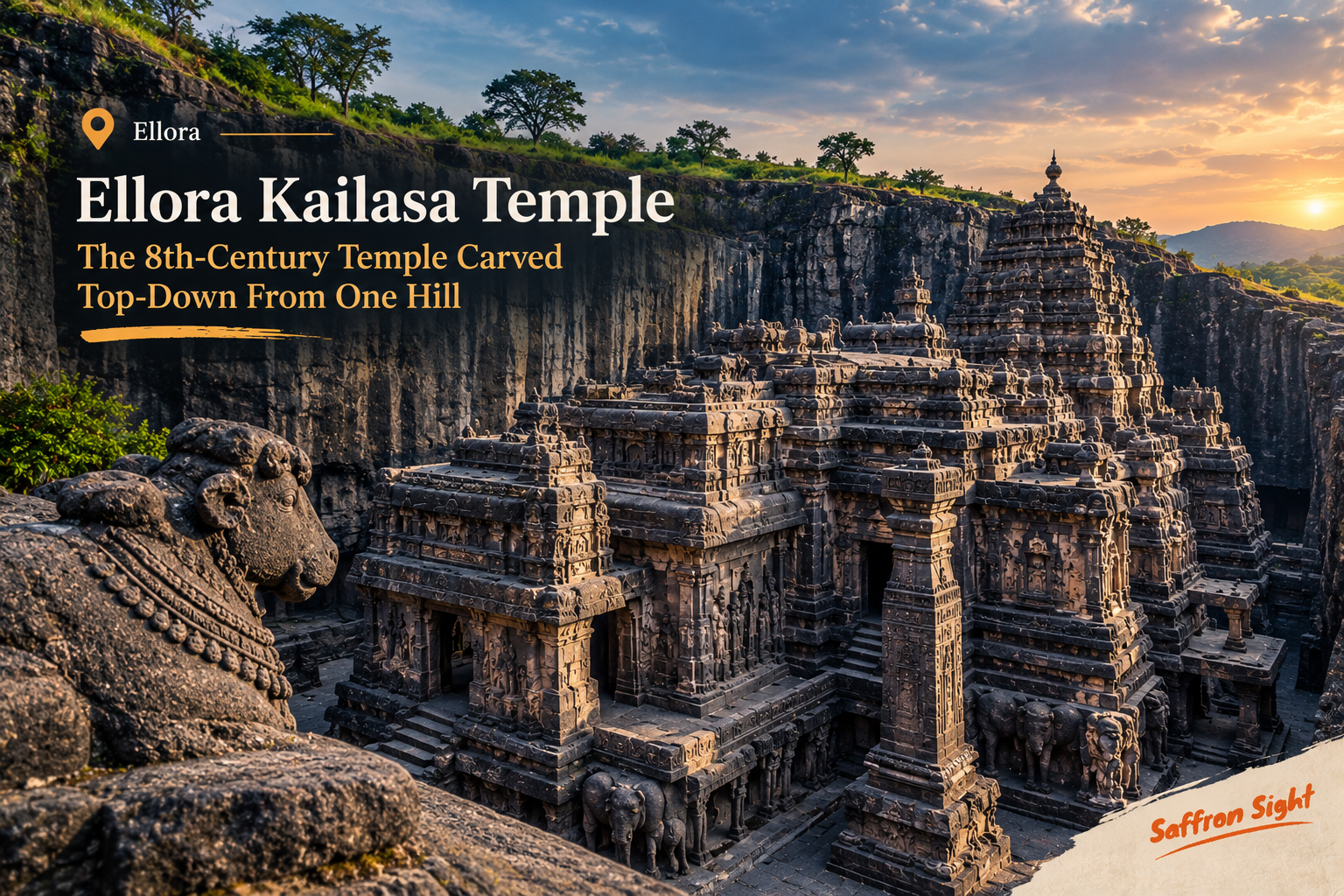
The Ellora Kailasa Temple, Cave 16, is a full temple complex carved out of a hillside in Maharashtra. It has a gateway, a courtyard, a pillared hall, a tall tower and a Nandi pavilion. Yet nobody stacked a single block to build it. Carvers removed the rock around the temple until the temple was all that remained.
You will find it at Ellora, near Chhatrapati Sambhajinagar (formerly Aurangabad). It is dedicated to Shiva and modelled on Mount Kailasa, his mythical Himalayan home. UNESCO counts it among the finest examples of rock-cut architecture in India.
This guide covers where Kailasa fits among Ellora’s 34 caves, who commissioned it, how the carvers worked, what to look for on the walls, and how to combine it with Ajanta.
Ellora’s 34 Caves at a Glance
Ellora has 34 monuments cut into a basalt cliff. They belong to three faiths, and the cave numbers roughly sort them out:
| Caves | Tradition | What to expect |
|---|---|---|
| 1-12 | Buddhist | Monasteries and prayer halls; Cave 10 is the well-known “carpenter’s cave” |
| 13-29 | Hindu | Shiva temples, including Kailasa (Cave 16) |
| 30-34 | Jain | Smaller, finely detailed caves with Jain Tirthankara figures |
UNESCO places the main Hindu excavations between roughly the 7th and 10th centuries. The three traditions sit side by side along one cliff, which is a big part of Ellora’s appeal.
Who Built Kailasa, and Why?
Short answer: Tradition credits the Rashtrakuta king Krishna I, who ruled around 756-773 CE.
Historians support this attribution. A copper-plate grant from Baroda, issued in the early 9th century, records that Krishna I had a Shiva temple made at Ellora. The inscription praises it as a work so beautiful that it seemed not to be made by human hands.
Some details are less certain:
- Completion: Stylistic studies suggest work, or at least additions, continued under later rulers. Treat “one king, one project” as a simplification.
- Duration: You will see figures like “18 to 25 years” online. No surviving record confirms them, so they remain estimates.
- Motive: We can say a temple of this size showed a dynasty’s wealth, devotion and prestige. Krishna I’s personal reasons are not documented.
The Rashtrakutas had recently risen to power in the Deccan. In that period, a grand temple was one way for a new dynasty to announce its confidence.
How the Carvers Worked Top-Down
Short answer: They cut deep trenches into the hillside to isolate a block of rock, then carved that block from the roof downward.
Most temples go up from the foundation. Kailasa went the other way. The accepted reconstruction runs like this:
- Plan the footprint. Designers fixed the layout on the hill before major cutting began.
- Cut trenches. Workers excavated deep trenches around the intended temple, leaving a large central mass of rock.
- Shape the top first. The tower and roofline were defined while the rock around them was still high.
- Work downward. As the surrounding rock came away, the carvers moved to the walls, pillars and lower levels.
- Hollow the interiors. The halls and the shrine were cut from the remaining mass.
- Finish the sculpture. Fine reliefs and figures were refined as surfaces were exposed.
Working this way meant the uncut rock below always served as the workers’ platform. There was no need for scaffolding.
It also left no room for error. Stone cannot be glued back on, so the overall design had to be settled early. Finer details may well have been worked out as the carving went on, and scholars still debate how much was fixed in advance.
The tools
The tools were ordinary: iron chisels, picks, hammers and wedges. Organisation did the rest, with quarrying teams removing bulk rock while skilled masons and sculptors followed behind. Claims of lost technology or machines have no archaeological support. The real achievement is human planning and skill.
How much rock was removed?
Estimates vary a lot. Some sources say 150,000 to 200,000 tonnes, others 250,000 tonnes, and a few say 400,000. The differences come from the assumptions about the original rock mass. Treat these as rough figures, not measurements.
Why basalt?
Ellora sits on the Deccan Plateau, formed by ancient volcanic lava flows. Basalt is hard and durable, and it holds fine detail. It could carry the weight of upper floors and slender pillars carved from the same stone.
Sculptures and Epic Panels to Look For
Allow time to walk around slowly. Here is what is worth finding:
- Ravana shaking Mount Kailasa. In Hindu mythology, the demon king Ravana tries to lift Shiva’s mountain, and Shiva pins it down with his toe. A carving of this scene appears on the main temple. It is a mountain story carved into a temple shaped like that mountain.
- Ramayana and Mahabharata panels. Narrative bands of both epics are carved in stone like a comic strip. Ask a licensed guide to point out the exact panels, since the sequence is easier to follow with someone explaining it.
- Elephants and lions at the plinth. Large animal figures appear to hold up the temple. Look for them early on, because they set the scale.
- Goddess panels. Look for the Gajalakshmi panel, where elephants pour water over the goddess Lakshmi, and the river goddess shrines.
- Traces of plaster and paint. Patches of old plaster remain in sheltered spots. A popular idea says the temple was once whitewashed to resemble a snow peak. That is an interpretation, not a documented fact.
Did you know? The Baroda inscription is a rare contemporary record that links this temple to a named king.
Fact vs Myth
Kailasa attracts “lost civilisation” and “alien technology” claims online. The evidence does not need them. The temple fits within a long Indian tradition of rock-cut architecture, and Ellora’s other caves show earlier and parallel experiments in the same craft.
Scholars have also noted stylistic similarities with southern temples such as the Virupaksha Temple at Pattadakal. That suggests knowledge travelling between regions, not a mystery.
Visiting Ellora: Practical Notes
- Location: About 30 km from Chhatrapati Sambhajinagar, which has the nearest airport and a main railway station.
- Time needed: Plan at least half a day for Cave 16 plus a few other caves. A full day is better if you want the Buddhist and Jain caves too.
- Best season: Post-monsoon months (roughly October to February) are generally comfortable, and the monsoon months bring greenery and waterfalls but slippery steps. Summers are hot and the stone surfaces heat up.
- Etiquette: Cave 16 is a protected monument. Dress modestly, keep voices low near shrines and do not touch the carvings.
- Nearby: Grishneshwar Jyotirlinga temple is close to Ellora, and Daulatabad Fort is on the road back to the city.
Timings, ticket prices and closing days change. Check the Archaeological Survey of India (ASI) or the Maharashtra tourism website before you go. As a general pattern, Ellora has traditionally closed on Tuesdays and Ajanta on Mondays. Confirm both.
Ajanta + Ellora in 2 Days: A Sample Plan
Ajanta is about 100 km from the city, so it needs a full day. Use the closing days to decide the order.
Day 1: Ellora
- Start with Cave 16 early, when it is quieter and the light is good.
- Spend the middle of the day on the Hindu caves near Kailasa.
- Visit a few Buddhist caves, such as Cave 10, and then the Jain caves if time allows.
- Finish at Grishneshwar if you like.
Day 2: Ajanta
- Leave early and spend the day with the Buddhist caves, which are known for their paintings and sculpture.
- Return to the city in the evening.
If your dates do not suit this order, simply swap the days around each site’s closing day.
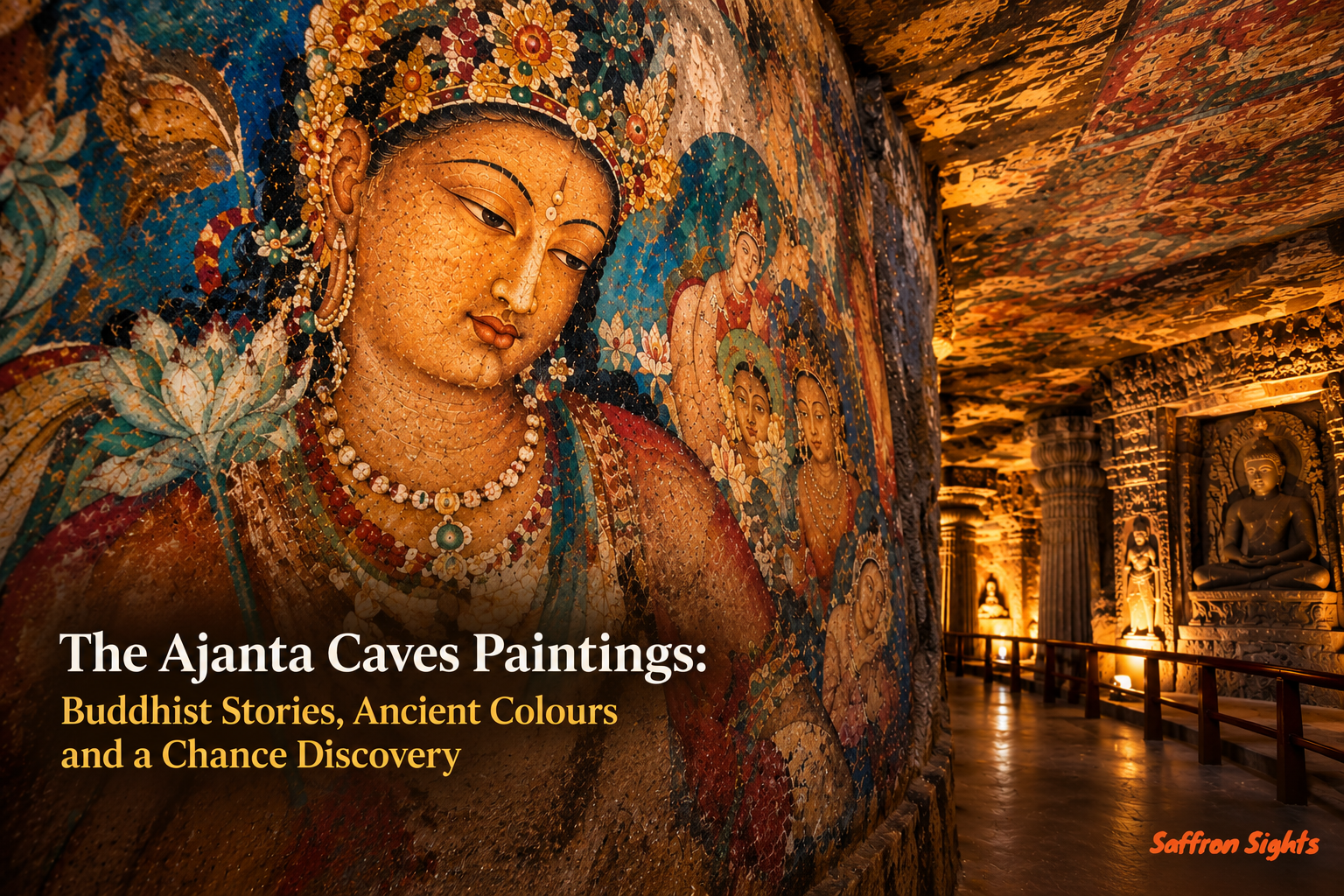
Read our companion guide to the Ajanta Caves for what to see there.
Why Cave 16 Still Matters
It shows what planning can achieve when mistakes cannot be undone. It also shows Indian temple architecture, myth, royal patronage and craft all in one monument. Conservation challenges such as water seepage and visitor pressure mean it needs continued care.
Key Takeaways
- Kailasa (Cave 16) is a monolithic temple carved from basalt at Ellora, Maharashtra.
- The carvers worked top-down, using trenches and unexcavated rock as their platform.
- Krishna I of the Rashtrakuta dynasty is traditionally credited, with work likely continuing later.
- Numbers for rock volume, workers and years are estimates, not confirmed facts.
- Pair Ellora with Ajanta over two days, and verify closing days first.
Related Topics
- Ajanta Caves: paintings and Buddhist art
- Grishneshwar Jyotirlinga near Ellora
- Daulatabad Fort
- Rashtrakuta dynasty and Deccan history
- Rock-cut architecture in India (Elephanta, Badami, Mahabalipuram)
Frequently Asked Questions
1. Was Kailasa carved from a single rock?
Yes. The temple was excavated from a continuous basalt hillside, not assembled from separate blocks.
2. Who built the Kailasa Temple?
Tradition and the Baroda copper plates connect it with Rashtrakuta king Krishna I (c. 756-773 CE). Work may have continued after his reign.
3. How long did it take?
Nobody knows for sure. Figures like 18 or 25 years are estimates, not documented facts.
4. How much time should I spend there?
At least half a day for Cave 16 and a few others, or a full day for a broader visit.
5. Can I visit Ajanta and Ellora together?
Yes, but give each its own day. Check closing days first, as they differ.