
Introduction
The Ajanta caves paintings are among the oldest and finest surviving Buddhist wall paintings in the world. They are in the Waghora River gorge in Maharashtra, India, in a curved rock face of about 30 caves cut into the hillside. UNESCO listed the site in 1983.
Why do they matter? The paintings show how people dressed, worshipped, travelled and told stories more than 1,500 years ago. Few ancient wall paintings anywhere have survived in such quantity.
This guide covers who made the caves, what the paintings show, how the colours lasted, how the site was found again, and how to plan a visit.
Who Carved the Caves, and When?
Direct answer: The caves were cut in two main phases, separated by several centuries.
Historical record: The earliest caves date from roughly the 2nd century BCE to the 1st century CE, during the Satavahana period. These are the simpler, earlier monasteries and prayer halls, such as Caves 9 and 10. The second phase came in the 5th century CE, when the Vakataka dynasty ruled much of the Deccan. Most of the best-known paintings come from this later phase, and some work may extend into the 6th century.
Most scholars connect the later work with the Vakataka court and its ministers and nobles, who funded caves as acts of devotion. Dating inside that phase is debated. The scholar Walter Spink argued the later work was done in a short, intense burst in the late 5th century, but not every historian accepts his tight chronology. It is safest to say “5th century CE” and leave it there.
The caves were Buddhist monasteries. Monks lived in them, meditated and prayed. Merchants and rulers supported them, and pilgrims passing through added to their importance.
Why the “2,000 years” claim needs care: You will often read that the paintings are 2,000 years old. That is true only for a few early fragments. The famous images, such as the figures in Cave 1, are closer to 1,500 years old.
The Jataka Stories on the Walls
Direct answer: Jataka tales are stories about the Buddha’s previous lives, told in Buddhist tradition. In them, he appears as a prince, a deer, an elephant or a monkey, learning generosity, patience and compassion.
This is Buddhist religious tradition, not history. The paintings were meant to teach. A monk or visitor walking the cave could read a story from the wall like a picture book, in an age when many people could not read.
Some well-known examples:
- Mahajanaka Jataka (Cave 1): A king gives up his throne and chooses a life of renunciation.
- Shibi Jataka (Cave 1): A king is ready to give his own flesh to save a dove.
- Vessantara Jataka (Cave 17): A prince gives away everything he owns, even his family, as an act of extreme generosity.
- Chhaddanta Jataka (Cave 17, with an early version in Cave 10): A six-tusked elephant gives up his tusks. Earlier paintings of this story survive in Cave 10.
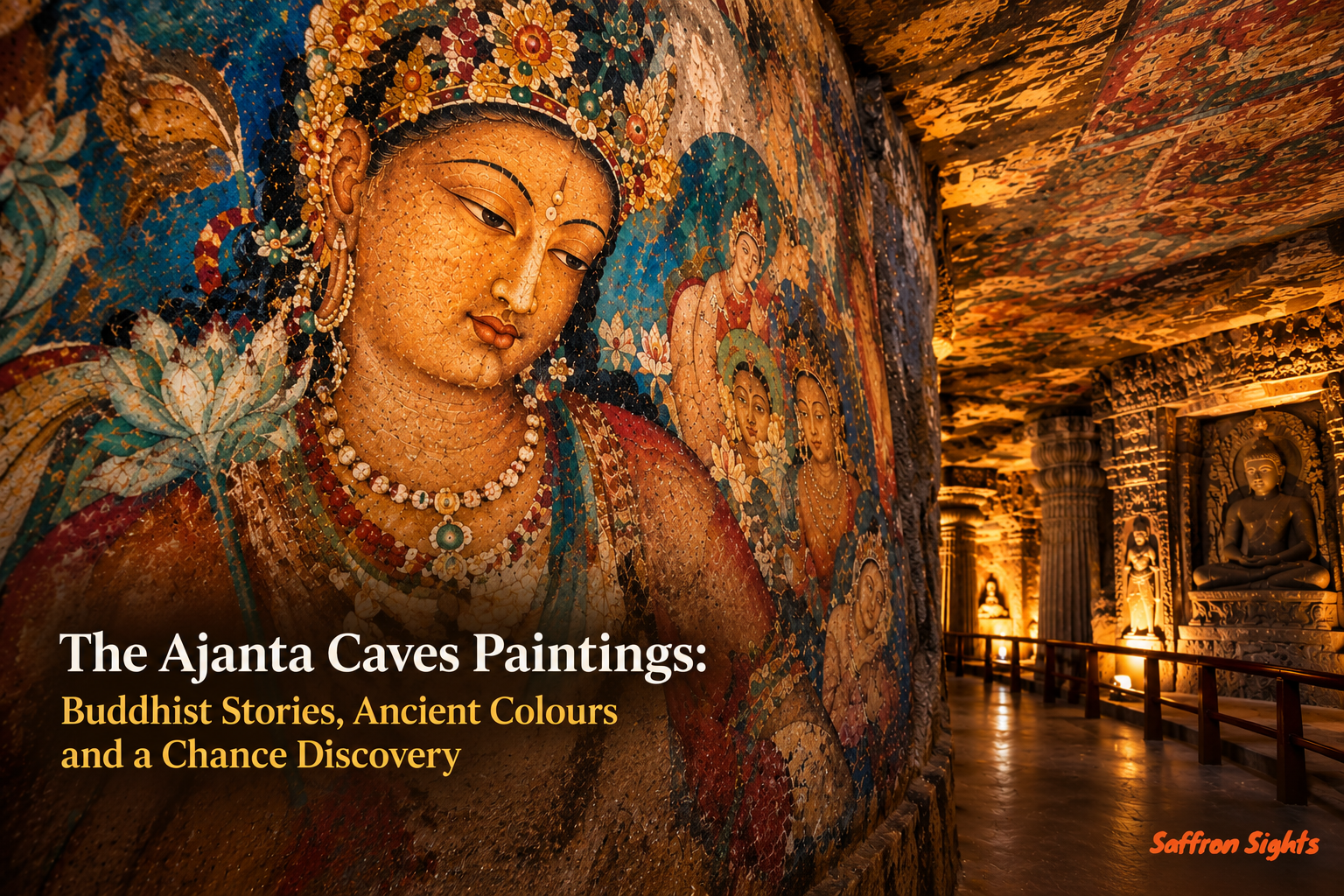
Cave 1 also has the famous Bodhisattva Padmapani, holding a lotus. A Bodhisattva, in Mahayana Buddhism, is a being who delays final liberation to help others. The painting is known for its calm, downward gaze and gentle posture.
Scenes in the caves often show crowded courts, dancers, musicians, merchants, animals and flowers. They show Buddhist teaching, but also what daily life and royal splendour looked like.
Did you know? The earlier caves (such as 9 and 10) show the Buddha through symbols such as a stupa, rather than as a human figure. Painted Buddha figures appear mainly in the later, 5th-century caves. This change in how the Buddha is shown tracks a change in Buddhist practice.
How the Colours Survived: Materials and Technique
Direct answer: The paintings lasted because of durable mineral pigments, a carefully built wall surface, and protection from sunlight. They did not survive untouched, though.
A wall built in layers
The caves are cut from hard volcanic basalt, which is not an easy surface to paint on. Studies of the plaster show that artists first roughened the rock. They then applied a thick coat of local earthy clay mixed with plant fibres such as grass or husks. Finally they added a thin white layer of lime or kaolin, which gave a smooth, bright surface for painting.
Think of it like preparing a wall before painting a room. If the plaster comes loose, the best paint falls with it.
Mineral colours
Researchers have identified a mix of materials in the paintings:
| Colour | Material identified in research |
|---|---|
| Red | Red ochre (iron oxide) |
| Yellow | Yellow ochre; orpiment in some studies |
| Green | Green earth (such as celadonite) |
| Blue | Lapis lazuli (natural ultramarine) in studied areas |
| White | Lime or kaolin |
| Black | Carbon (such as lampblack) |
Iron-oxide earth colours are very stable. The blue is a special case. Lapis lazuli is linked to sources in the region of present-day Afghanistan, which suggests long-distance trade reached these caves. Not every painting used the same recipe, and scientists have also found other materials in some areas, such as lac, a red colourant from insects, in Cave 2. So “all mineral” is a simplification.
Not true fresco
Many people call Ajanta’s works frescoes, but they are better described as tempera, or dry-applied wall painting. In true fresco, paint goes onto wet plaster. At Ajanta, artists painted on prepared dry plaster, using a binder, probably animal glue. This gave them control to layer colour and shape faces with soft shading. The trade-off is that dry-applied paint is more sensitive to moisture.
Why the caves helped, and where they did not
The caves kept out direct sun, which fades many colourants. Later caves were left unfinished or abandoned relatively soon, so they gathered less lamp soot than caves in long use.
But the paintings are still fragile. Humidity swings, water seepage, soot, past varnish treatments and large visitor numbers have all caused damage. Researchers have flagged humidity as a leading threat. Early 20th-century restoration with shellac varnish later darkened in places. So some colours you see are original, some are changed by age, and some areas are simply lost.
A note on popular claims: Some websites mention special ancient glues with named ingredients or give very exact chemical explanations. These details often come from secondary sources and are not firmly established for Ajanta. Treat them as possibilities, not proven facts.
Rediscovery in 1819
Direct answer: In April 1819, a British hunting party stumbled on the caves, and an officer named John Smith is the person most often credited.
According to commonly told accounts, Smith, an officer of the Madras Cavalry, was out hunting near the gorge. He noticed the horseshoe-shaped cliff and its carved doorways, and found his way to Cave 10. He scratched his name and the date on a painted figure inside. That graffiti is still sometimes pointed out, and it remains a sore point for conservators.
“Discovery” needs context. The caves were not unknown to local people, and they were not completely forgotten. The story is better described as a rediscovery for the wider world. Soon after, officials and artists came to copy the paintings, and the site’s fame spread.
The 19th century was hard on the paintings. Copies made for exhibitions were damaged in a fire in London in 1866, according to widely told accounts. Early restoration attempts caused harm. Today, the Archaeological Survey of India (ASI) manages the site and its conservation.
Past, Present and Future
Past: A monastic community used the caves, which were patronised by kings, merchants and nobles. Work stopped as patronage declined.
Present: Ajanta is a UNESCO World Heritage Site and a major tourist and study destination. Visitor numbers put pressure on the fragile paintings, and ASI controls access and lighting inside the most delicate caves.
Outlook: Conservation is likely to keep focusing on humidity monitoring, careful cleaning and managing the number of people inside caves. Exact future plans should be checked with ASI.
Visitor Guide: Planning Your Trip
Where is Ajanta?
The caves are in the Aurangabad district of Maharashtra, in the Waghora River gorge. The city of Aurangabad is now officially called Chhatrapati Sambhajinagar, and it is the usual base for visitors.
How to reach
- Nearest major airport: Chhatrapati Sambhajinagar (Aurangabad).
- Rail: Aurangabad and Jalgaon are the main railheads. Jalgaon is often used by people arriving from the north and east.
- Road: Ajanta is roughly 100 km from Aurangabad by road. Taxis and buses run on the route. Check the current journey time before you plan your day.
Ajanta View Point
The Ajanta View Point sits on the hill across the gorge, giving a wide view of the whole horseshoe curve of caves. It helps you understand how the monks chose this quiet bend in the river. Photographers often go for early light. If you plan to visit, allow extra time and ask locally about the current access and conditions.
Timings and tickets
I have not included ticket prices or exact timings here. They change, and they should come from a verified source. Check the official ASI website or on-site notices for opening hours, the weekly closing day and fees. As a general planning point, many monuments have one weekly closure, so confirm it before you travel.
Best months to visit
Winter is the most comfortable season. This is the start of the winter travel season: the monsoon has passed, the hillsides are still green, and the days are cooler. Plan for roughly October to March, then check the forecast.
The monsoon months have their own appeal, with a greener gorge and waterfalls, but paths can be slippery and rain may disrupt plans. Summer is hot and dry, so carry water and start early.
How long to spend
Plan a full day. Many visitors prioritise a few caves rather than trying to see all of them. Caves 1, 2, 16 and 17 are often recommended for paintings, and 9, 10, 19 and 26 for architecture and sculpture.
Etiquette and responsible visiting
- Do not touch the walls or paintings.
- Follow the rules on flash photography and lighting in each cave.
- Dress modestly and keep your voice low inside the caves.
- Take your rubbish with you.
- Respect the guidance of ASI staff and licensed guides.
Fun Facts
- Cave 10 holds one of the oldest painted areas at the site.
- The caves were cut into the rock from the top down, according to scholars of rock-cut architecture.
- The paintings show a lot about daily life, with jewellery, hairstyles, clothing and musical instruments.
- A single small graffito from 1819 has become part of the site’s history.
Key Takeaways
- The site has two main phases: early (2nd century BCE to 1st century CE) and later (mostly 5th century CE).
- The paintings teach through Jataka tales, stories of the Buddha’s previous lives.
- Layered plaster, mineral pigments and low light helped the colours last, but loss and fading are real.
- The 1819 find by John Smith brought the caves to wider notice, though local people already knew of them.
- Visit in winter, verify timings and fees with ASI, and follow conservation rules.
Related Topics
- Ellora Caves: Hindu, Buddhist and Jain rock-cut temples
- Kailasa Temple at Ellora
- Buddhist heritage sites in India
- Rock-cut architecture of the Deccan
- Bagh Caves and other ancient Indian wall paintings
Frequently Asked Questions
1. How old are the Ajanta caves paintings?
The earliest fragments date from about the 2nd century BCE to the 1st century CE. Most famous paintings come from the 5th century CE.
2. What do the paintings show?
They show Jataka tales, scenes from the Buddha’s life, royal courts, figures such as Bodhisattvas, animals and decorative designs.
3. Why have the colours lasted so long?
Mineral pigments, layered plaster and low light inside the caves helped. Even so, moisture, soot and past restoration have faded or damaged many areas.
4. Who rediscovered Ajanta?
A British hunting party in 1819, with John Smith of the Madras Cavalry usually named. Local people had known of the caves before.
5. When is the best time to visit?
Winter, roughly October to March, is the usual choice. Confirm current timings, the weekly closing day and fees with ASI.