
Introduction
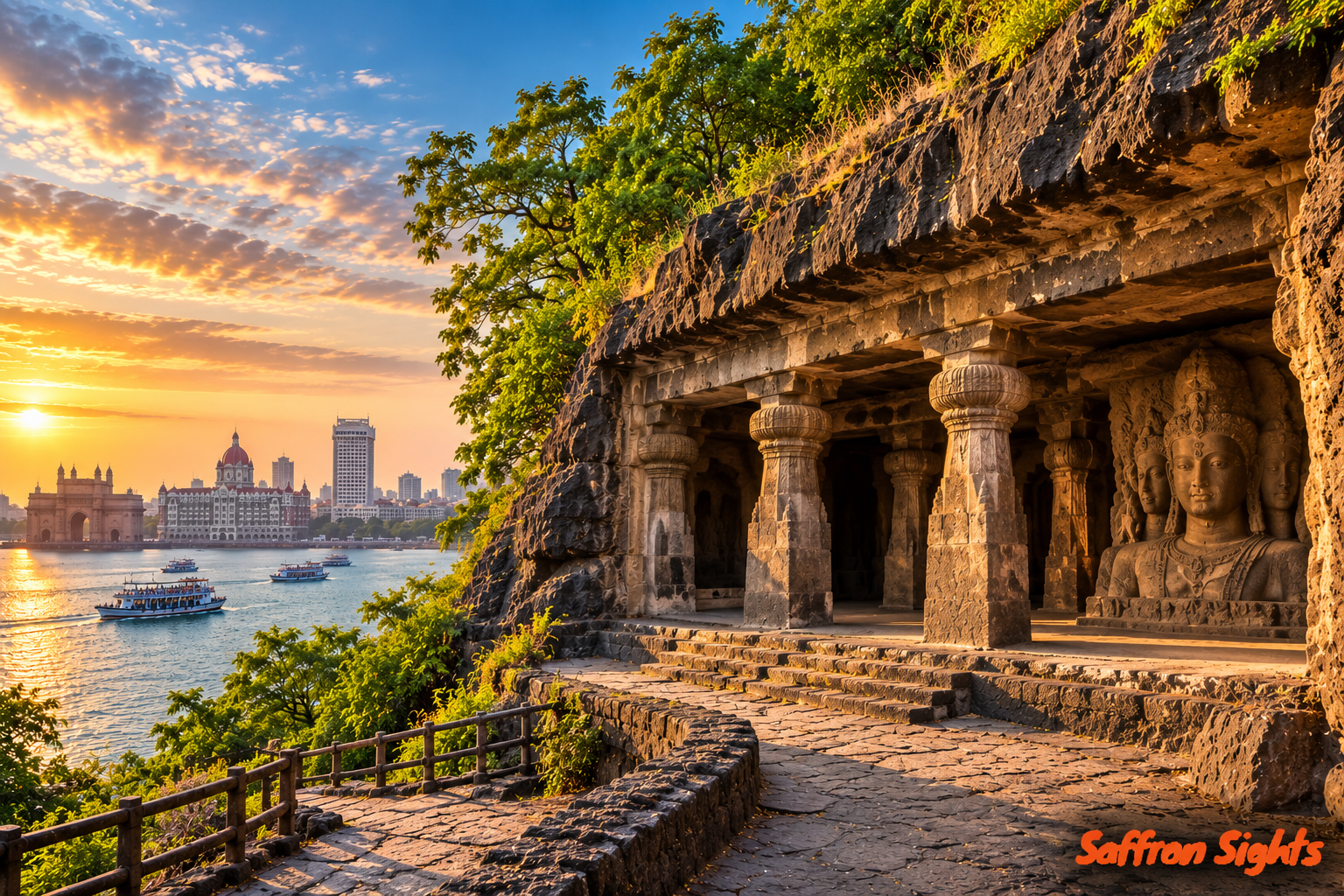
Ten kilometres across the water from the Gateway of India, a wooded island holds a temple that was never built. It was carved. Sculptors cut into a basalt hill around the 6th century, leaving behind pillars, shrines and a three-faced image of Shiva that still stops visitors mid-step.
These are the Elephanta Caves Mumbai travellers reach by ferry from Colaba: a UNESCO World Heritage Site on Elephanta Island, also called Gharapuri. They matter because they hold some of the finest Shaiva sculpture in India, and because few ancient monuments sit this close to a major city.
If you’re exploring the city’s cultural heritage, discover more heritage places to explore in Mumbai on Saffron Sight.
This guide covers the ferry, the story behind the name, the Trimurti sculpture, the debate over who built the caves, and a half-day plan for year-end visitors.
Where Are the Elephanta Caves in Mumbai?
The caves are on Elephanta Island (Gharapuri) in Mumbai Harbour. The Archaeological Survey of India (ASI) places the island about 11 km north-east of Apollo Bandar, the Gateway of India area, and 7 km from the nearest mainland shore. Most guides round this to 10 km.
The island feels like part of Mumbai, but it falls in Raigad district. There are seven caves in two groups: five Hindu caves on the western hill and two Buddhist caves on the eastern hill. Most visitors spend nearly all their time in Cave 1, the Great Cave.
Ferry From the Gateway of India: Timings and Ticket Tips
Short answer: boats leave the jetty beside the Gateway of India from about 9:00 am, roughly every 30 minutes, and the crossing takes about an hour. Sources disagree on some details, so treat the table as a planning guide and confirm on the day.
| Item | What to expect |
| First boat | About 9:00 am from the Gateway of India jetty |
| Frequency | Roughly every 30 minutes |
| Last outbound boat | Reported anywhere between 2:00 and 3:30 pm. Ask at the counter |
| Return boats | From about noon until about 5:30 pm |
| Crossing time | About 1 hour each way |
| Return fare | About ₹200 (economy) to ₹260–₹290 (upper deck or luxury), as reported in 2026 guides. Operators set fares |
| ASI cave ticket | ₹40 for Indian, SAARC and BIMSTEC visitors (₹35 online); ₹600 for other foreign visitors (₹550 online); children under 15 free |
| Cave hours | 9 am to 5 pm, closed on Mondays (ASI) |
A few tips that save time:
- Buy at the counters near the jetty. Reports say there is no advance booking for this route, so tickets are sold first come, first served. Ignore touts selling “packages”.
- Keep your return ticket. The fare covers both legs, and it is usually valid on any return boat.
- Pay a little extra for the upper deck if you want fresher air and a view of the Gateway and the Taj Mahal Palace Hotel.
- Wear the life jacket. Authorities made life jackets mandatory for Gateway of India boat rides after a ferry and Navy craft collision in December 2024.
- Carry cash in small notes. Digital payments and ATMs are not reliable on the island.
- Expect weather changes. Boats can be rescheduled or cancelled in bad weather.
- Another option: boats also run from CBD Belapur jetty in Navi Mumbai. They are quicker but cost more and run less often.
Why Is It Called Elephanta?
Short answer: the Portuguese named it in the 16th century, after a large stone elephant they found near the landing place. They called the island Ilha Elefante, which became Elephanta.
The local name, Gharapuri, is often translated as “city of caves”. Britannica, however, says it comes from a small village at the island’s southern end, so the exact meaning is debated. The ASI adds that Gharapuri is identified with a place called Puri, mentioned in the Aihole inscription of the Chalukya king Pulakeshin II. It is one of the few written clues to the island’s early past.
The elephant had an eventful afterlife. In 1864 the British tried to ship it to England, and it broke in the attempt. The pieces went to Victoria Gardens in Byculla, now Jijamata Udyan, and were put back together. Today it stands outside the Dr Bhau Daji Lad Museum. The animal that named the island no longer lives there.
The Trimurti (Sadashiva) Sculpture
Short answer: the Trimurti is the colossal three-faced bust of Shiva at the end of Cave 1’s north–south axis, set in a deep central recess. UNESCO gives its height as 7 metres. Other sources say 5 to 6.3 metres, depending on whether the base is counted.
Does it show Brahma, Vishnu and Shiva? Not in current scholarship. Earlier writers read the three heads as the Hindu trinity, which is how the name “Trimurti” stuck. The ASI calls the figure Mahesa-murti and describes three forms of Shiva: Aghora, fierce and turbulent; Tatpurusha, calm and meditative; and Vamadeva, gentle and pleasing.
Scholars also argue that a fourth face is implied at the back and a fifth looks upward, matching the five faces of Sadashiva. In Shaiva tradition, Sadashiva is Shiva in his all-encompassing form. UNESCO’s own description still uses the older creator, preserver and destroyer reading, so you will meet both explanations.
The cave tells more of Shiva’s story in large panels. UNESCO counts fifteen big reliefs around the lingam shrine. Look for:
- Ardhanarishvara (east side, per the ASI): Shiva and Parvati joined in one body, a symbol of male and female principles united.
- Gangadhara: Hindu tradition holds that Shiva caught the river Ganga in his hair as she fell from heaven, softening her force.
- Ravana shaking Kailasa: in the story, the demon king tries to lift Shiva’s mountain and is pressed down.
- Kalyanasundara: the wedding of Shiva and Parvati.
- Nataraja and Andhakasuravadha: the cosmic dancer, and Shiva defeating the demon Andhaka.
Tip: The cave is dim and the figures are huge. Stand near the centre of the hall to take in the whole bust, then step closer to study the faces.
Who Built the Caves? Theories Explained Simply
Short answer: nobody knows for certain. No inscription at the site names the patron, so scholars work from style, plan and coins.
- Kalachuri dynasty (the leading view): V. V. Mirashi proposed this in 1955. Walter Spink later linked the caves to King Krishnaraja, whose copper coins have been found on the island, reportedly more than 30 of them. The Kalachuris followed the Lakulisa-Pashupata form of Shaivism, which fits the cave’s imagery. Coins are a strong clue, not a signature.
- Konkan Mauryas: a local dynasty that ruled the region at the time. Some references treat them as the alternative to the Kalachuris.
- Chalukyas of Badami: supported by scholars such as R. S. Gupte, Brahmanand Deshpande and K. V. Soundara Rajan. Critics note that the Chalukya monuments at Aihole, Badami and Pattadakal look quite different.
- Rashtrakutas: James Fergusson placed the caves around 750 CE. Few scholars hold this older view today.
Dating also varies. UNESCO says the caves were made from about the mid-5th to 6th centuries. The ASI says about the 6th to 7th. An ICOMOS evaluation from 1982 noted that opinions ranged from the 6th to the 8th century. For readers, the safe summary is: carved in the 6th century or soon after, by a patron most likely linked to the Kalachuris.
Cave 1’s plan resembles Dumar Lena (Cave 29) at Ellora, according to the ASI. Two Mumbai caves, Jogeshwari and Mandapeshwar, share design details with Elephanta.
From Worship to World Heritage: The Island Through Time
The island’s story is older than the caves. Google Arts & Culture notes Buddhist stupa mounds dating to the 2nd century BCE. The ASI lists a long chain of rulers after that: the Konkan Mauryas, Trikutakas, Chalukyas of Badami, Silaharas, Rashtrakutas, Kalyani Chalukyas, Yadavas, the Muslim rulers of Ahmedabad, the Portuguese, the Marathas and the British.
Britannica says that after the Portuguese took the island in the 16th century, it stopped being a place of worship and its sculptures were damaged by soldiers. You will often hear that the Portuguese used the carvings for target practice. The story is widely repeated, but I could not trace it to a primary document, so treat it as a popular account.
The ASI restored and preserved the caves, with major work in the 1970s according to Britannica. UNESCO inscribed them in 1987 under criteria (i) and (iii), recognising the reliefs as a masterpiece of artistic creation and a rare record of Shiva worship. An early ICOMOS evaluation had recommended deferring the nomination.
Today the pressure is physical. UNESCO notes that salt activity and surface deterioration are affecting the rock, and that repairs to the façade and pillars were made for structural stability. As an outlook only: a ropeway from Mumbai was proposed and reported in 2018, and environmental groups objected. Check current status before assuming either way.
A Half-Day Elephanta Caves Mumbai Plan, With Food and Return Options
This is a sample plan, not an official timetable.
- 8:15–8:45 am: Reach the Gateway of India, buy tickets and put on your life jacket.
- 9:00 am: Take the first boat. Aim to be near the front of the queue.
- About 10:00 am: Land, walk the pier or take the toy train (small extra charge), and buy your ASI ticket on the way up.
- 10:20–10:45 am: Climb roughly 120 steps. Allow 15–25 minutes with breaks.
- 10:45 am–12:00 pm: Cave 1. See the Trimurti first, then the side panels, the lingam shrine and the pillared hall.
- 12:00–12:45 pm: Visit the other western-hill caves. Add Cannon Hill only if you have energy and clear skies.
- 12:45–1:15 pm: Walk down, buy a snack and drink, and join the return queue.
- About 1:30 pm: Board a return boat. You should be back at the Gateway by roughly 2:30 pm.
Food. Travellers report simple stalls and small eateries near the jetty and along the climb, selling snacks and cold drinks at higher-than-mainland prices. Carry water. For a proper meal, wait until Colaba, where the Causeway and the lanes behind it are full of cafés and restaurants.
Return options. The Gateway of India is about 2–2.5 km from Churchgate and CSMT stations, so a short taxi ride gets you onward. If you finish early, the Kala Ghoda area is close. The last return boat is reported at about 5:30 pm; don’t cut it fine.
Visiting at Year-End
- Check the Mondays. The caves are closed on Mondays, including 21 and 28 December 2026. The ASI lists Monday as the weekly closure; some guides mention public-holiday closures, so verify.
- Expect crowds around Christmas, New Year and weekends. This is a reasonable guess, not a measured figure. Weekday mornings are likely to be calmer.
- Dress for sun, not rain. December is outside the monsoon, but the steps are open and exposed. Wear grip-soled shoes, a hat and sunscreen.
- Treat it with respect. The caves were made for Shiva worship. Keep voices low, do not touch the carvings, and do not feed the monkeys or flash snacks.
- Guides: hire one on the island, check their ID and agree the price first.
Quick Facts for Students
- Site: Elephanta Caves, Elephanta (Gharapuri) Island, Raigad district, Maharashtra.
- UNESCO status: World Heritage Site since 1987, criteria (i) and (iii).
- Managed by: Archaeological Survey of India.
- Cave 1: about 39 m deep; the main hall is 27 m square (UNESCO).
- Tradition: Shaiva, linked to the Pashupata sect; likely Kalachuri patronage, still debated.
Fun Facts
- The island only received mains electricity in 2018, through a roughly 7 km undersea cable. Before that, villagers relied on generators.
- There are no cars on the island, only the miniature railway.
- The stone elephant that gave the island its name now stands in Byculla, not at the caves.
- Cave 1’s plan echoes a cave at Ellora, some 300 km inland.
- The “Trimurti” is probably not the Hindu trinity at all.
Key Takeaways
- Reach the Gateway of India by about 8:30 am for the 9:00 am boat, and budget five to six hours in total.
- The caves are closed on Mondays, so plan a different day, especially in the busy year-end weeks.
- Cave 1’s Sadashiva is best read as three forms of Shiva, not Brahma, Vishnu and Shiva.
- The Kalachuri theory is the strongest, but the builders are still uncertain.
- Fares and timings change, so verify them locally and with the ASI before you travel.
Related Topics
- Kanheri Caves, Sanjay Gandhi National Park
- Ellora’s Cave 29 (Dumar Lena) and the Kailasa temple
- Jogeshwari and Mandapeshwar caves in Mumbai
- The stone elephant at the Dr Bhau Daji Lad Museum, Byculla
- Gateway of India and a Colaba heritage walk
Frequently Asked Questions
1. How long is the ferry to the Elephanta Caves?
About one hour each way from the Gateway of India. Add queuing, the climb and your time in the caves, and the full trip takes five to six hours.
2. Are the Elephanta Caves open on Mondays?
No. The ASI lists the caves as open from 9 am to 5 pm and closed on Mondays.
3. How much does a trip cost?
The ferry is reported at about ₹200–₹290 return, depending on class. The ASI ticket is ₹40 for Indian, SAARC and BIMSTEC visitors and ₹600 for other foreign visitors, with small discounts online and free entry for children under 15. Add a little for the toy train and food. Confirm all prices locally.
4. Is the Trimurti Brahma, Vishnu and Shiva?
No, not according to the ASI and most scholars. It shows three faces of Shiva, and may imply two more, in the Sadashiva form.
5. Is it suitable for children and older visitors?
Children under 15 enter free. The climb is about 120 steps, with a toy train covering only the pier. Visitors with mobility issues should plan carefully, ask about bearer chairs on the island and go slowly.