
Introduction
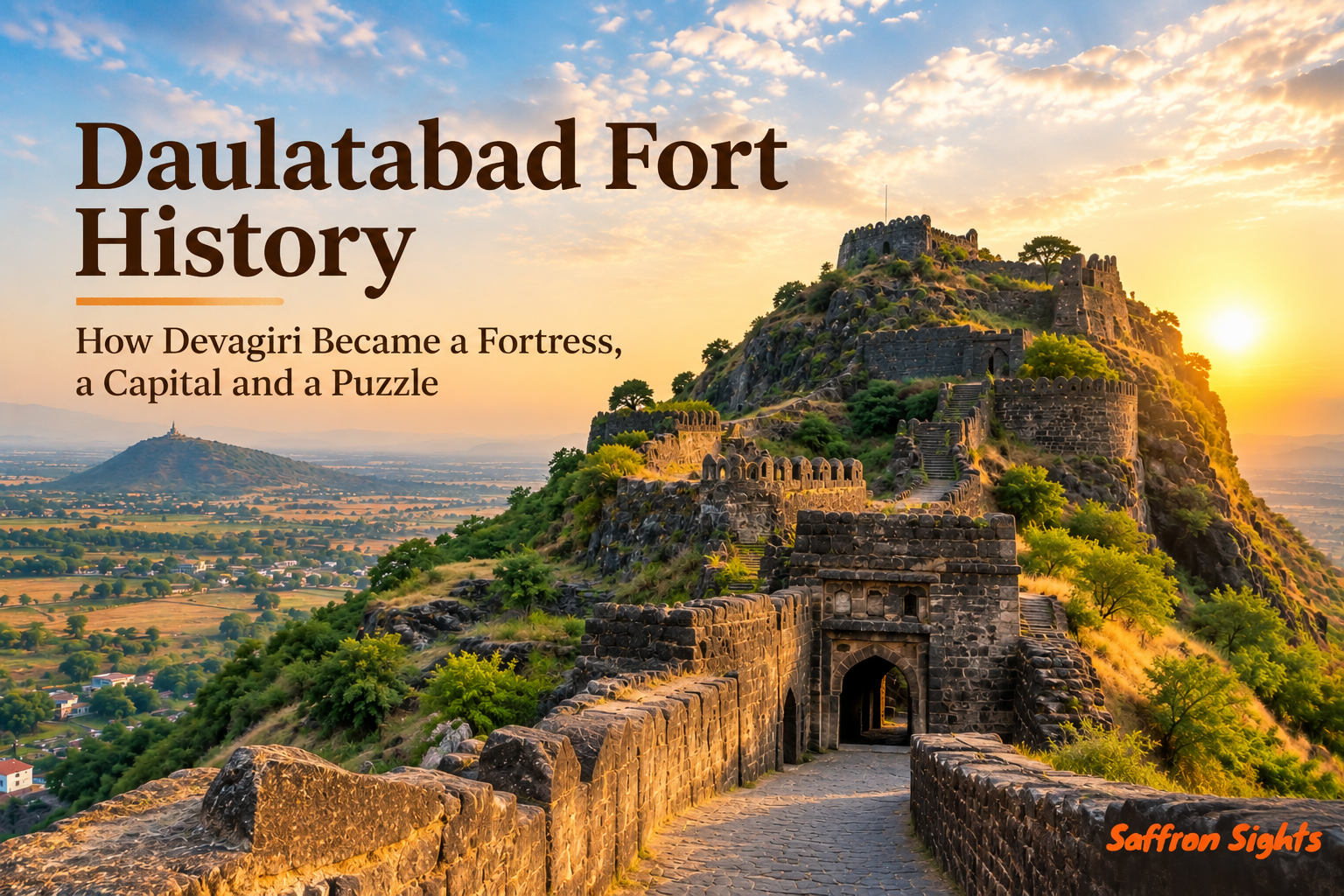
Daulatabad Fort stands about 15 to 16 km northwest of Chhatrapati Sambhajinagar (formerly Aurangabad) in Maharashtra, on the road to the Ellora Caves. A steep, isolated hill rises about 200 metres from the Deccan plain, and the fort is carved into it.
Daulatabad fort history spans more than 800 years. A Hindu dynasty made the hill its capital. A Delhi sultan tried to rule all of India from it. Later dynasties fought over it, and today it is a protected monument and one of Maharashtra’s most visited heritage sites. This guide explains who held it, what they built, which stories are documented and which are folklore, and how to plan the climb.
Where Is Daulatabad Fort, and Why Does the Hill Matter?
Short answer: The fort is on a rocky hill near Daulatabad village, roughly 15 to 16 km from Chhatrapati Sambhajinagar and close to Ellora.
A fort on a long ridge can be approached from several sides. This hill stands alone, so builders could reshape every slope. From the top, defenders could watch the plains in all directions. The hill also lies on routes linking northern India with the Deccan, which is why so many rulers wanted it.
From Devagiri to Daulatabad: The Yadava Legacy
Short answer: Devagiri was the capital of the Yadava (Seuna) dynasty. Its founding as a capital is traditionally linked to Bhillama V, around 1187.
Devagiri is usually understood as “Hill of the Gods”. Exact dates in early Deccan history vary between sources, so “around 1187” is the safest way to say it.
The Yadavas ruled much of the western Deccan. At Devagiri they combined a royal city with a hill citadel. They were also patrons of learning. The Marathi saint-poet Dnyaneshwar and his Dnyaneshwari (about 1290) are placed in the reign of the Yadava king Ramachandra. The minister Hemadri (Hemadpant) is remembered for his Sanskrit writing, and a style of Maharashtra temple architecture carries his name. So Devagiri belongs to Marathi literary history as well as military history.
The Khalji raid of 1296
In 1296, Alauddin Khalji, then a prince of the Delhi Sultanate, raided Devagiri. King Ramachandra (Ramadeva) agreed to pay a heavy price to end the attack.
A popular story says that sacks hauled into the fort in a hurry held salt instead of grain. This comes from the chronicler Ferishta, who wrote about three centuries later. Treat it as tradition, not proven detail. What is clear is that a northern army reached the Deccan quickly and the Yadava kingdom was never the same afterwards.
Muhammad bin Tughlaq’s Capital Shift
Short answer: Around 1327, Sultan Muhammad bin Tughlaq renamed Devagiri “Daulatabad” and moved his capital there from Delhi. He reversed the plan a few years later.
Daulatabad is commonly translated as “City of Fortune”. Tughlaq’s reasoning was geographical. Delhi lay far to the north, while Daulatabad sat closer to the centre of his large empire and had strong natural defences.
The episode is described by Ziauddin Barani, a historian at the Delhi court, and by the Moroccan traveller Ibn Battuta, who reached India a few years later and recorded what he heard. Accounts describe a hard journey of roughly 1,100 km. Historians still debate how many people were moved and how harsh the order was. Some accounts describe the whole population of Delhi, while others point to the court, officials and elites.
The experiment was abandoned and the capital returned to Delhi. The lesson is simple: a good fortress is not always a good capital. A strong hill cannot, by itself, run an empire.
Tip for readers: Whenever you read about this episode, ask two questions: who wrote it, and when? The chroniclers had their own viewpoints.
Defence Tricks: Moat, Steep Rock and the Dark Passage
Short answer: Daulatabad was hard to take because several defences worked one after another, not because of any single wall.
Layered walls
Several rings of fortification protect the hill, with a citadel at the top. Sources use different names for the rings, such as Amberkot, Mahakot, Kalakot and Balakot, and the layout changed as rulers added to it. Breaking through one wall did not end the fight.
Scarped rock
Builders cut the lower slopes into near-vertical faces, a method called scarping. Sources commonly give the height of these faces as about 50 metres. Attackers could not easily climb them, and ladders had nowhere to rest. Much of the defence came from stone that was removed.
The moat
A deep rock-cut moat separates the outer defences from the upper citadel. A narrow crossing let defenders control who came across.
Legend check: Many guides say the moat held crocodiles. This is a popular claim and is not securely documented. Treat it as folklore.
Spiked gates and false turns
The gates have sharp turns, so attackers could not charge in a straight line. Iron spikes on doors were meant to stop war elephants from ramming them. Curved walls and misleading paths added to the confusion.
The Andheri
The Andheri (“the dark one”) is a winding rock-cut passage leading toward the upper fort. It is narrow, dark and uneven, so soldiers had to move in single file and lost their bearings.
Popular accounts add more drama: a heated iron cover above the passage, false light shafts that lure people toward drops, and smoke fires. These stories are widely repeated at the site. Some may rest on real features, but the details vary and hard evidence is thin. What you can verify yourself is the darkness, the tight turns and the uneven steps, which are enough to explain why it worked.
Water
A fort must survive a siege as well as an assault. Daulatabad has large rock-cut tanks, such as the Hathi Haud, built to store water through a long blockade.
Was Daulatabad Ever Captured?
Short answer: Yes. Its reputation is for being very hard to storm, not for being impossible to take.
The fort passed from the Yadavas to the Delhi Sultanate, then to the Bahmanis, Nizam Shahis, Mughals, Marathas and the Nizams of Hyderabad. Accounts often point to starvation, bargaining or betrayal rather than a successful frontal assault.
A well-known example is the Mughal siege of 1633 under Shah Jahan’s general Mahabat Khan. Accounts say the fort fell after its commander, Fateh Khan, was won over. Details differ by source, so treat the exact terms as reported, not settled.
Under the Mughals, Daulatabad also held important prisoners. Historians record that Abul Hasan, the last Qutb Shahi ruler of Golconda, was imprisoned here after Aurangzeb’s conquest in 1687. A strong fort works as a prison as well as a shelter. For exact dates of each later change of control, check a recognised history text or the Archaeological Survey of India (ASI).
Chand Minar and the Bharat Mata Temple
Chand Minar
The Chand Minar is a tall tower of about 63 metres (210 ft), built in the Bahmani period. It is commonly said to mark a Bahmani victory at the fort. Sources give the date as 1435 or 1445, so “mid-15th century” is the safest wording. Traces of its colourful decoration can still be seen.
The Bharat Mata temple
Near the fort’s entrance is a large pillared hall. Historians describe it as a mosque of the early 14th century built with pillars taken from an older temple, and local tradition links the site to a Hindu shrine. After Independence, a Bharat Mata shrine was set up inside the hall. The building carries all these layers, which makes it a useful place to understand how sacred spaces were reused over time. Visit with respect and follow any signs.
Other Things to Look For
- Mendha Toph: a large cannon with a ram’s-head design, associated with the Mughal period. Sources differ on its exact maker and date.
- Hathi Haud: the large water tank mentioned above.
- The summit: wide views across the plain that show why the hill was so valuable.
Past, Present and Future
Past: a Yadava capital, a Tughlaq experiment, a contested Deccan stronghold, then a prison and garrison.
Present: Daulatabad is a protected ASI monument and is usually visited together with Ellora.
Outlook (not a confirmed plan): Old forts face weathering, crowding and litter. Conservation, clear signage and regulated access in dark passages are the usual measures heritage sites rely on. Visitors help by staying on marked paths.
For Students and Exam Readers
- Yadava capital: Devagiri, associated with Bhillama V (about 1187).
- 1296: Alauddin Khalji’s raid on Devagiri in Ramachandra’s reign.
- About 1327: Tughlaq shifts the capital to Daulatabad.
- Related policy: Tughlaq also introduced token currency, another ambitious experiment of his reign.
- Chand Minar: Bahmani-period tower, mid-15th century.
- Exam tip: Questions usually ask why the capital shift failed (distance, administration, hardship), not only the date.
Fun Facts
- A medieval fortress and the Ellora rock-cut caves can be seen on the same day.
- The fort’s defence depends partly on stone that was cut away.
- You can follow Yadava, Delhi Sultanate, Bahmani and Mughal history in one walk.
- The Andheri confuses first-time climbers even in daylight, because darkness hides the steps as well as the enemy.
Trek Tips: Torch, Water, Shoes
Best time: October to February is the most comfortable. The Deccan gets very hot in summer, and the stone can be slippery in the monsoon.
How long: Plan around three hours for the fort, more if you want to look closely at the Chand Minar and the hall. Add time if you are combining it with Ellora.
Checklist
- A torch or phone light for the Andheri.
- Water. There is no easy resupply on the climb.
- Shoes with grip. Avoid sandals.
- A hat and sunscreen.
- Patience with children and older family members, since the climb is steep and the dark passage can frighten some people.
- Stay on marked paths and follow any site restrictions.
How to reach: The nearest airport and main railway station are both at Chhatrapati Sambhajinagar, and roads lead from there to the fort and Ellora. Check local taxi and bus options on the day.
Entry fees and timings: These change. Check the latest on the ASI website or at the gate before you travel.
A simple one-day plan
- Arrive early, before the heat and crowds.
- Walk the outer enclosure, the pillared hall and the base of the Chand Minar.
- Cross the moat area, enter the Andheri with your torch and continue to the summit.
- Rest, then see the Mendha Toph and the water tank on the way down.
- Continue to Ellora if you have time and energy, or save it for another day.
Etiquette and responsible tourism
- The pillared hall is a shared historical and religious space. Dress modestly and keep your voice low.
- Do not scratch or write on stone, and do not climb on walls.
- Carry wrappers and plastic back down with you.
- Use a torch, not a naked flame, in passages.
- Ask before photographing people, especially worshippers.
Families and older visitors
Children often enjoy the dark-passage story, but the steps are steep. Older travellers can enjoy the lower enclosure and the Chand Minar area without attempting the summit.
Photography tips
- Late afternoon in winter gives soft light on the Chand Minar.
- Shoot the moat and scarped rock from the approach, where the scale is clearest.
- In the Andheri, brace your phone against a wall and avoid flash in tight, crowded spaces.
Local food
Chhatrapati Sambhajinagar is known for Mughlai-influenced dishes such as naan qalia. Ask your hotel or driver for current, well-reviewed places.
Why Daulatabad Matters Today
For students, Daulatabad links the Yadavas, the Delhi Sultanate and Tughlaq’s capital shift in one place. For travellers, it shows how builders used a landscape as a weapon. For culture lovers, the hall and Chand Minar show how one site gathers layers over centuries. It is a protected monument, so please leave it as you found it.
Key Takeaways
- Devagiri was a Yadava capital from about 1187, and the name Daulatabad came with Tughlaq in the 14th century.
- The 1327 capital shift is real history, but the scale of the movement is still debated.
- The fort’s strength came from layers: scarped rock, moat, gates, the Andheri and water storage.
- Writers such as Barani, Ibn Battuta and Ferishta shaped how we know the story, but they do not always agree.
- For the climb, go in winter and carry a torch, water and grippy shoes.
Related Topics
- Ellora Caves and the Kailasa Temple
- Muhammad bin Tughlaq and the Delhi Sultanate
- Grishneshwar Jyotirlinga near Ellora
- Dnyaneshwar and the Yadava-era Marathi literary tradition
- Forts of Maharashtra and the Deccan
Frequently Asked Questions
1. Who built Daulatabad Fort?
No single ruler built it. The Yadavas established Devagiri as their capital around 1187, and later rulers expanded and adapted it.
2. Why did Muhammad bin Tughlaq shift his capital to Daulatabad?
It was more central within his empire and easy to defend. The move was reversed because it was hard to run the empire from there.
3. What is the Andheri at Daulatabad Fort?
It is a dark, winding rock-cut passage leading toward the upper fort, designed to slow and confuse attackers.
4. What is the best time to visit Daulatabad Fort?
October to February, when the weather is cooler for climbing.
5. Do I need a torch at Daulatabad Fort?
Yes. A torch or phone light helps in the Andheri, where the steps are uneven and parts are very dark.