
Introduction
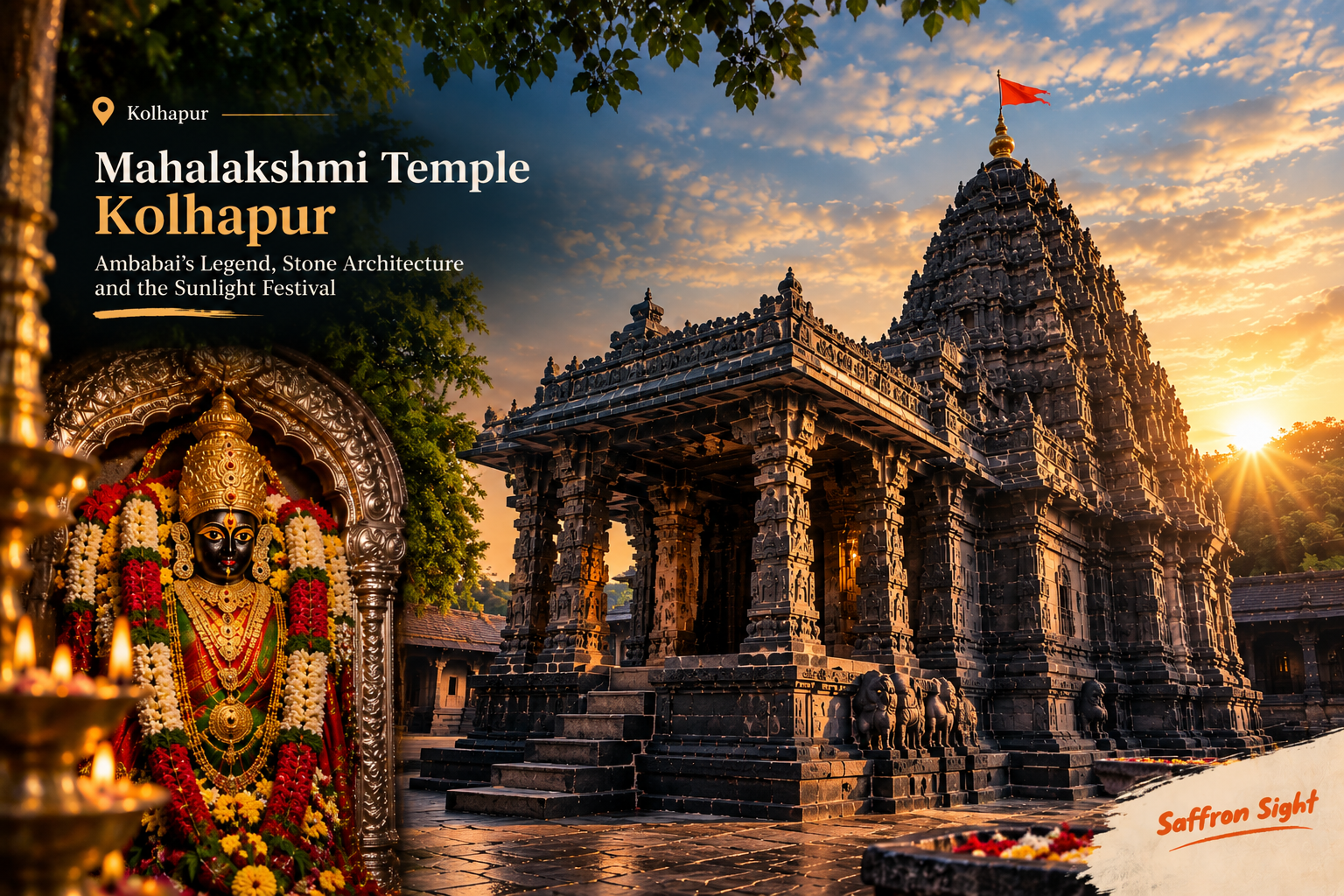
The Mahalakshmi Temple in Kolhapur, Maharashtra, is the home of Ambabai, the “Mother” of the city. It stands in the heart of old Kolhapur, just west of the Old Palace. Pilgrims have come here for centuries, and many local families still begin big occasions with a visit.
Most people think of Lakshmi as the goddess of wealth. At Kolhapur, devotees see her as something larger: a ruling, self-reliant Mother Goddess. Three things set this temple apart: its Shakti Peeth tradition, its west-facing idol, and a festival in which the setting sun’s rays move through the temple toward the Goddess. This guide covers the legend, the architecture, Kirnotsav, the rituals, and what to eat and buy afterward.
What Is the Mahalakshmi Temple in Kolhapur?
The Mahalakshmi (Ambabai) Temple is a Hindu temple in Kolhapur dedicated to the goddess Mahalakshmi, known locally as Ambabai. The city’s ancient name is Karaveera (also spelled Karvir), and you will often hear the Goddess called Karveer Nivasini, “the resident of Karveer”.
Devotees count it among the Shakti Peethas, the seats of the Goddess. They also call Kolhapur Dakshin Kashi, the “Kashi of the South”. The temple’s own website says it is one of the “three and a half” Shakti Peethas of Maharashtra.
The Legend of Ambabai and Shakti Peeth Belief
Sati and the Shakti Peethas
According to Hindu tradition, Sati was the daughter of Daksha and the wife of Shiva. She gave up her life after Daksha insulted Shiva at a great sacrifice. A grief-stricken Shiva carried her body across the world. Vishnu then used his Sudarshana Chakra, and parts of her body fell at different places. Each place became a Shakti Peeth.
Two cautions apply:
- The lists vary. Traditions count 51, 52, 108 and other totals, so no single list is accepted everywhere.
- The body part differs between accounts. Many popular sources say Sati’s eyes fell at Kolhapur. Others describe it differently. Treat it as belief, not settled fact.
Kolhasura and the Karaveera Mahatmya
A second story explains why the Goddess stays here. According to regional Puranic tradition, a demon named Kolhasura tormented the gods and sages. Mahalakshmi defeated him. In popular tellings, the dying demon asked that the city carry his name and that the Goddess remain forever. This is mythology, and it is how many devotees explain both the name Kolhapur and Ambabai’s permanent presence.
The “Three and a Half” Peethas of Maharashtra
| Peetha | Place | Deity |
|---|---|---|
| Full | Kolhapur | Mahalakshmi (Ambabai) |
| Full | Tuljapur | Tulja Bhavani |
| Full | Mahur | Renuka Mata |
| Half | Vani (Nashik) | Saptashrungi Devi |
Some writers link these to the syllables of “Om”. That is a devotional reading, not a historical claim.
The Tirupati Connection
A popular story says Lakshmi left Vishnu after an insult and settled at Karaveera, while Vishnu went to the Venkatachala hills. Many devotees believe a Tirupati pilgrimage is complete only with a visit to Kolhapur. Some accounts also mention a ceremonial offering sent from Tirumala to Kolhapur each year. Details differ between sources, so check before repeating them.
Chalukyan-Era Temple Architecture
The temple is traditionally attributed to the Chalukya king Karnadeva, around the 7th century CE. The temple’s official site says construction continued for roughly two centuries after that. It describes the structure as Hemadpanthi, a style of fitted dark-stone masonry common in the Deccan.
The temple also changed over time:
- Shikhara (spire): The official site says it was built in the 18th century by the ruler of Karveer.
- Garuda Mandap: The official site dates this front hall to the second half of the 18th century.
- Overall: Treat any single date for the whole complex with care. It is a layered structure.
What you will see:
- Carved dark stone and a sequence of pillared halls leading to the sanctum (garbhagriha).
- A two-storey main shrine. The official site says the Mahalakshmi idol is on the ground floor and a Matulinga (citron) shrine is on the first floor.
- Smaller shrines around the temple, including the Navagraha shrine and a Sheshashayi Vishnu temple. Shrines of Mahakali and Mahasaraswati also stand within the complex, reflecting the local belief that Ambabai holds all three powers.
The Idol
Tourism descriptions say the black-stone idol is roughly three feet tall and weighs about 40 kg. Devotees call it swayambhu, “self-manifested”. That is a religious belief.
The iconography is unusual:
- Four arms. Sources vary slightly, but the attributes usually listed are a citron fruit, a mace, a shield and a bowl.
- A crown with a serpent and a Shiva Linga. Devotees read this as Shaiva and Vaishnava traditions meeting in one image.
- A lion behind her. The lion is usually linked to Durga and reinforces her warrior-mother image.
- A west-facing orientation. Most Hindu temples face east. This one does not.
You may read online that the whole temple is laid out as a Sri Yantra, or that its stones create a “bio-energetic field”. I found no reliable source for these claims, so they are left out here.
Kirnotsav: When Sunlight Reaches the Goddess
Kirnotsav (also spelled Kiranotsav) is the “festival of rays”, when the setting sun’s light travels through the temple toward the idol of Ambabai. The name joins kirana (ray) and utsav (festival).
How It Works
Because the idol faces west, the setting sun can send light along the temple’s axis. The sun’s setting point shifts through the year, so the alignment works only in certain windows. That is why it happens twice a year and not every evening.
When Does It Happen?
Commonly cited dates are:
- Around 31 January to 2 February
- Around 9 to 11 November
Some years’ reports describe a longer five-day festival, and the exact days shift. Some sites also list wrong months, such as March and September. Confirm the current year’s dates with the temple committee.
What Devotees Report
Local reports describe a three-step sequence. On the first day the rays reach the feet, on the second they rise to the waist or chest, and on the third they reach the face. Before the festival, experts reportedly check the light’s path with instruments. Cloud cover can still hide the sun, so there is no guarantee on any given evening.
For devotees, this is Surya, the Sun, paying homage to the Goddess. For students of architecture, it shows how builders used the sun’s path in sacred design. Both readings can stand together.
Tip: Arrive well before sunset. Crowds are large, and the temple staff will tell you where visitors may stand.
Daily Rituals and Festivals
Daily Worship
Worship follows a daily rhythm that usually includes:
- Kakad Aarti at dawn
- Abhishek and alankar, where the idol is bathed and dressed
- Aarti through the day and Shej Aarti at night
Timings change, so check the current darshan and aarti schedule before you go.
Navratri
Navratri is the temple’s biggest festival. It begins with Ghatasthapana, the ritual installation of the sacred pot. According to a 2025 report, the temple marks this with a cannon salute, a tradition said to be about 150 years old. The Goddess is decorated in a different alankar each day.
Crowds are huge. In 2026, authorities expected about 25 lakh devotees during the 10-day festival, which began on 11 October. If you prefer a calmer darshan, choose a weekday outside festival periods.
Other Festivals
The temple’s official site also names Rathotsav, celebrated in the month of Chaitra, as one of its major festivals.
Where Is It and How Do You Reach It?
The temple is in the old city of Kolhapur, in southwestern Maharashtra, near the Karnataka border.
- By train: Chhatrapati Shahu Maharaj Terminus is the main station.
- By air: Kolhapur Airport serves the city. Check current flights.
- By road: Buses and taxis connect Kolhapur to other Maharashtra cities and nearby Karnataka.
- Locally: Autos, taxis and walking all work. Lanes near the temple get crowded.
Best time to visit. October to February has the most comfortable weather. The monsoon (about June–September) brings rain and greenery. Summer is hot. Pick early November or late January for Kirnotsav.
How long to stay. The temple visit takes a few hours. A full day or two lets you add the Old Palace, food and shopping.
Etiquette. Dress modestly and follow the temple’s rules on footwear, bags, phones and photography. Do not block the queue.
Timings, rules and fees change. Verify them with the temple committee or Maharashtra Tourism before you travel.
Kolhapur Food and Shopping
- Misal. A spicy sprouted-lentil curry with bread, farsan and onions. Kolhapuri misal is known for its heat, and many places serve a milder plate if you ask.
- Tambda and pandhra rassa. “Tambda” means red and “pandhra” means white. These are mutton curries, the red one being spicier. Vegetarians have plenty of other choices.
- Kolhapuri chappals. Handmade leather sandals with a Geographical Indication (GI) tag. Ask about the leather and stitching before you buy.
Many pilgrims eat vegetarian on the day of darshan, so choose restaurants accordingly.
Beyond the Temple
- New Palace and museum: Kolhapur’s royal history.
- Bhavani Mandap: A historic city landmark.
- Rankala Lake: A quiet spot in the evening.
- Jyotiba Temple: A hill shrine near Kolhapur and a popular day trip.
Did You Know?
- Most Hindu temples face east, but Ambabai faces west.
- Kolhapur’s other name, Dakshin Kashi, reflects its fame as a place of liberation.
- The temple’s spire and Garuda Mandap are 18th-century additions to a much older
temple. - Kolhapuri chappals carry a GI tag.
Key Takeaways
- The Mahalakshmi Temple Kolhapur is the seat of Ambabai, a sovereign Mother Goddess.
- Its Shakti Peeth status is a matter of belief, and accounts vary.
- The temple is traditionally attributed to Karnadeva (about the 7th century CE), with major 18th-century additions.
- Pair your visit with misal and chappals, and follow temple rules.
- Kirnotsav depends on the west-facing layout and the setting sun. Check the dates for the year.
Related Topics
- Tuljapur Bhavani Temple and the Shakti Peethas of Maharashtra
- Jyotiba Temple near Kolhapur
- Kolhapur’s New Palace and royal heritage
- Hemadpanthi and Chalukyan temple styles
- Navratri traditions across India
Frequently Asked Questions
1. Where is the Mahalakshmi Temple in Kolhapur?
It is in the old city of Kolhapur, Maharashtra, just west of the Old Palace.
2. Why is it called a Shakti Peeth?
Hindu tradition links it to the Sati legend and to the worship of the Goddess as Ambabai. Accounts differ on which part of Sati fell here.
3. When is Kirnotsav?
t is commonly cited as around 31 January–2 February and 9–11 November. Confirm the year’s dates with the temple committee.
4. When is the best time to visit?
October to February is pleasant. Navratri and Kirnotsav bring festival atmosphere and very large crowds.
5. What should I eat and buy?
Try Kolhapuri misal, and tambda or pandhra rassa if you eat non-vegetarian food. Buy Kolhapuri chappals from a reputable shop.