Key Takeaways
- Shivaji Maharaj chose Raigad mainly for its natural defences: an isolated, steep-sided hill high in the Sahyadri range.
- He captured the hill, then called Rairi, in 1656 and rebuilt it into a full capital.
- His coronation as Chhatrapati took place here in June 1674, and he died here in 1680.
- The Hirkani story is local folklore, not documented history. It explains the name of a real bastion.
- You can climb the steps or take the ropeway. Start early and avoid the heavy monsoon days.
Raigad Fort History: Why Shivaji Maharaj Chose It as His Capital
Introduction
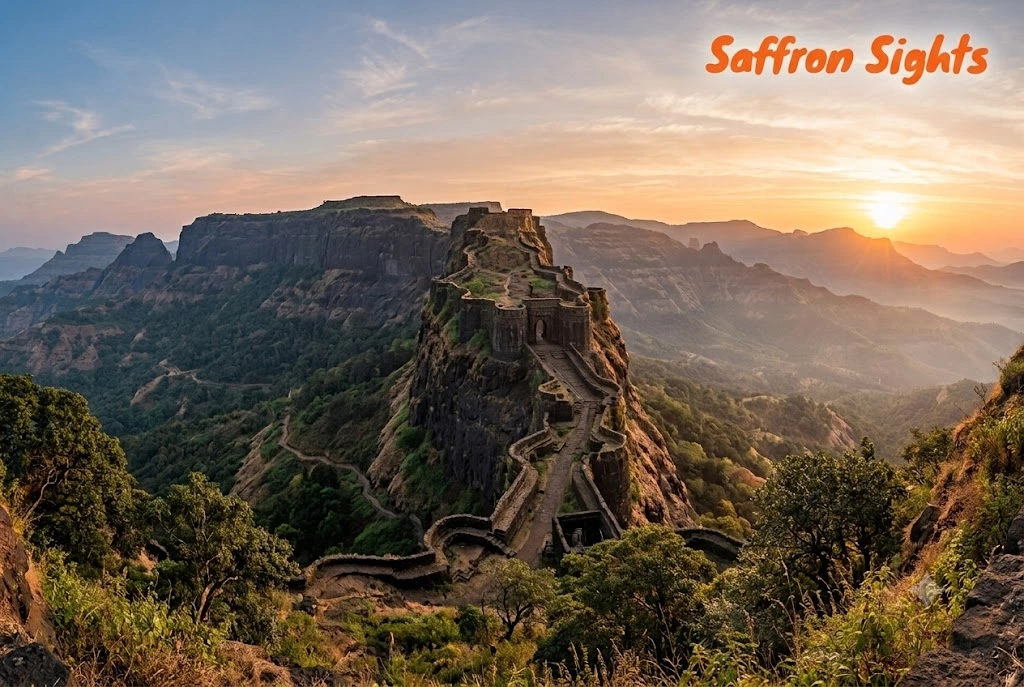
Shivaji Maharaj chose Raigad because no other fort he held was as hard to attack. It sits on an isolated hill in the Sahyadri mountains of Maharashtra, about 820 metres above sea level, with steep rock faces and deep valleys around it. It also had a flat top big enough to hold a whole royal court.
The fort is in Raigad district, near the town of Mahad. This is where Shivaji was crowned Chhatrapati in 1674, and where he died six years later. In 2025, UNESCO added Raigad to its list of Maratha forts, the “Maratha Military Landscapes of India”. It is one of 12 forts on that listing.
This guide covers the military reasons behind the choice, the coronation, the legend of Hirkani, the sites on top, and how to plan a visit.
Where Is Raigad Fort Located?
Raigad Fort stands in the Sahyadri (Western Ghats) range in Raigad district, Maharashtra. It lies inland from the Konkan coast, roughly 25 km from Mahad. The fort is about 820 m (2,700 ft) above sea level. Pune and Mumbai are both a few hours away by road.
Why Shivaji Chose Raigad: Terrain and Defence
A hill built for defence
The hill was originally called Rairi. Sources describe it as an isolated mass of rock with steep scarps on most sides. This matters for two reasons.
- Attackers had few places to climb. Sheer cliffs meant a besieging army could not simply surround and rush the walls.
- Defenders could see far. From the top you can watch the surrounding ridges and valleys. Enemy movement could be spotted early.
The Sabhasad Bakhar, a Marathi chronicle of Shivaji’s reign written in the late 1600s, records his admiration for the hill’s height and steep rock. According to the chronicle, he judged it stronger than the famous fort of Daulatabad. Treat this as the chronicle’s account, since it was written some years after the events.
Space to run a capital
A fort that is only a cliff is not enough for a capital. Raigad’s summit is broad. That allowed palaces, a court hall, storehouses, water tanks and a market street. The fort could hold stored grain and water for a long siege.
Where Raigad sits in the story
Shivaji took Rairi from the More family of Javali in 1656, then rebuilt and renamed it Raigad. The work is credited to his engineer Hiroji Indulkar. Before this, Rajgad had served as an important seat of his government.
A point on which sources disagree: Some summaries say Shivaji left Rajgad because the 1665 Treaty of Purandar made it vulnerable. That reason is not firmly established, and Rajgad was not among the forts he surrendered. A safer reading is that Raigad offered better terrain and more room, and that its rebuilding made it the natural choice.
What about “the only way in”?
Some websites say Raigad has just one access route. That is overstated. The main entrance is the Maha Darwaja, but there is also a smaller secret gate, the Chit Darwaja, and the cliff path linked to the Hirkani legend. The fort was heavily guarded, but not single-entry.
You may also read that Europeans called Raigad the “Gibraltar of the East”. It is a popular description and worth repeating only as that.
The 1674 Coronation of Shivaji Maharaj
For years Shivaji had ruled as a powerful chief, but he held no royal title. Rulers around him treated him as a subordinate of larger sultanates. A formal coronation would change that.
The ceremony took place at Raigad on 6 June 1674. Historical accounts say Pandit Gaga Bhatt of Varanasi, a respected scholar, led the Vedic rites. Shivaji took the title Chhatrapati, and the event is remembered as the start of Hindavi Swarajya, or self-rule.
Some details make the event feel real:
- Foreign witnesses were present. An English envoy from Bombay, Henry Oxenden, attended. His account is one reason historians trust the broad outline of the event.
- A second ceremony followed. In September 1674 a further ritual was performed according to Tantric tradition.
- A personal loss came days later. Shivaji’s mother, Jijabai, died shortly after the coronation.
Raigad was therefore the capital the Maratha state was crowned in.
Hirkani Buruj and the Story of Hirkani
The Hirkani story is a local legend. No document confirms it.
According to the tradition, Hirkani was a milkmaid from a nearby village who sold milk at the fort. One evening she stayed too long, and the gates were shut at sunset, as was the rule. Her baby was at home, so she did not wait for morning. She climbed down the steep cliff in the dark and reached her village.
Shivaji was said to be amazed. He rewarded her, and the bastion built on that cliff face was named Hirkani Buruj in her honour. The extra defence was meant to block the route she had found.
What can you take from the story?
- The Hirkani Buruj exists and you can see it.
- The name is attached to the legend, but the incident cannot be verified.
- It reflects how locals remember the fort, as a place where ordinary people mattered too.
Jagadishwar Temple and Shivaji’s Samadhi
Near the eastern edge of the fort stand two of its most visited places.
- Jagadishwar Temple: A temple to Shiva. It is commonly credited to Hiroji Indulkar, and local tradition links it to Shivaji’s wish for a place of worship in his capital. Remove your footwear and dress modestly.
- Shivaji’s Samadhi: The memorial marks where he was cremated after his death on 3 April 1680. Many visitors come to pay respects, and the site is quiet and dignified.
Near the temple complex you will also find a memorial associated with Wagya, a dog said to have been Shivaji’s. This is popular tradition, and historians have debated it. If you visit, treat it as local lore.
What Else to See on the Fort
- Maha Darwaja: The grand main gate, flanked by strong bastions.
- Rajsabha: The royal court area where the throne stood. A replica throne marks the spot today.
- Bazarpeth: Ruins of twin rows of market shops. They show the fort was a working town.
- Gangasagar Lake: A large water tank that reminds you how important water supply was.
- Watchtowers and ramparts: Good for views and photos on a clear day.
After Shivaji: A Brief History
After Shivaji’s death in 1680, the fort remained a centre of the Maratha state. In 1689 Mughal forces captured it after a siege, and it was renamed Islamgarh for a time. The Marathas later regained control. In 1818 the British took the fort and much of the construction was damaged. Today it is a protected heritage site and part of the UNESCO listing.
How to Reach Raigad Fort
The usual base is Pachad village, near the foot of the fort. Most visitors go by road from Mahad.
- Nearest airports: Pune and Mumbai are the main options. Both need a road journey afterwards.
- Nearest railway: Stations on the Konkan Railway, such as Mangaon and Veer, are the closest. Road transport is needed from there.
- By road: Mahad is the nearest town, and the fort lies a short drive beyond it. Expect a long drive from Pune or Mumbai, so many travellers take a full day.
Steps or ropeway?
| Steps | Ropeway | |
| Effort | Steep climb, roughly 1,400 to 1,700 steps (counts vary) | Short ride, then some walking |
| Good for | Fit visitors, students, history walks | Families with children, older visitors |
| Watch for | Slippery stone in rain, heat in summer | Closures in strong wind or heavy rain |
Check current ticket prices, timings and ropeway operating days with the operator or official sources before you travel, since these change.
Best Time to Visit
- October to February: Cool and clear, the most comfortable for climbing.
- June to September (monsoon): Green and misty, with great views when the clouds lift. Steps get slippery, and the ropeway may stop in bad weather.
- March to May: Hot. If you go, start at dawn.
Many people visit around 6 June, when the coronation anniversary (Shivrajyabhishek Din) is celebrated. Expect crowds.
How long should you spend?
Plan about half a day on top, and a full day including travel.
Tips for Visitors
- Start early so you finish before the afternoon heat.
- Wear shoes with good grip. Carry water and a cap.
- Dress modestly at the temple and samadhi.
- Keep the fort clean. Carry your rubbish back down.
- Stay on marked paths near cliff edges.
- Hiring a local guide helps bring the sites to life.
Did You Know?
- Raigad is one of 12 forts in the UNESCO “Maratha Military Landscapes of India” listing (2025).
- Rairi, the old name, means something close to “the fort of Rai”. The rename to Raigad came after Shivaji took charge.
- The fort was designed as a complete town, with a market, court and water tanks inside its walls.
Key Takeaways
- Raigad’s isolated, steep terrain and broad summit made it the best fit for a capital.
- Shivaji acquired Rairi in 1656 and rebuilt it, with Hiroji Indulkar credited as the builder.
- The coronation of 6 June 1674 made Raigad the seat of Hindavi Swarajya.
- Hirkani’s tale is folklore. Hirkani Buruj itself is a real bastion.
- For visitors: start early, choose steps or ropeway to match fitness, and check current timings and fees.
Frequently Asked Questions
1. Why did Shivaji Maharaj choose Raigad as his capital?
Because of its natural defences, its commanding height in the Sahyadri, and a summit large enough for a full capital with palaces, water tanks and markets.
2. When was Shivaji crowned at Raigad?
On 6 June 1674, with Gaga Bhatt of Varanasi performing the rites.
3. Is the Hirkani story true?
It is a local legend. The bastion called Hirkani Buruj exists, but the incident itself has no documentary proof.
4. Should I climb the steps or take the ropeway?
The steps suit fit visitors who want the full experience. The ropeway suits families and older travellers, though it can close in bad weather.
5. What is the best time to visit?
October to February is the most comfortable. The monsoon is beautiful but slippery.