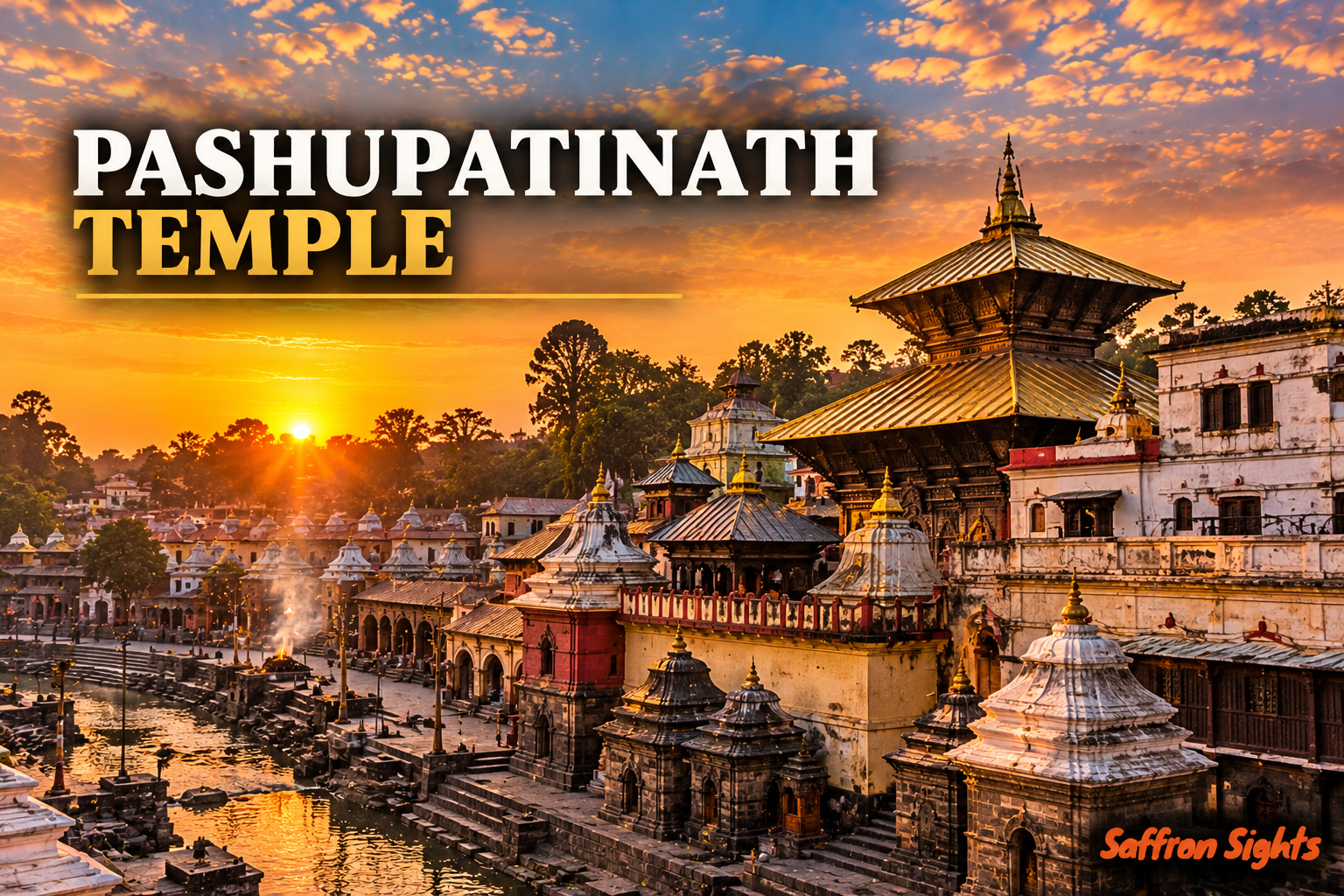

Where Pashupatinath Stands and Why It Matters
Imagine a temple so old that nobody knows exactly when it began. Its golden roof shines above a quiet river, and its stories are older than most of the buildings around it. That is Pashupatinath Temple.
Pashupatinath Temple is in eastern Kathmandu, Nepal, on the banks of the Bagmati River. It is dedicated to Lord Shiva in his form as Pashupati, which means “Lord of all living beings” or “protector of animals.” It is among the oldest and holiest Hindu temples in Nepal. Every year, pilgrims from Nepal, India and many other countries come here, and the crowds are biggest during Maha Shivaratri.
In 1979, the temple area became part of the Kathmandu Valley World Heritage Site (UNESCO). That listing has seven monument zones, and Pashupatinath is one of them. It was not listed on its own.
This article does one thing differently. It keeps history (what records and inscriptions show) apart from legend (what sacred stories and tradition tell us). Both are important, but they are not the same thing.
Quick facts
- Location: Bagmati River bank, eastern Kathmandu, Nepal
- Deity: Shiva as Pashupati
- Earliest firm record: 400 CE
- Style: Two-tiered pagoda with a gilded roof
- UNESCO listing: 1979 (Kathmandu Valley)
- Complex size: More than 500 temples, shrines, images and ashrams
What Does the Name “Pashupatinath” Mean?
The name has three parts:
- Pashu means living beings or animals.
- Pati means lord or protector.
- Nath means master.
Together they mean “the Lord and protector of all living beings.” Pashupati is an old title of Shiva. It is also linked to the Pashupata school of Shaivism, one of the early Shiva-worshipping traditions of India. So the name carries a very old idea of Shiva as the caretaker of every living creature.
Origin: Who Built Pashupatinath Temple?
Many people ask this, and the honest answer is: no single builder is proven.
- The site is believed to be very ancient, and tradition places its start long before written records.
- The earliest firm record of a temple here dates to 400 CE.
- An old chronicle called the Gopal Raj Vamshavali credits early Licchavi kings, such as Prachanda Deva and Supuspa Deva, with building or enlarging the temple. This is chronicle tradition. It is not settled archaeology.
- Over the centuries, many kings and communities rebuilt, repaired and improved it.
So the best answer to “Who built Pashupatinath Temple?” is this: Licchavi-era royal support is traditionally credited, and later Malla-era rulers did major rebuilding.
Purpose: Why Was the Temple Created?
The site began as a place to worship Shiva, and it never stopped being one. The temple stands on a sacred river, in a valley that has long been seen as holy. For Hindus, it serves three main purposes:
- Daily worship of Shiva as Pashupati.
- Pilgrimage. Devotees, sadhus (holy men) and families come from across Nepal and India.
- Rites linked to death and moksha. The Bagmati ghats are a place where many Hindus believe the soul is helped on its journey.
Historical Context: A Timeline of Pashupatinath
Here is the timeline with the type of source marked. This helps readers know what is record and what is tradition.
| Period | What happened | Type |
| Ancient / pre-Vedic origins | Sacred use of the site is believed to be very old | Tradition |
| 400 CE | Earliest firm record of a temple or shrine | Record |
| 5th century (Licchavi era) | Kings like Prachanda Deva and Supuspa Deva linked to building or expansion | Chronicle tradition |
| 1099–1126 CE | King Shivadeva is said to have rebuilt the temple | Historical tradition |
| Medieval Malla era | King Ananta Malla is credited with adding a roof | Historical tradition |
| 15th to 17th centuries | Malla kings, including Shivasimha Malla, helped shape the pagoda form seen today | Mixed sources |
| Late 1600s | A major renovation is recorded. Sources give different dates and details, so say “late 17th century” | Record, with varying details |
| 1979 | Listed as part of the Kathmandu Valley World Heritage Site | Record |
Why the dates vary: The old temple was made largely of wood. Termites, fires and earthquakes damaged it again and again, so it was rebuilt many times. Britannica places the present stone-and-metal structures in the 15th century, while other accounts point to a major renovation in the late 1600s. The safest wording is that the pagoda we see today comes from centuries of repair and rebuilding, not from one single date.
Later rulers: The Shah and Rana periods added gates, security and surrounding shrines. Today the Pashupati Area Development Trust (PADT) manages the wider temple area.
Stories and Legends of Pashupatinath
These stories are sacred traditions. They are not proven by archaeology, but they are a big part of why people love this temple.
Legend 1: Shiva as a Deer
According to this tradition, Lord Shiva and Goddess Parvati visited the Kathmandu Valley and were charmed by its beauty. They turned into deer and wandered in the forest east of the Bagmati River, a place linked to the name Mrigasthali (“place of the deer”).
The other gods searched for Shiva and wanted him to return to his divine duties. Shiva tried to escape. In the struggle, one of his antlers broke. The broken antler is said to have become the sacred lingam that people worship here.
Note: This is a Puranic and local devotional story. Different tellings have small differences.
Legend 2: The Cow and the Milk
In another popular story, a cow, linked with the divine cow Kamadhenu, poured her milk every day over one hidden spot in the ground. A curious farmer dug there and found a swayambhu lingam, meaning one that appeared by itself and was not made by human hands. This became the heart of the shrine.
Think of it like a treasure hunt: a puzzling daily mystery led to a sacred discovery.
Legend 3: The Link to Kedarnath
This story connects Nepal with India, which is why many Indian pilgrims love it.
After the great war told in the Mahabharata, the Pandavas wanted to meet Shiva and ask forgiveness. Shiva did not want to be found, so he hid as a bull. When the Pandavas caught him, he sank into the earth, and his body is said to have appeared in different Himalayan places:
- Hump: Kedarnath
- Arms: Tungnath
- Face: Rudranath
- Navel: Madhyamaheshwar
- Hair: Kalpeshwar
In many tellings, the head (or face, in some versions) is said to appear at Pashupatinath in Nepal.
Important: Versions differ. Some say head, some say face. Whether Pashupatinath formally belongs to the Panch Kedar group (the five Kedar shrines) is also not agreed by everyone. Texts such as the Shiva Purana, Skanda Purana and regional traditions are cited for this story, so check the exact text when you quote it.
Is Pashupatinath a Jyotirlinga?
No, not in the standard list. The traditional list of the twelve Jyotirlingas does not include Pashupatinath. Some devotional traditions link it with Kedarnath, which is a Jyotirlinga, but that does not make Pashupatinath one of the twelve.
The Chaturmukha (Four-Faced) Lingam
Inside the main sanctum is a rare four-faced Shiva lingam, called the Chaturmukha lingam. Its faces look toward the four directions. Tradition also speaks of a fifth face on top that cannot be seen. Many devotees link these faces to different aspects of Shiva, such as creation, protection and destruction. Because different traditions explain the meaning in different ways, it is best to say “devotees believe” rather than give one fixed meaning.
Architecture: What Makes the Temple Special
Pashupatinath is a fine example of Nepali pagoda-style architecture.
- Two-tiered pagoda roof. The sloping roofs are covered in gilded (gold-coated) copper, which glitters in sunlight.
- Silver-plated doors. The main doors are covered in silver sheets with fine carvings.
- Golden pinnacle (finial). A gold-colored spire sits at the top.
- Nandi, the sacred bull. A large figure of Shiva’s bull Nandi sits near the temple, facing the sanctum.
- Carved wooden struts. Wooden supports under the roof show the skill of Newar craftspeople.
- A huge complex. Around the main temple are more than 500 shrines, images, ashrams and other monuments. Use “more than 500” rather than an exact count, since counts vary by source.
Simple comparison: Think of the temple as the “main character” in a very big village of shrines. Hundreds of smaller monuments surround it, each with its own story.
The Bagmati Ghats: Living Heritage, Seen with Respect
The Bagmati River is part of the temple’s identity. Stone steps called ghats run along the river. Hindus bathe here, offer prayers, and perform final rites for the dead. The best-known cremation area is Arya Ghat.
This is a place of real grief and prayer, not a show. Visitors are asked to:
- Be quiet and calm.
- Ask permission before photographing people, and avoid photographing funeral rites.
- Dress modestly.
- Treat the area as a living place of worship.
A good way to see it is as a place where the idea of life, death and release is part of daily life, and where Hindus come to honour their loved ones.
The India–Nepal Shiva Pilgrimage Connection
For Indian devotees, Pashupatinath is more than a faraway temple. The Kedarnath story links the Himalayan shrines of India with the shrine in Nepal, so many pilgrims treat these places as parts of one sacred journey.
Tradition also speaks of a long link between the temple and priests from South India, and a connection with the sage Adi Shankaracharya. These are traditions, so they are best presented as “according to tradition.”
If you want to follow a Shiva pilgrim thread, the stories of Kedarnath, the Panch Kedar shrines and Pashupatinath are a good starting point. You can also read about another grand Shiva temple in our guide to the Ellora Kailasa Temple (Cave 16).
Literary and Historical References
Pashupatinath appears in several old texts and traditions:
- Gopal Raj Vamshavali: a Nepali royal chronicle that mentions early kings and the temple.
- Nepal Mahatmya (linked with the Skanda Purana): a text that praises the sacred geography of Nepal. Many Pashupati legends are retold through it.
- Shiva Purana and Skanda Purana: texts cited for the Shiva-as-bull story that links to Kedarnath.
- Inscriptions: old stone records from the Licchavi era mention worship at the site. This is why the 400 CE record matters.
- The Mahabharata: the great war that begins the Pandava story.
Past, Present and Future
Past: A small, ancient shrine grew into a royal and religious centre, rebuilt many times after wood decay, fires and earthquakes.
Present: The temple is one of the busiest Shiva sites in South Asia. The inner sanctum is for Hindus only, and much of the wider complex is open to other visitors. Maha Shivaratri brings huge crowds and sadhus from many places.
Future: The challenge is to protect an old, crowded, living site. That means careful repair, safe crowd handling, a clean Bagmati River, and respect for religious rules.
Key Facts for Students and Exams
- Deity: Shiva as Pashupati
- River: Bagmati
- City and country: Kathmandu, Nepal
- UNESCO year: 1979, as part of the Kathmandu Valley World Heritage Site
- UNESCO zones in the valley (seven): Hanuman Dhoka (Kathmandu Durbar Square), Patan Durbar Square, Bhaktapur Durbar Square, Swayambhunath, Boudhanath, Pashupatinath and Changu Narayan
- Earliest firm record: 400 CE
- Main lingam: Four-faced (Chaturmukha)
- Style: Nepali pagoda
- Managed by: Pashupati Area Development Trust (PADT)
Fun Facts
- The temple area has more than 500 shrines and monuments.
- The name means “Lord of all living beings,” and it covers animals as well as people.
- Maha Shivaratri draws huge crowds, including sadhus from far away.
- The roof is gilded copper, and the doors are covered in silver.
- The Bagmati River is sacred, and it is also a place of daily ritual.
- Pashupatinath is not one of the twelve Jyotirlingas, though many people assume it is.
Frequently Asked Questions
- Who built Pashupatinath Temple?
No single builder is proven. The Gopal Raj Vamshavali chronicle credits Licchavi kings such as Prachanda Deva, but this is tradition. Later Malla-era kings rebuilt and improved it many times. The earliest firm record of a temple here dates to 400 CE, so it is best described as a site shaped by many generations.
- Why is Pashupatinath important to Hindus?
It is one of the holiest Shiva temples, where Shiva is worshipped as Pashupati, “Lord of all living beings.” Hindus value it as a pilgrimage centre with ancient legends, a rare four-faced lingam, and sacred rites on the Bagmati ghats. The Kedarnath story also links it with pilgrimage in India.
- Can non-Hindus enter the main temple?
The inner sanctum is traditionally for Hindus only. Non-Hindus can usually visit much of the outer complex and see the temple from the river area. Rules can change, so visitors should follow the latest temple guidance. This is a long-standing religious rule and should be treated with respect.
- Which UNESCO zone includes Pashupatinath?
Pashupatinath is one of seven monument zones in the Kathmandu Valley World Heritage Site, listed by UNESCO in 1979. It was not listed as a separate site. The other zones include the three Durbar Squares, Swayambhunath, Boudhanath and Changu Narayan.
- Is Pashupatinath one of the 12 Jyotirlingas?
No, not in the standard list of twelve Jyotirlingas. Some traditions link Pashupatinath with Kedarnath through Shiva Purana stories, but this does not make it one of the twelve. It is best described as a major Shiva shrine with its own special importance.
- How old is Pashupatinath Temple?
The sacred use of the site is believed to be ancient, with tradition pointing to a much earlier start. The earliest firm record of a temple dates to 400 CE, so it is more than 1,600 years old in written history. The building you see today comes from many rounds of rebuilding.
- Is there a real story behind Pashupatinath Temple?
Yes. Its documented history includes a 400 CE record, Licchavi-era references, Malla-era rebuilding and UNESCO listing in 1979. The deer, cow and Kedarnath stories are sacred traditions. They are loved by devotees, but they are not archaeological proof.
- What is the “secret” of Pashupatinath Temple?
There is no verified hidden secret. Its power comes from ancient Shiva worship, the four-faced lingam, its riverside setting, living rituals and its role in Hindu pilgrimage and funeral rites. Many “mystery” claims online come from legends or social media and have no firm source.
Key Takeaways
- Pashupatinath Temple is a major Shiva shrine on the Bagmati River in Kathmandu, and it is part of a UNESCO World Heritage Site (1979).
- The earliest firm record is 400 CE. Older origins come from tradition.
- No single builder is proven. Licchavi kings are traditionally credited, and Malla kings rebuilt it many times.
- The deer, cow and Kedarnath stories are legends, not proven history.
- It is not counted among the twelve Jyotirlingas.
- The inner sanctum is for Hindus only. Visitors should respect the ghats and the rites held there.