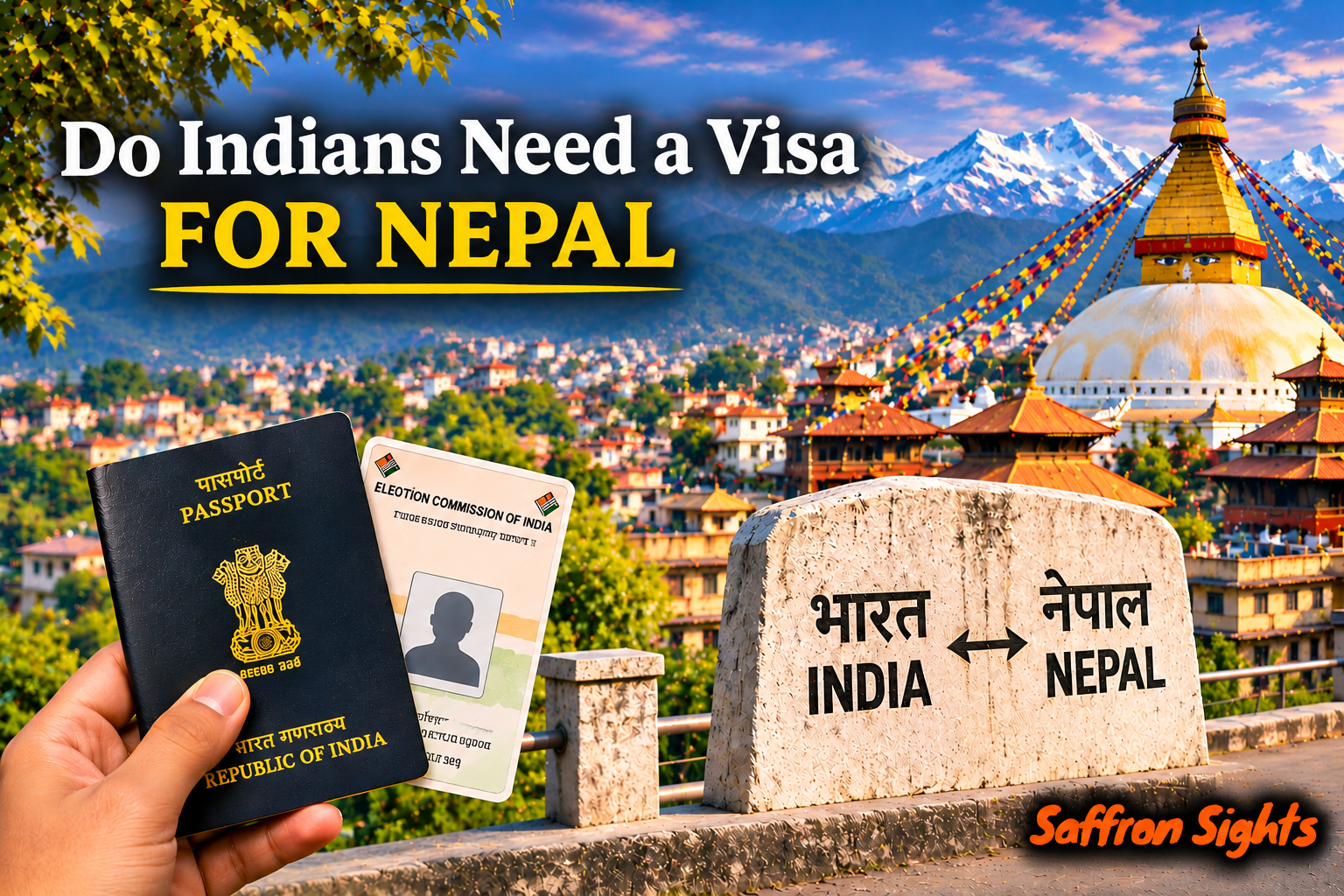

Short answer: No. Indian citizens do not need a visa to enter Nepal, and there is no fixed limit on how long an individual visitor can stay. You still need valid proof of nationality: carry a passport or a voter ID (original, not a photocopy). By air, a passport is the safest choice because airlines apply their own check-in rules. Indian rupee notes of ₹100 and below can be carried freely, and ₹200 and ₹500 notes are allowed up to a total of ₹25,000.
This page is a rule box first and an explanation second. Immigration and currency rules are the part of a Nepal trip most likely to change, so every claim below is dated and linked to its source. For the full trip plan, go to the Nepal Travel Guide for Indians.
Introduction: what the rule is, where it applies and why it matters
Indian citizens do not need a visa to enter Nepal. The rule applies at every land border crossing and at Kathmandu airport, and it is the reason a trip to Nepal feels closer to a domestic holiday than a foreign one for many Indian families. The border itself is 1,751 km long and runs through five Indian states (Uttarakhand, Uttar Pradesh, Bihar, West Bengal and Sikkim), according to Wikipedia. What matters in practice is not a visa but proof of nationality: a passport or another accepted photo ID, which this guide covers in detail below.
Origin: where the visa-free arrangement comes from
The arrangement traces to the Indo-Nepal Treaty of Peace and Friendship, signed in Kathmandu on 31 July 1950 and effective the same day. Wikipedia names the signatories as Mohan Shamsher Jang Bahadur Rana, the last Rana Prime Minister of Nepal, for Nepal, and Chandreshwar Prasad Narain Singh, India’s ambassador to Nepal, for India. Article 7 grants each country’s nationals reciprocal privileges in residence, property ownership, trade and commerce, and movement. Wikipedia says this is what allows citizens to cross without passports or visas, although it also notes that Nepalese law does not provide for a fully open border, so ID checks and rules for vehicles and goods still apply.
The boundary itself is older. The 1816 Treaty of Sugauli, signed after Nepal lost the Anglo-Nepalese War (1814 to 1816), set the modern boundary and ceded large areas to the British East India Company; the British later returned parts of the Terai (Wikipedia, India-Nepal border). A 1923 treaty between Nepal and Britain then recognised perpetual peace and friendship, and the 1950 treaty replaced that British-era framework (Wikipedia).
Purpose and motive: why the treaty was signed
Wikipedia says the treaty was meant to strengthen ties and maintain peace and to build a close strategic, defence and foreign-policy relationship. India was concerned about the rise of Communist China and its invasion of Tibet, while the Rana rulers feared Chinese support for Nepal’s Communist Party. The free-movement clause served a practical purpose too: communities on both sides of the Terai and the hills had long traded, married and worked across the line, and Article 7 protected that.
Historical context: seven decades of the same rule
| Year | Event | Source |
|---|---|---|
| 1816 | Treaty of Sugauli sets the boundary after the Anglo-Nepalese War | Wikipedia |
| 1923 | Nepal-Britain treaty of perpetual peace and friendship | Wikipedia |
| 1950 | Indo-Nepal Treaty signed on 31 July; Rana rule ends about three months later | Wikipedia |
| 1952 | A Communist Party of Nepal uprising attempt; India and the Rana regime expand military cooperation | Wikipedia |
| 1975 | After India’s annexation of Sikkim, Nepal proposes a “Zone of Peace” and seeks renegotiation; India does not endorse it | Wikipedia |
| 1987 and 2015 | Border blockades strain relations | Wikipedia (India-Nepal border) |
| 2008 | Maoist leader Pushpa Kamal Dahal says the treaty will be scrapped but does not pursue it | Wikipedia |
| 2014 | India and Nepal agree to “review” and “adjust” the treaty | Wikipedia |
| January 2021 | Foreign Minister Pradeep Kumar Gyawali calls for review and revision | Wikipedia |
Many Nepalese view the treaty as unequal, arguing that it encroaches on sovereignty, was signed under an undemocratic regime and benefits Indians in Nepal (Wikipedia). Advocacy groups in the Terai and Bihar, such as the Nepal India Open Border Dialogue Group, push for the border to stay open. None of this has changed the visa rule for travellers so far.
Stories and legends: myths about the open border
There is no legend attached to a visa rule, but there are common myths. The first is that “no visa” means “no documents.” It does not; Indian visitors are expected to carry accepted ID, and Nepalese immigration can ask for it. The second is that the open border applies equally to vehicles; it does not, and Indian-registered vehicles need a customs pass (see India to Nepal by Bike). A third is that the border is fenced; Wikipedia says there are no fences along most of the border, which is why there are many small official and unofficial crossings. An unusual human detail from the same page: Byansi communities on both sides of the border share landholding and a common system of five mukhiyas (local leaders).
Literary references: the texts behind the rule
The key documents are the Treaty of Sugauli (1816), the 1923 Nepal-Britain treaty and the 1950 Treaty of Peace and Friendship, which has ten articles. Wikipedia quotes Article 1 as establishing “everlasting peace and friendship.” For further reading, look at the full treaty text on the Ministry of External Affairs and Nepal’s foreign ministry sites; our sources summarise rather than quote the full text.
Past, present and future
In the past the rule served Rana-era and Cold War strategic concerns. Today it supports a large tourism flow: an Ekantipur report dated 28 June 2026 says about 2,500 vehicles carrying Indian tourists enter Nepal per day through six border points. Rules for vehicles are being modernised, with India and Nepal discussing a digital cross-border vehicle permit system (Kathmandu Post, 5 October 2026). The treaty itself remains under review debates. For travellers, the likeliest future change is not a visa but tighter ID and vehicle checks; verify the position before each trip.
Educational value: key facts for students and competitive exams
- The Indo-Nepal Treaty of Peace and Friendship was signed on 31 July 1950 in Kathmandu.
- It has ten articles; Article 7 covers reciprocal rights of residence, property, trade and movement.
- It remains in force until either party gives one year’s notice (Article 10).
- The India-Nepal border is 1,751 km long and touches Uttarakhand, Uttar Pradesh, Bihar, West Bengal and Sikkim.
- The Treaty of Sugauli (1816) ended the Anglo-Nepalese War.
- Disputed areas include Kalapani (about 35 sq km at the India-Nepal-China trijunction) and Susta (20 to 140 sq km, per Wikipedia).
- Major crossings: Sunauli-Belahia, Raxaul-Birgunj (“Gateway of Nepal”), Panitanki-Kakarbhitta, Jogbani-Biratnagar, Banbasa-Dodhara Chandani and Rupaidiha-Nepalgunj.
Fun facts
- Tens of thousands of people cross the border each day for trade and tourism (Wikipedia).
- Raxaul-Birgunj is known as the “Gateway of Nepal.”
- Indian visitors need no visa, but Indian banknotes above Rs 100 are not accepted in Nepal; see Indian Currency in Nepal.
Additional insights
The most useful way to think about “no visa” is as a presumption that you can prove who you are. Carry the document you will actually be asked for, keep a photocopy and a phone photo as backup, and carry separate ID for children. If you plan to drive in, plan the vehicle paperwork before you reach the border rather than at it.
At a glance: Nepal entry rules for Indians (checked 31 October 2026)
| Question | Answer | Source and date |
|---|---|---|
| Visa required? | No | Nepal Tourism Board statement, 14 May 2026 (reported by ETV Bharat) |
| Time limit on stay? | None fixed for an individual visitor | Same statement |
| Accepted ID | Passport or voter ID | Nepalese Embassy, New Delhi, as quoted by HappyFares |
| Aadhaar, PAN, driving licence | Not officially recognised for entry; do not rely on them | Secondary reports; confirm with the Embassy |
| Indian currency | ₹100 and below unlimited; ₹200 and ₹500 up to ₹25,000 in total | RBI notification of 28 Nov 2025; Nepal cabinet decision of 15 Dec 2025 (IANS) |
| Own vehicle | Customs pass needed; up to 30 days per calendar year | Indian Embassy, Kathmandu notice (9 Aug 2019); Nepal Tourism Board, May 2026 |
Reminder: These are the rules we could verify on the date above. Print or screenshot the official page before you travel, because border officers decide on the day.
Do Indians need a visa for Nepal?
Indians do not need a visa. Under the long-standing open-border arrangement between India and Nepal, Indian citizens can enter, stay and travel in Nepal without a visa. In May 2026, a wave of social-media reports claimed that new time limits or visa requirements were coming for Indians. The Nepal Tourism Board publicly called those reports “entirely false and baseless” on 14 May 2026 and said the open-border arrangements remain in place.
Two ideas often get mixed up, so keep them apart:
- Visa-free means you do not apply to Nepal for permission to enter.
- ID-free it is not. You must still prove you are an Indian citizen.
Foreign passport holders, including people who are of Indian origin, are in a different position. If you hold an OCI card or a non-Indian passport, the visa-free rule for Indian citizens does not automatically apply to you, so check with the Nepalese Embassy before you book.
Which ID is accepted by air and by land?
By air
Carry a passport. The Nepalese Embassy in New Delhi says Indians can travel with a passport or a voter ID, but airlines set their own check-in policies and a passport removes any doubt at the counter. If you plan to fly to Kathmandu, Pokhara or Bhairahawa (for Lumbini), treat the passport as mandatory in practice.
By land
Checks at land crossings are more relaxed, but you should still carry the original passport or voter ID. Photocopies and phone photos are risky. If you are travelling with family, every adult should have their own document.
What about Aadhaar, PAN and a driving licence?
These are reported as not officially recognised for entry. Some border officers may accept them informally, but that is luck rather than a rule. Keep them as secondary ID only. Because we found the Aadhaar position only in secondary sources, confirm it on the Embassy of Nepal’s website before you travel.
| Document | By air | By land | Our advice |
|---|---|---|---|
| Passport | Accepted | Accepted | Best option |
| Voter ID (original) | Accepted by the Embassy, but airline may insist on passport | Accepted | Good for road trips |
| Aadhaar | Not officially recognised | Informal, not guaranteed | Carry as backup only |
| PAN or driving licence | Not recognised | Not recognised | Backup only |
| OCI card with foreign passport | Different rules | Different rules | Check with the Embassy |
What do children and senior citizens need?
Children: Carry the child’s birth certificate and a parent’s ID. If the child has a passport, that is the simplest document. If a child travels without both parents, or with someone who is not a parent, carry a letter of consent and ask the airline and the Embassy what they require. Unaccompanied minors need extra documentation.
Senior citizens: The ID rules are the same as for any adult. The practical issues are different: carry the passport or voter ID in a safe, easy-to-reach pocket, keep a printed list of medicines with their generic names, and if the trip includes high places such as Muktinath, read the altitude advice in Nepal Trip with Elderly Parents.
How much money can you carry, and in which notes?
Until December 2025, carrying Indian notes above ₹100 into or out of Nepal was illegal. The rule changed in two steps:
- The Reserve Bank of India notified on 28 November 2025 that most travellers may carry notes above ₹100 up to ₹25,000 between India and Nepal or Bhutan.
- On 15 December 2025, Nepal’s cabinet allowed citizens of Nepal and India to carry ₹200 and ₹500 notes when travelling between the two countries (IANS report).
What that means for you:
- ₹100 notes and smaller: carry freely.
- ₹200 and ₹500 notes: keep the total within ₹25,000.
- ₹2,000 notes: avoid. The RBI withdrew them in 2023, and Nepal does not accept them.
- Nepali rupees (NPR): get them from an ATM or a licensed money-changer. Trek permit counters and many small shops use only NPR.
The rate used in third-party guides is roughly NPR 1.60 for every ₹1. For a longer explanation and for what to do with leftover cash, see Indian Currency in Nepal.
Can you take your own car or bike?
Yes, with a customs pass. An Indian Embassy notice dated 9 August 2019 says a vehicle can visit the nearest town on a day pass without paying customs duty, provided it is registered at the border and returns the same day. For longer stays, the vehicle must be registered for a fixed number of days at ₹100 to ₹500 per day by vehicle type, up to 30 days in a calendar year.
Things have been changing. In May 2026 the Nepal Tourism Board said vehicles can get a 30-day entry permit that can be renewed for a fee. In October 2026 the Kathmandu Post reported that Nepal and India had agreed in August to digitise cross-border vehicle permits, with several months of preparation still to come. Expect the process to change and check before you ride or drive. We keep the detail in India to Nepal by Road and India to Nepal by Bike so this page stays short.
What happens at the border?
Most Indian travellers cross at one of the road border towns used for Lumbini, Janakpur and the Kathmandu route. On a typical crossing:
- You pass the Indian check post and walk or drive across the boundary.
- Security personnel may check your ID and bags. Officers may ask where you are going and for how long.
- If you are driving, you stop at the customs desk to register the vehicle and get the pass.
- You collect your NPR if you have not already changed money.
- On the way out, you return the vehicle pass and may be asked about any goods you are carrying.
Carry your documents in one pouch, keep a printout of the booking for your first night, and be polite. A calm, prepared traveller is rarely delayed for long.
What items are restricted?
The usual advice is to avoid anything that can look like trade goods or controlled items. Gold, large quantities of electronics, drones and satellite phones may need extra permission, and some prescription medicines need a doctor’s note. We have not confirmed current duty-free limits from an official page, so check the Nepal Customs and Indian Customs websites for exact limits, especially for drones, cameras, gold and alcohol. Treat anything above personal use as a risk.
What are the most common mistakes?
- Assuming Aadhaar will be enough. Carry a passport or voter ID.
- Carrying photocopies. Officers can insist on the original.
- Ignoring the ₹25,000 limit for ₹200 and ₹500 notes. Cash can be seized or you can be fined.
- Carrying ₹2,000 notes. They are no longer legal tender in India and are not accepted.
- Skipping the vehicle pass. An unregistered vehicle can be treated as illegally imported and seized.
- Believing rumours. Social-media posts claiming new visa fees or time limits appear every few months. Check the Nepal Tourism Board and the Embassy before changing plans.
- Not allowing a buffer. Border towns, local strikes and festival crowds can add hours.
- Overstaying a vehicle pass. Ask for an extension at the nearest customs office before the pass expires.
Update log
| Date | Change |
|---|---|
| 31 Oct 2026 | Rule box checked against May 2026 Nepal Tourism Board statement, Dec 2025 currency decisions and Oct 2026 vehicle permit report |
Frequently asked questions
Do Indians need a visa for Nepal?
No. Indian citizens can enter Nepal without a visa, and the Nepal Tourism Board said in May 2026 that there is no fixed limit on an individual visitor’s stay. You must still show proof of nationality, such as a passport or an original voter ID, when you enter.
Is Aadhaar enough to enter Nepal?
Not officially. The Nepalese Embassy says Indians can travel with a passport or voter ID, and Aadhaar is reported as not recognised. Some border officers may accept it informally, but you should carry a passport or voter ID as your main document.
What documents do children need?
Carry the child’s birth certificate and a parent’s ID, or the child’s passport. If a child travels without both parents, take a signed consent letter and confirm with your airline and the Embassy. Unaccompanied minors need extra paperwork.
Do I need a passport to fly to Nepal?
A passport is the safest option. The Embassy accepts a passport or voter ID, but airlines set their own check-in rules and may insist on a passport. If you fly from India, carry a valid passport to avoid being refused at the counter.
How much Indian currency can I carry?
Notes of ₹100 and below are unlimited. ₹200 and ₹500 notes are allowed up to ₹25,000 in total, following the RBI notification of 28 November 2025 and Nepal’s decision of 15 December 2025. Do not carry ₹2,000 notes.