
By Saffron Sight · Nepal Travel Hub · Last updated 31 October 2026
Short answer: Indian citizens do not need a visa to enter Nepal, and there is no fixed limit on how long an individual visitor can stay. Carry a passport or a voter ID, spend Indian rupees (notes of ₹100 and below freely, ₹200 and ₹500 notes within a ₹25,000 limit), and choose between flying (under two hours from Delhi), the train to a border town followed by a road crossing, or driving your own vehicle on a Nepali customs pass. October–November and March–May are the best months for most trips.
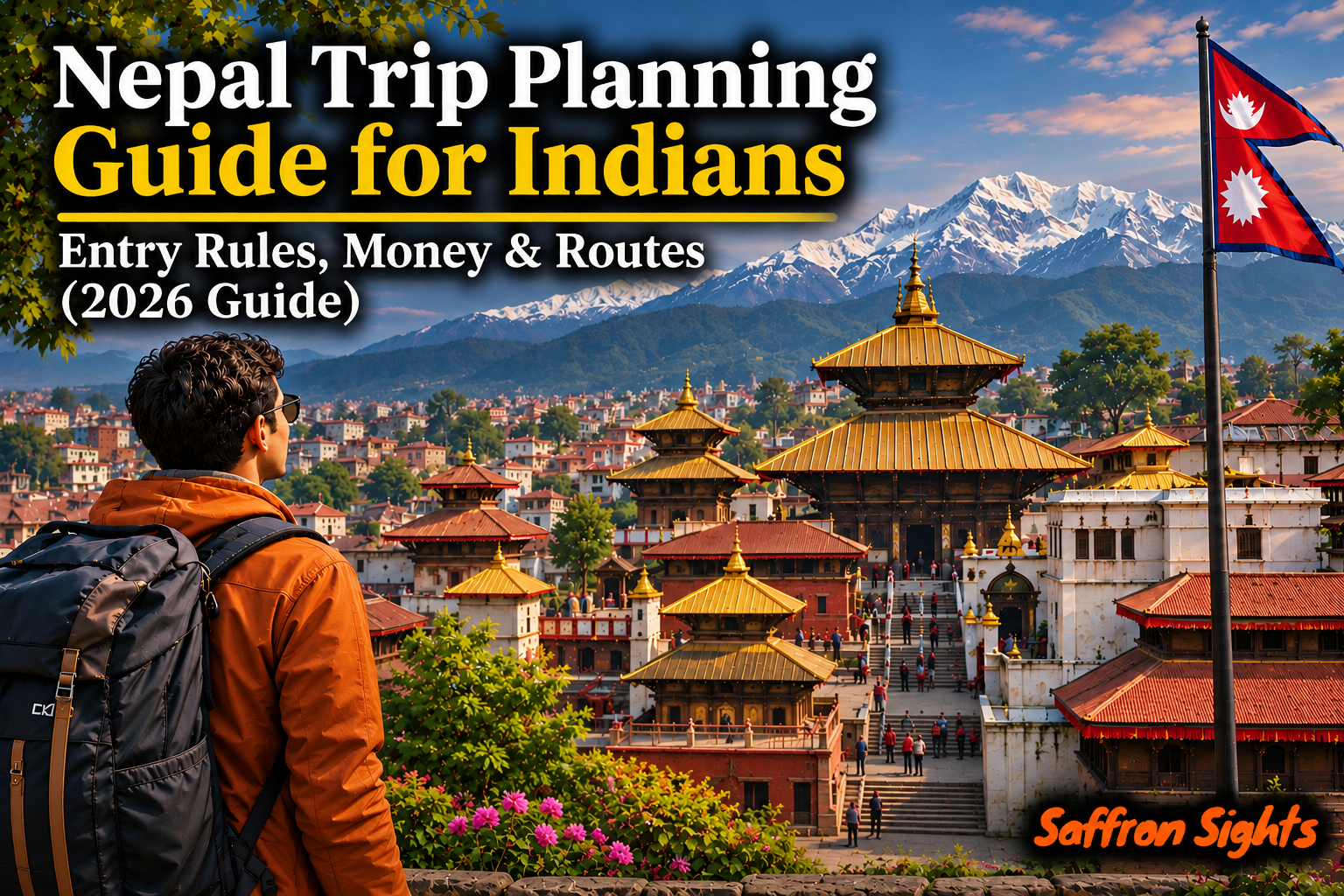
Nepal is the one foreign country where an Indian family can decide on Thursday and be in Kathmandu by Saturday. That ease is also why trips go wrong. People treat the border like a state line and then discover that ID rules, vehicle passes, currency limits, festival crowds and altitude all work differently on the other side. This guide is the hub of the Saffron Sight Nepal series. It covers what you must settle before you book (entry, ID, money, transport), how to choose where to go, three day-by-day sample plans, and the mistakes that cost Indian travellers the most time and money. Every place and topic links to its own detailed guide.
Nepal trip planning at a glance
| Question | Answer (as of 31 October 2026) |
|---|---|
| Visa needed for Indians? | No. Open-border arrangements remain in place. |
| Stay limit? | No fixed limit for individual visitors (Nepal Tourism Board statement, 14 May 2026). |
| Accepted ID | Passport or voter ID. Aadhaar is not officially recognised; do not rely on it. |
| Currency | Indian rupee widely accepted; Nepali rupee (NPR) is local currency, at roughly NPR 1.60 per ₹1. |
| INR note limits | ₹100 and below: no limit. ₹200 and ₹500: allowed up to ₹25,000 after the December 2025 change. |
| Own vehicle | Customs pass needed; up to 30 days per calendar year; ₹100–500 per day by vehicle type (embassy notice from 2019, confirm before travel). |
| Best months | October–November and March–May |
| Altitude | Kathmandu about 1,400 m; Pokhara about 820 m; Lumbini about 150 m; Muktinath about 3,700 m |
| Time zone | Nepal Standard Time is 15 minutes ahead of IST |
| Flight time | Delhi to Kathmandu is under two hours |
Do Indians need a visa or passport for Nepal?
Indians do not need a visa. Under the long-standing open-border arrangement between the two countries, Indian citizens can enter, stay and, in most cases, travel freely in Nepal without a visa. On 14 May 2026 the Nepal Tourism Board publicly rejected reports of new time limits, visa requirements or restrictions on Indian visitors as “entirely false and baseless”, and said the open-border arrangements remain in place.
Visa-free does not mean ID-free. The Nepalese Embassy in New Delhi says Indians can travel with a passport or a voter ID. The practical rules look like this:
- By air: Carry a passport. Airlines apply their own check-in policies, and a passport is the safest document. A voter ID is the other officially accepted option.
- By land: Checks are more relaxed, but treat the passport or voter ID as your primary document and carry the original, not a photocopy.
- Aadhaar, PAN and driving licence: Reported as not officially recognised for entry. Some border officers may accept them informally, but you should not plan around that. Keep them as secondary ID.
- Children: Carry the child’s birth certificate and a parent’s ID. Unaccompanied minors need extra documentation, so check with the airline or the Embassy.
- OCI and other non-citizens: The visa-free rule applies to Indian citizens. If you hold an OCI card or a foreign passport, confirm your status with the Nepalese Embassy before booking.
- Work or long stays: This guide covers tourism. For work, study or a long stay, confirm the permit position with the Embassy of India, Kathmandu.
Detailed rules, edge cases and the mistakes that get travellers turned back are in Do Indians Need a Visa for Nepal?
How do you reach Nepal from India?
There are three practical routes, and each suits a different traveller.
By air
Flights connect several Indian cities with Kathmandu, and the Delhi–Kathmandu sector takes under two hours. Pokhara has an international airport, and Bhairahawa (for Lumbini) has one too, so you can plan an open-jaw trip, such as arriving in Kathmandu and leaving from Pokhara or Bhairahawa. Flying is the right choice for seniors, families with young children, short trips and anyone heading straight to the mountains. Book early for October–November, when fares and hotels peak. Check current direct routes from your city before you plan, as airlines add and drop services.
By train and road
For budget travellers and pilgrims, the rail-plus-road route is the classic option. You take a train to a border railhead, cross, and continue by bus, shared jeep or taxi.
| Border crossing | Indian railhead | Nepal side | Best for |
|---|---|---|---|
| Sunauli | Gorakhpur (UP) | Bhairahawa, then Lumbini, Pokhara | Lumbini first, Buddhist circuit, western Nepal |
| Raxaul | Raxaul (Bihar) | Birgunj, then Kathmandu | Fastest road link to Kathmandu |
| Jogbani | Jogbani (Bihar) | Biratnagar | Eastern Nepal, Koshi Tappu |
| Panitanki | New Jalpaiguri or Siliguri (WB) | Kakarbhitta, then Ilam | Ilam, eastern hills, combining with Darjeeling |
| Rupaidiha | Nanpara (UP) | Nepalgunj | Bardia National Park |
| Banbasa | Tanakpur (Uttarakhand) | Mahendranagar | Far-western Nepal |
Road journeys in Nepal are slow. A rule of thumb is to budget six to eight hours for what looks like 200 km on a map. Night buses are cheap but tiring; for families, a private car with a driver from the border is worth the extra cost. Step-by-step guides: Lumbini from India and How to Reach Nepal from India: Road, Train and Flight Compared.
By your own vehicle
You can drive or ride your own vehicle, but it must be registered with Nepali customs. The Indian Embassy in Kathmandu describes two types of pass:
- Day pass: A vehicle can visit the nearest Nepali town or market for one day without paying customs duty, provided the owner registers it at the border check post and gets a day pass or challan. The vehicle must return the same day, and the pass is handed back to Nepal Customs at Bhansar on the way out.
- Longer stay: A vehicle going beyond the nearest town or staying overnight must register for a set number of days. The embassy notice says charges are NRs 100–500 per day depending on vehicle type, and the vehicle may stay up to 30 days in total per calendar year.
If you overstay, you must seek an extension before your pass expires, at the nearest Nepal Customs office (Bhansar). A vehicle without a valid pass can be treated as illegally imported and seized. The Nepal Tourism Board said in May 2026 that vehicles can receive a 30-day entry permit that can be renewed for a fee, and described an online facilitation system for visitors arriving by land with private vehicles. In October 2026 the Kathmandu Post reported that Nepal and India had agreed in August to digitise cross-border vehicle permits, with several months of preparation still to come, so expect the process to change. Always carry the pass where police can inspect it. Riders should also read India to Nepal by Bike.
Which route should you pick?
| If you are… | Best route |
|---|---|
| A family with children or seniors on a 5-day trip | Fly into Kathmandu |
| A pilgrim or Buddhist-circuit traveller | Train to Gorakhpur, cross at Sunauli, start at Lumbini |
| A road-tripper with a car or bike | Own vehicle with a customs pass; plan around the 30-day yearly cap |
| A budget traveller with 10 days | Train plus road in, fly back |
| Travelling from North Bengal or Sikkim | Cross at Kakarbhitta to Ilam, then fly or drive on |
How does money work for Indians in Nepal?
Indian rupees are widely accepted in Nepal, especially in tourist areas and border towns, and the Nepali rupee is the legal currency. The two currencies have been linked at a fixed rate for decades; a recent third-party guide uses roughly NPR 1.60 per ₹1. Prices in Kathmandu and Pokhara are often quoted in both.
The note-size rule
The rule that confuses most travellers concerns note size. Until December 2025, carrying Indian notes above ₹100 into or out of Nepal was illegal. On 15 December 2025 Nepal’s cabinet allowed citizens of Nepal and India to carry ₹200 and ₹500 notes while travelling between the two countries, following a Reserve Bank of India notification dated 28 November that lets most travellers carry notes above ₹100 up to ₹25,000 between India and Nepal or Bhutan. In practice:
- Carry ₹100 and smaller notes for everyday spending; there is no limit on them.
- Keep ₹200 and ₹500 notes within the ₹25,000 limit in total.
- Do not carry ₹2,000 notes. The RBI withdrew them in 2023, and unexchanged older high-denomination notes remain stuck in Nepal’s banking system.
- Some shopkeepers may still be wary of large notes, so keep a mix.
Practical money tips
- Nepali rupees. Use an ATM or a licensed money-changer for NPR. Permit counters on treks often accept only NPR, so change money before you queue.
- ATM fees. ATMs in Nepal charge a fee per withdrawal and have per-transaction limits, so withdraw larger amounts less often.
- Small cash. Keep small notes for buses, temple donations, tips and border towns.
- Cards and UPI. Cards are accepted in hotels and larger restaurants in Kathmandu and Pokhara but not in villages. Digital payment links between India and Nepal have been expanding, so check whether your UPI app works abroad before relying on it.
- Carrying NPR back. Indians can reportedly carry only a limited amount of Nepali currency (about NPR 25,000) back to India, so avoid leftover cash.
Full explainer: Indian Currency in Nepal. For budgets by trip length, see Nepal Trip Cost from India.
When is the best time to visit Nepal?
Nepal has four seasons that shape what is possible.
| Months | Season | What to expect |
|---|---|---|
| October–November | Autumn | Clearest skies, best mountain views, busiest and most expensive; Dashain and Tihar bring crowds |
| December–February | Winter | Cold nights, very clear mornings; Terai wildlife parks and Lumbini are pleasant; high passes may close |
| March–May | Spring | Rhododendron blooms in the hills, warm days; haze builds by May |
| June–September | Monsoon | Heavy rain, landslides, leeches, cloud-covered mountains; Mustang and Dolpo are in the rain shadow |
October–November is the first choice for first-timers and families who want views. March–May is a close second. For temples, Lumbini and Kathmandu, the monsoon is workable if you accept rain. Month-by-month detail, including festival dates, is in Best Time to Visit Nepal and the Nepal Festivals Calendar.
Where should you go in Nepal by interest?
Pick your anchor places by interest first, then add logistics.
| If you love… | Go to | Start here |
|---|---|---|
| Temples and pilgrimage | Kathmandu Valley, Muktinath, Janakpur | Pashupatinath, Muktinath, Janaki Mandir |
| Buddhist heritage | Lumbini, Boudhanath, Swayambhunath | Lumbini, Boudhanath |
| UNESCO heritage and architecture | Kathmandu Valley’s seven zones | Kathmandu Valley UNESCO Sites |
| Lakes and mountain views | Pokhara | Places to Visit in Pokhara |
| Trekking | Annapurna, Everest, Langtang | Best Treks in Nepal |
| Wildlife | Chitwan, Bardia | National Parks in Nepal |
| Festivals and culture | Kathmandu Valley | Nepal Festivals Calendar |
| Quiet hill towns | Bandipur, Tansen, Gorkha | Offbeat Places in Nepal |
Temples and pilgrimage
Nepal’s most important Hindu sites for Indian visitors are Pashupatinath in Kathmandu, Muktinath in Mustang, Janaki Mandir in Janakpur and Budhanilkantha near Kathmandu. Pashupatinath’s inner sanctum is restricted to Hindus, though Indian nationals enter the complex free, according to a 2026 visitor guide. Muktinath is sacred to both Hindus and Buddhists and sits at about 3,700 m, so altitude planning matters. Read Pashupatinath Temple Visit Guide and Muktinath Yatra from India.
Buddhist heritage
Lumbini, the Buddha’s birthplace, is a short distance from the Sunauli border, which makes it the natural first stop for Indian pilgrims. Pair it with Ramagrama and Tilaurakot, then continue to the stupas of Kathmandu. The wider picture is in Buddhist Circuit in Nepal and India.
Mountains without trekking
You do not need to trek to see the Himalaya. Sarangkot and the World Peace Pagoda near Pokhara, Nagarkot and Dhulikhel near Kathmandu, and the Everest and Annapurna mountain flights all give views. For genuine walking, start with the easiest options in the Best Treks in Nepal guide.
What are good 5, 7 and 10-day Nepal plans?
These are templates. Add a buffer day if you travel in monsoon or festival season.
5 days: Kathmandu and Pokhara by air
| Day | Plan |
|---|---|
| 1 | Arrive Kathmandu; Boudhanath at dusk |
| 2 | Pashupatinath in the morning; Kathmandu Durbar Square and Kumari Ghar |
| 3 | Swayambhunath, Patan; evening flight or drive to Pokhara |
| 4 | Phewa Lake and Tal Barahi; Old Bazaar |
| 5 | Sarangkot sunrise; fly back |
Details: Kathmandu Valley in 3 Days and Pokhara 3-Day Itinerary.
7 days: the classic first-timer loop
| Day | Plan |
|---|---|
| 1–3 | Kathmandu Valley: Boudhanath, Pashupatinath, Durbar Squares, Patan, Bhaktapur |
| 4 | Travel to Pokhara; lake evening |
| 5 | Sarangkot sunrise, caves and falls, World Peace Pagoda |
| 6 | Travel to Chitwan; afternoon village walk |
| 7 | Morning safari; return |
Full plan: Nepal 7-Day Itinerary.
10 days: Buddhist and heritage circuit by road
| Day | Plan |
|---|---|
| 1 | Cross at Sunauli; Lumbini |
| 2 | Lumbini monastery zone, Maya Devi Temple, Ashoka Pillar |
| 3 | Ramagrama or Tilaurakot; travel to Tansen or Pokhara |
| 4–5 | Pokhara: lake, caves, pagoda, Sarangkot |
| 6 | Bandipur or Gorkha on the way to Kathmandu |
| 7–9 | Kathmandu Valley, Bhaktapur, Changu Narayan |
| 10 | Nagarkot or Dhulikhel sunrise; fly out |
Slow down wherever you can. One major activity a day and one slack day make a trip feel like a holiday rather than a race.
What does a Nepal trip cost for an Indian traveller?
Costs depend mostly on season, transport mode and activities, so treat any single “per day” figure with caution. In general:
- Cheapest: Rail and bus, guesthouses and local food, mostly inside Kathmandu Valley and Lumbini.
- Mid-range: Flights between cities, three-star hotels, a guide for a day or two, and a Chitwan safari package.
- Most expensive: Festival-season Kathmandu hotels, helicopter flights, mountain flights, treks with flights to Lukla or Jomsom.
Costs that surprise Indian travellers: entry fees at heritage sites (Indians usually pay SAARC rates, and Pashupatinath is free for Indians, but rates vary and carrying proof of nationality matters), airport taxis, trekking permits (Indian rates are lower than foreigner rates), and mountain-flight cancellations that add nights. See Nepal Trip Cost from India for budgets by 5, 7 and 10 days.
What should you know about health, safety, etiquette and altitude?
Health
Carry basic medicines, rehydration salts and any prescription drugs in original packaging. Drink bottled or filtered water. Buy travel insurance, and if you plan to trek or visit Muktinath, check that it covers altitude and helicopter evacuation.
Safety
Nepal is generally welcoming for Indian visitors. Use registered taxis or hotel-arranged cars, agree fares first, keep copies of your ID, and check road conditions in monsoon, when landslides close highways. Do not leave valuables unattended on buses.
Etiquette
- Remove shoes before entering temples and homes.
- Walk clockwise around stupas and spin prayer wheels clockwise.
- Dress modestly; cover shoulders and knees at religious sites.
- Ask before photographing people, priests or cremations.
- Some temple interiors are restricted to Hindus or Buddhists.
- Avoid public displays of anger; calm negotiation works better.
Altitude
Kathmandu and Pokhara are low enough for most people. Muktinath (about 3,700 m) and any trek can cause altitude sickness. Ascend gradually, drink water, avoid alcohol on arrival at height, and descend if symptoms worsen. See Altitude Sickness in Nepal. Seniors should read Nepal Trip with Elderly Parents.
What mistakes should Indian travellers avoid?
- Assuming Aadhaar will do. Carry a passport or voter ID.
- Carrying ₹2,000 notes or too many ₹500 notes. Respect the ₹25,000 limit for ₹200 and ₹500 notes.
- Skipping the vehicle pass. An unregistered car or bike can be seized.
- Booking too tight. Roads and mountain flights are unpredictable; keep a buffer day.
- Travelling during Dashain or Tihar without booking. Buses and hotels sell out, and offices and shops close. See the Nepal Festivals Calendar.
- Underestimating Muktinath’s altitude. Seniors especially should plan acclimatisation or a helicopter option.
- Expecting every temple to be open to everyone. Check access rules before you travel.
- Not carrying proof of nationality for fee discounts. SAARC and Indian rates need ID.
Frequently asked questions
Is Nepal cheap for Indian tourists?
Nepal is generally good value for Indians because rupees are accepted and the two currencies are linked, but costs vary. Guesthouses and local food are cheap, while flights, safaris, treks and festival-season Kathmandu hotels are not. Season and activities drive the total more than the exchange rate does.
Which ID is accepted for Indians entering Nepal?
The Nepalese Embassy in New Delhi says Indians can travel with a passport or a voter ID. Airlines may insist on a passport at check-in. Aadhaar is reported as not officially recognised, though some land crossings accept it informally, so carry a passport or voter ID as your main document.
Can Indians take their own vehicle to Nepal?
Yes, with a customs pass. An Indian Embassy notice says vehicles can stay up to 30 days per calendar year at NRs 100–500 per day depending on type, with day passes for short trips. Nepal said in May 2026 that a 30-day permit can be renewed for a fee. Without a pass, the vehicle can be seized.
Which month is best for an Indian family trip?
October–November gives the clearest mountain views and mild weather, and March–May is the second best, with blooming hills. Book early for Dashain and Tihar. Avoid June–September for hill travel because of landslides, unless you stay in Lumbini or Kathmandu.
Do Indians need a visa for Nepal?
No. Indian citizens can enter Nepal without a visa and there is no fixed limit on an individual visitor’s stay, according to the Nepal Tourism Board in May 2026. You still need a passport or voter ID. OCI and foreign-passport holders should check their status with the Nepalese Embassy.
Can I use Indian rupees in Nepal?
Yes. Indian rupees are widely accepted. Notes of ₹100 and below can be carried freely, while ₹200 and ₹500 notes are allowed within a ₹25,000 limit since December 2025. Avoid ₹2,000 notes, which the RBI withdrew in 2023.