
The 108 Water Spouts and a Shrine at 3,710 m
What Is Muktinath Temple?
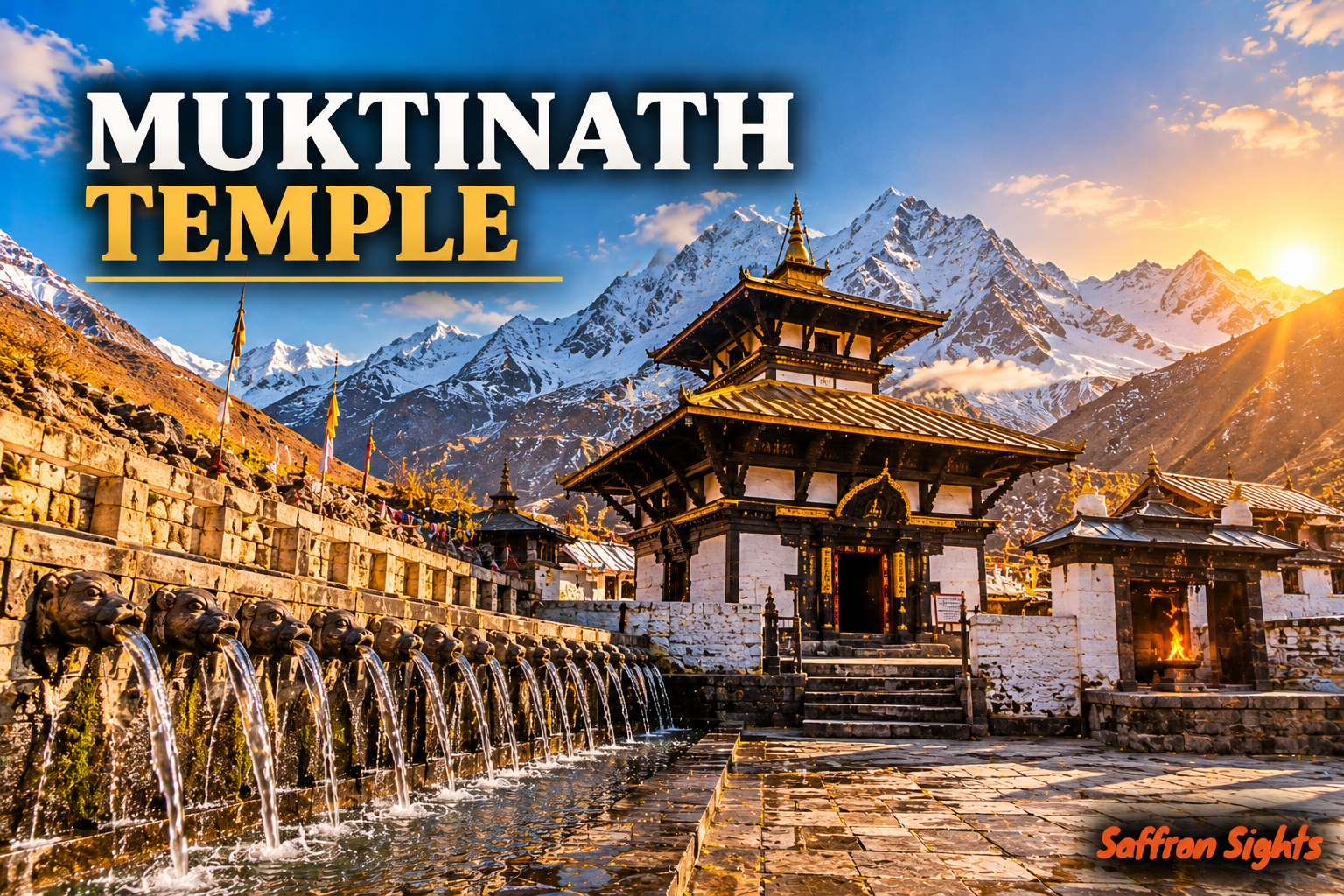
Picture a small pagoda in a cold, dry mountain valley, with snow peaks all around. Behind it, 108 stone water spouts pour ice-cold water. Next door, a small shrine holds a flame that burns beside water. This is Muktinath Temple.
Muktinath is in the Mustang District of Nepal, at the foot of the Thorong La mountain pass. Its height is about 3,710 m (12,172 ft) on the temple’s own website. The Nepal Tourism Board (NTB) gives 3,800 m. So the safe way to write it is “about 3,700–3,800 m.”
The name has two parts: Mukti means liberation or salvation, and Nath means lord. Muktinath means “Lord of Liberation.”
What makes it special is that two faiths share it. Hindus worship the main deity as Lord Vishnu. Tibetan Buddhists revere the same deity as Avalokiteshvara (Chenrezig), the bodhisattva of compassion. Hindu priests and Buddhist caretakers both serve here.
Quick facts
- Location: Ranipauwa, Muktichhetra Rural Municipality, Mustang, Nepal
- Altitude: about 3,710 m (temple site) to 3,800 m (NTB)
- Hindu name: Mukti Kshetra (“field of liberation”)
- Buddhist name: Chumig Gyatsa (“Hundred Waters”)
- Water spouts: 108
- Sacred pools (kunds): 2
- Nearby pass: Thorong La, about 5,400 m (sources vary: 5,380 to 5,416 m)
Origin: Who Built Muktinath Temple, and When?
There is no firm record of one founder or one founding year, so any claim like “7,000 years old” has no reliable source.
- Current pagoda: NTB says it is believed to date to the early 19th century.
- Main Vishnu idol: traditionally dated to the 16th century.
- Earlier shrine: presumed. Pilgrims have likely worshipped here for much longer than the present building has stood.
So the pagoda is fairly young, while the sacred place is much older.
Purpose: Why Do People Come Here?
For Hindus, the purpose is moksha, freedom from the cycle of birth and death. Many believe that darshan and the ritual bath at Muktinath can help on that path. For Buddhists, it is a place of compassion, meditation and tantric practice. Tibetan Buddhism counts it among its 24 Tantric places.
Visitors fall into three groups:
- Pilgrims, mostly from Nepal and India.
- Trekkers, who reach it on the Annapurna Circuit after crossing Thorong La.
- Culture travellers, who come to see the shared Hindu-Buddhist worship.
Why Muktinath Is Sacred to Hindus
Mukti Kshetra and Vishnu
Hindus call Muktinath a Mukti Kshetra. NTB notes that the site appears in traditions linked to the Ramayana, the Baraha Purana and the Skanda Purana. Many Vaishnava traditions also list it among the 108 Divya Desams, the holy shrines of Vishnu. Since the other Divya Desams are in India, people often call Muktinath the only one outside it. Treat this as a religious classification and write “regarded by many Vaishnavas as…”
If you have read our story of Ashadhi Wari to Vitthal’s temple at Pandharpur, you will see a similar spirit. In both, people walk or climb long distances for a glimpse of the Lord. The difference is the air: Pandharpur is near sea level, and Muktinath is above 3,700 m.
The 108 Water Spouts (Muktidhara)
Behind the temple, 108 spouts shaped like bull or cow mouths (gaumukh) pour out spring water. Pilgrims walk under the streams as a ritual bath. The water is very cold, even in sunny weather.
Why 108? It is a sacred number in both Hindu and Buddhist practice. The exact reason differs by tradition, so no single explanation is universal.
Two Sacred Kunds
Two pools sit within the temple area. Pilgrims usually bathe in them before going under the spouts. (Many guides name them as Laxmi Kund and Saraswati Kund. Check the names on site.)
Shaligram Stones
The nearby Kali Gandaki River gives up black fossil stones called shaligrams. These are ammonite fossils, the shells of sea creatures that lived long before humans, and they are more than 100 million years old. Hindus worship them as natural forms of Vishnu. A black shaligram is kept in the temple.
Why fossils on a mountain? The Himalayas rose from the floor of an ancient sea called the Tethys. That is how shells of sea animals ended up in a high mountain river.
Why Muktinath Is Sacred to Buddhists
- Chumig Gyatsa (“Hundred Waters”): the Tibetan name, which points to its many springs.
- Chenrezig / Avalokiteshvara: Buddhists see the central deity as the bodhisattva of compassion.
- Guru Rinpoche (Padmasambhava): Tibetan tradition says he meditated here on his way to Tibet.
- 24 Tantric places: Muktinath is counted among them. Some descriptions link these places to the Dakinis, often called “sky dancers.”
- Mebar Lha Gomba (Jwala Mai): Buddhists revere the flame shrine, where fire burns beside water. They read it as a symbol of balance among the elements.
If you want to see how Buddhism lives in modern India, read our guide to Chaitya Bhoomi in Mumbai, the memorial of Dr. B.R. Ambedkar.
Jwala Mai: The Eternal Flame
Next to the main shrine stands the Jwala Mai Temple. Inside, a small blue flame burns beside a spring of water. Fire and water in one spot feel miraculous to many pilgrims. Scientists link such flames to natural gas seeping through the rock.
Note: do not say the flame has burned “for centuries” unless you have a dated source. “Eternal” is the traditional description. No authority has dated it.
Stories and Legends
These are traditions, not proven history.
- Shaligram and the curse (a Puranic tradition): In one popular tale, the devoted wife of the demon Jalandhara, Vrinda, cursed Vishnu to become a stone after he tricked her. That stone is said to be the shaligram. Tellings vary by text and region.
- Guru Rinpoche’s meditation: Tibetan tradition says the great teacher meditated in the valley.
- Shared worship: For generations, Hindu and Buddhist pilgrims have prayed here, often at the same shrines at the same time.
Literary and Historical References
- Ramayana, Baraha Purana and Skanda Purana: traditions linked to the site, according to NTB.
- Vaishnava Divya Desam lists: Muktinath is included in many devotional lists.
- Tibetan Buddhist tradition: it appears as Chumig Gyatsa among the 24 Tantric places.
- Modern records: the Annapurna Conservation Area Project (ACAP) keeps visitor counts.
Past, Present and Future
Past: A mountain spring site became a place of worship for two faiths. A pagoda was built in the early 19th century.
Present: Today it is easy to reach. Flights connect Pokhara and Jomsom, and roads continue toward Muktinath. One route guide gives the trip from Jomsom as about 1.5 hours by jeep or a 6-hour hike. NTB’s route description gives roughly five hours on foot.
Most visitors are Indian pilgrims. The Himalayan Times reported that in 2017 Indian tourists entering Muktinath were counted at 24,888. (This is older data. Look for newer ACAP figures before you publish.)
Future: Higher visitor numbers raise questions about waste, crowding and altitude safety. Careful planning protects both the shrine and the pilgrims.
Educational Value: Key Facts for Students
- Country and district: Nepal, Mustang
- Main deity (Hindu): Vishnu
- Main deity (Buddhist): Avalokiteshvara / Chenrezig
- Hindu term: Mukti Kshetra
- Buddhist term: Chumig Gyatsa
- Water spouts: 108
- Pools: 2
- Fossil stone: shaligram (ammonite) from the Kali Gandaki
- Buddhist ranking: one of the 24 Tantric places
- Religion in Nepal (2021 census): about 81% Hindu and 8% Buddhist (confirm exact figures)
Fun Facts
- Fire and water share one shrine at Jwala Mai.
- The shaligram is a sea fossil worshipped in the mountains.
- At about 3,800 m, the air holds roughly 35% less oxygen than at sea level.
- The same deity has two names, depending on who prays.
- Indian visitors make up the bulk of foreign pilgrims, according to ACAP data reported in 2018.
Muktinath and the Annapurna Circuit
Trekkers reach Muktinath by crossing Thorong La (about 5,400 m) on the Annapurna Circuit. For them, the temple is a reward after a hard pass. Read our guide to the best time for the Annapurna Circuit, and compare it with the Annapurna Base Camp trek.
Dated Fact Box (verify before publishing)
Checked October 2026 from the temple’s website and operator pages. Rules change, so add the date when you publish.
| Item | Detail |
| Temple hours | 7:00 AM–12:00 PM and 1:00 PM–6:00 PM (lunch break 12:00–1:00 PM) |
| Aarti | Summer 5:00–6:30 PM; winter 4:30–5:00 PM |
| Permits | Muktinath lies in the Annapurna Conservation Area, so an ACAP permit is needed. Operator pages list NPR 3,000 for foreigners. A TIMS card is also quoted at NPR 2,000 (NPR 1,000 for groups). |
| Best seasons | March–May and September–November |
| Winter | Open in principle, but snow, cold and road trouble can block access |
| Acclimatisation | Stay a night in Jomsom (about 2,720–2,800 m) first |
Practical Box for Indian Pilgrims
- Carry warm layers, a dry change of clothes for the cold-water bath, sunscreen, sunglasses and personal medicines.
- Fly or drive? Most Indian yatris go Kathmandu or Pokhara, then Jomsom by flight, then jeep. Helicopter options also exist.
- Elderly pilgrims: horse rides and stretcher carry exist locally, but get a doctor’s advice first. Fast gain in height raises the risk of Acute Mountain Sickness (AMS).
- Weather: spring and autumn are the safest times.
- Logistics: costs, itineraries and packages belong on our Muktinath Yatra from India page.
Frequently Asked Questions
- Why is Muktinath famous?
Muktinath is famous for its 108 sacred water spouts, a natural eternal flame at Jwala Mai, shaligram stones and shared worship by Hindus and Tibetan Buddhists. It is also a major stop on the Annapurna Circuit, below Thorong La. Hindus call it a place of liberation, and Buddhists call it Hundred Waters.
- What is the altitude of Muktinath?
The temple’s official site gives 3,710 m (12,172 ft), while the Nepal Tourism Board gives 3,800 m. Because sources differ, “about 3,700–3,800 m” is the safest answer. At this height, the air holds roughly one-third less oxygen than at sea level, so slow acclimatisation matters.
- Can elderly pilgrims visit Muktinath?
Yes, with planning. The cold, thin air and fast height gain can cause altitude sickness. Elderly pilgrims should see a doctor first, spend a night in Jomsom, wear warm clothes and use local horse or stretcher support if needed. Spring and autumn offer the safest weather.
- Is Muktinath open in winter?
The temple is generally open all year, but winter brings snow, freezing temperatures and possible road or flight disruption. Open does not mean easy to reach. Spring (March to May) and autumn (September to November) are safer. Check weather and local conditions before travelling.
- Is Muktinath a Vishnu or Shiva temple?
Muktinath is mainly a Vishnu temple in Hindu tradition and part of the Vaishnava pilgrim circuit. Buddhists revere the same deity as Avalokiteshvara (Chenrezig). It is not primarily a Shiva shrine. For a Shiva temple example, see our guide to the Ellora Kailasa Temple.
- What are the 108 water spouts of Muktinath?
They are 108 stone spouts, often shaped like bull or cow mouths, behind the temple. Spring water flows from each one. Pilgrims walk under the streams as a ritual bath for purification. The number 108 is sacred in Hindu and Buddhist practice, though explanations differ by tradition.
- Do I need a permit to visit Muktinath?
Yes. Muktinath lies in the Annapurna Conservation Area, so visitors need an ACAP permit, and trekkers usually need a TIMS card too. Operator pages quote NPR 3,000 for ACAP, but fees and rules change. Check the latest rules with ACAP or the Nepal Tourism Board.
- What is the best time to visit Muktinath?
The best months are March to May and September to November, when weather is steadier and views are clearer. Monsoon can bring landslides, and winter is cold with snow. Always leave a spare day for flight or road delays in the mountains.
Key Takeaways
- Muktinath Temple is a high-altitude shrine in Mustang, Nepal, at about 3,700–3,800 m.
- Hindus worship Vishnu here as the Lord of Liberation. Buddhists revere Avalokiteshvara at Chumig Gyatsa.
- Its main features are 108 spouts, 2 pools, the Jwala Mai flame and shaligram stones.
- The current pagoda is believed to be from the early 19th century, while the sacred site is older.
- It is not a Shiva temple.
- Altitude sickness is the biggest risk. Go in spring or autumn and acclimatise.
Related Topics
- Ashadhi Wari Pandharpur
- Chaitya Bhoomi Mumbai
- Ellora Kailasa Temple
- Elephanta Caves Mumbai (for the Trimurti of Brahma, Vishnu and Shiva)
- Pashupatinath Temple History
- Best Treks in Nepal, hub ()