
Introduction
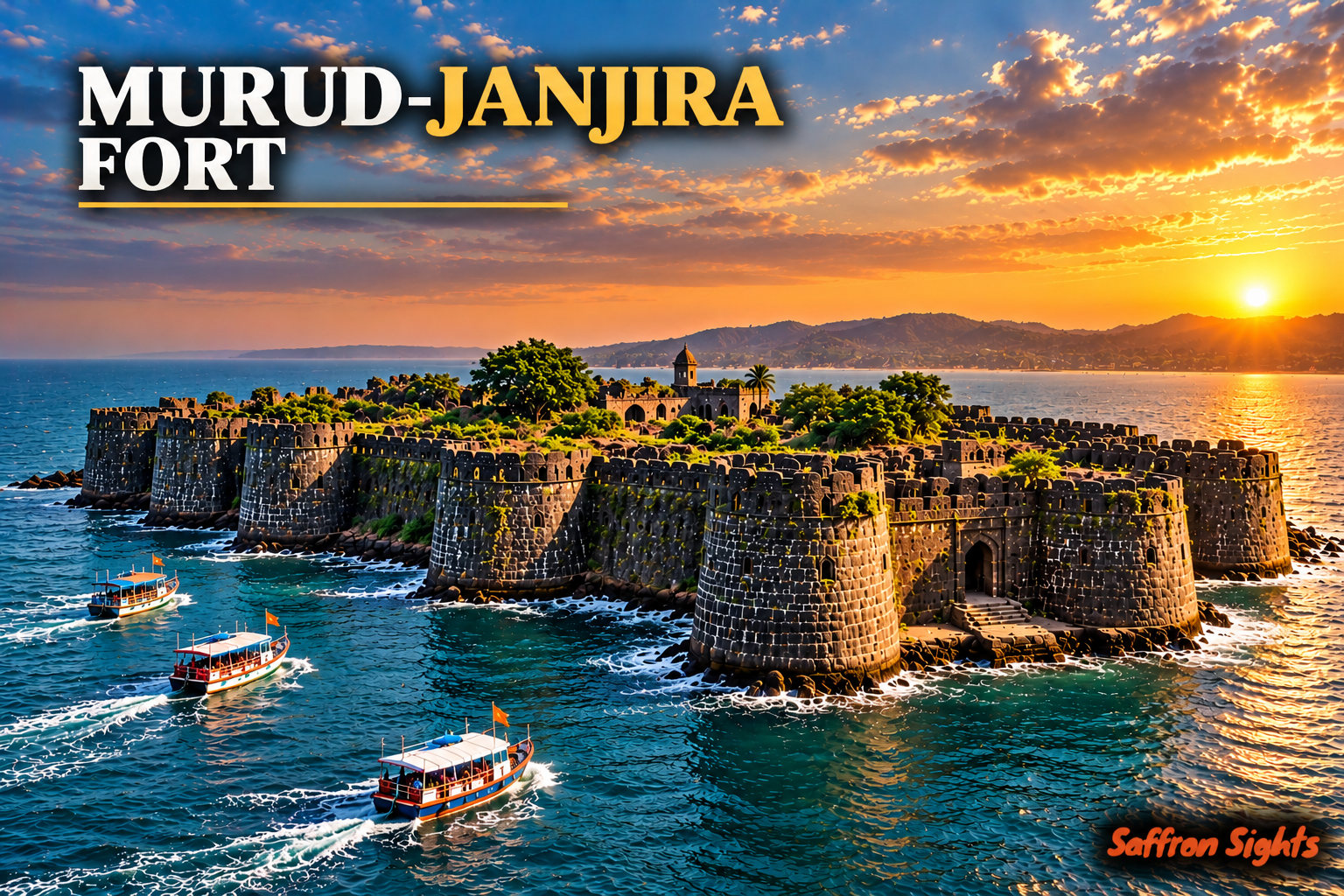
Murud-Janjira is the island fortress off the Konkan coast of Maharashtra that no attacking army ever managed to capture by force. Marathas, Mughals, Portuguese, Dutch and British all tried their luck against it, and it stayed in Siddi hands until the princely state joined independent India. This guide tells the story behind the fort, explains why Shivaji Maharaj and Sambhaji Maharaj both failed to take it, and answers who owns it today.
| Detail | Summary |
|---|---|
| Place | Island off Murud, Raigad district, Maharashtra |
| Built | Wooden outpost in the 15th century; stone fort traditionally dated to 1567 |
| Ruled by | The Siddis, a maritime power of African (largely Abyssinian) descent |
| Famous cannons | Kalal Bangadi, Chavri and Landa Kasam |
| Maratha attempts | Shivaji’s attempts failed; Sambhaji’s siege of 1682 failed |
| Owner today | Government of India, protected by the Archaeological Survey of India |
The Story Behind Murud-Janjira
From a fishermen’s outpost to a stone fortress
According to local tradition, the fort began in the 15th century as a modest wooden outpost raised by fishermen on a rocky island, meant to keep pirates away. Malik Ambar, the Abyssinian regent of the Ahmadnagar Sultanate, is credited with replacing it with a massive stone fortress in 1567. Sources differ on the exact dates and builders, but all agree on the result: the island became a serious naval base.
The Siddis and the name “Janjira”
The name is usually traced to the Arabic word jazeera, meaning “island”. The Siddis, people of African and often Abyssinian descent, built a lasting maritime principality around Murud, and Janjira became both their capital and the emblem of their power on India’s western coast.
Why Janjira Was So Hard to Capture
No single feature protected the fort. It was the combination of position, design, firepower and supplies that made it so stubborn.
An island just far enough away. The rock sat close enough to the mainland for messages and trade, yet far enough out to rule out a direct land assault.
A hidden gateway. The main entrance was tucked into a curved recess of the massive outer wall. A boat crossing the water could barely see it until it was very close, so enemy gunners had little chance of aiming at it from a distance.
No dock to land on. Attackers had to climb onto wet stone steps straight from rocking boats, while defenders fired down on them from above.
Bastions and cannons. High walls and rounded bastions let defenders cover approaching ships from many angles. Counts vary: Maharashtra Tourism lists 26 artillery towers, while other accounts describe 19 rounded bastions, probably because of different ways of counting towers, arches and surviving structures. At its height the fort reportedly held as many as 572 cannons of Indian and European make, and three of them became legends: Kalal Bangadi, Chavri and Landa Kasam.
The Maharashtra Gazetteer adds a useful correction to the folklore. It says the great Kallal Bangdi gun at the main gate was believed to have been brought by the Peshwa’s army, probably around 1735, and left behind when that army retreated. The same source records guns made in Sweden, Spain, Holland and France, which shows how cosmopolitan Janjira’s arsenal was. (The Peshwas who sent that army ruled from Pune; read the story of their palace in our Shaniwar Wada history.)
Fresh water inside a sea fort. Perhaps the biggest advantage was two freshwater reservoirs inside the walls, even though the Arabian Sea surrounded the island. Many sieges are won through thirst and starvation rather than assault. With fresh water, barracks, a palace and a mosque inside, Janjira could outlast blockades that would have broken most coastal forts.
A secret route out. On the western side, the Darya Darwaza, or Sea Gate, gave the garrison a discreet way to move messages, supplies, reinforcements or even evacuees when the main approach was under threat.
Shivaji Maharaj and the Fort He Could Not Win
Shivaji Maharaj’s record as a fort-taker is formidable. His commander Tanaji Malusare recaptured Kondhana in the 1670 night assault described in our Battle of Sinhagad history, and he built a sea fortress of his own, as told in our Sindhudurg Fort history. Yet the Siddi stronghold on his own coast was one he never managed to take.
Shivaji saw Janjira as a major obstacle to Maratha authority along the Konkan. When his attempts to capture it failed, he changed tactics and, in 1676, built Padmadurg (also called Kasa Fort) close by, as a rival naval base to challenge the Siddis from the water.
Sambhaji Maharaj’s Siege of 1682
Chhatrapati Sambhaji Maharaj, Shivaji’s son, pressed the campaign harder. In January 1682 he launched a major siege, with the general Dadaji Raghunath Deshpande taking part, and attempted an extraordinary engineering feat: filling the channel with stone and rock to build a causeway to the island.
The siege failed. Accounts differ on the immediate cause. Some stress a Mughal attack that forced Sambhaji to withdraw, while others point to the sheer difficulty of the causeway. Either way, Janjira stayed in Siddi hands.
Was Janjira Really “Never Attacked”?
The popular phrase needs care. Janjira was attacked, besieged and pressured many times. What it never suffered was capture by military force. By the 18th century Siddi power had shrunk, and the fort eventually became part of the Indian Union after independence rather than falling in battle.
Who Owns Janjira Fort Today?
Today Janjira is owned by the Government of India and protected as a centrally protected monument under the Archaeological Survey of India (ASI). Siddi families reportedly continued to live inside the fort even after independence, until the ASI moved them out in 1972. The fort is now open to visitors, who reach it by boat from Rajapuri jetty.
What Is History and What Is Legend?
| Claim | Status |
|---|---|
| No attacker captured Janjira by force | Well supported |
| It was never attacked or invaded | Inaccurate; it was attacked repeatedly |
| Stone fort built by Malik Ambar in 1567 | Traditional date; sources vary on dates and builders |
| 572 cannons at its peak | Reported figure, not firmly verified |
| Kallal Bangdi brought by the Peshwa’s army | Recorded in the Maharashtra Gazetteer (c. 1735) |
| Sambhaji’s siege of 1682 failed | Well supported, though the exact reason is debated |
Frequently Asked Questions
What is the story behind the Murud-Janjira fort?
Murud-Janjira began as a wooden fishermen’s outpost on a rocky island and was rebuilt in stone, traditionally in 1567, under Malik Ambar of the Ahmadnagar Sultanate. It became the capital of the Siddis, a maritime power of African descent. Its hidden gateway, high walls, heavy artillery and freshwater reservoirs let it withstand attacks by the Marathas, Mughals, Portuguese, Dutch and British, which earned it the title of the unconquered sea fort.
Which fort did Shivaji Maharaj never win?
The best-known fort Shivaji Maharaj never won is Murud-Janjira, the Siddi island fortress off the Konkan coast. After his attempts failed, he built Padmadurg (Kasa Fort) nearby in 1676 as a rival naval base.
Who is the owner of Janjira Fort?
Janjira Fort is owned by the Government of India and protected by the Archaeological Survey of India. It passed out of Siddi control when the princely state joined India after independence.
Did Sambhaji Maharaj capture Janjira Fort?
No. Sambhaji Maharaj besieged Janjira in January 1682 and tried to build a causeway of stone across the channel, but the siege failed and the fort remained with the Siddis. For how his own story ended, read the FAQ at the end of our Battle of Sinhagad guide.