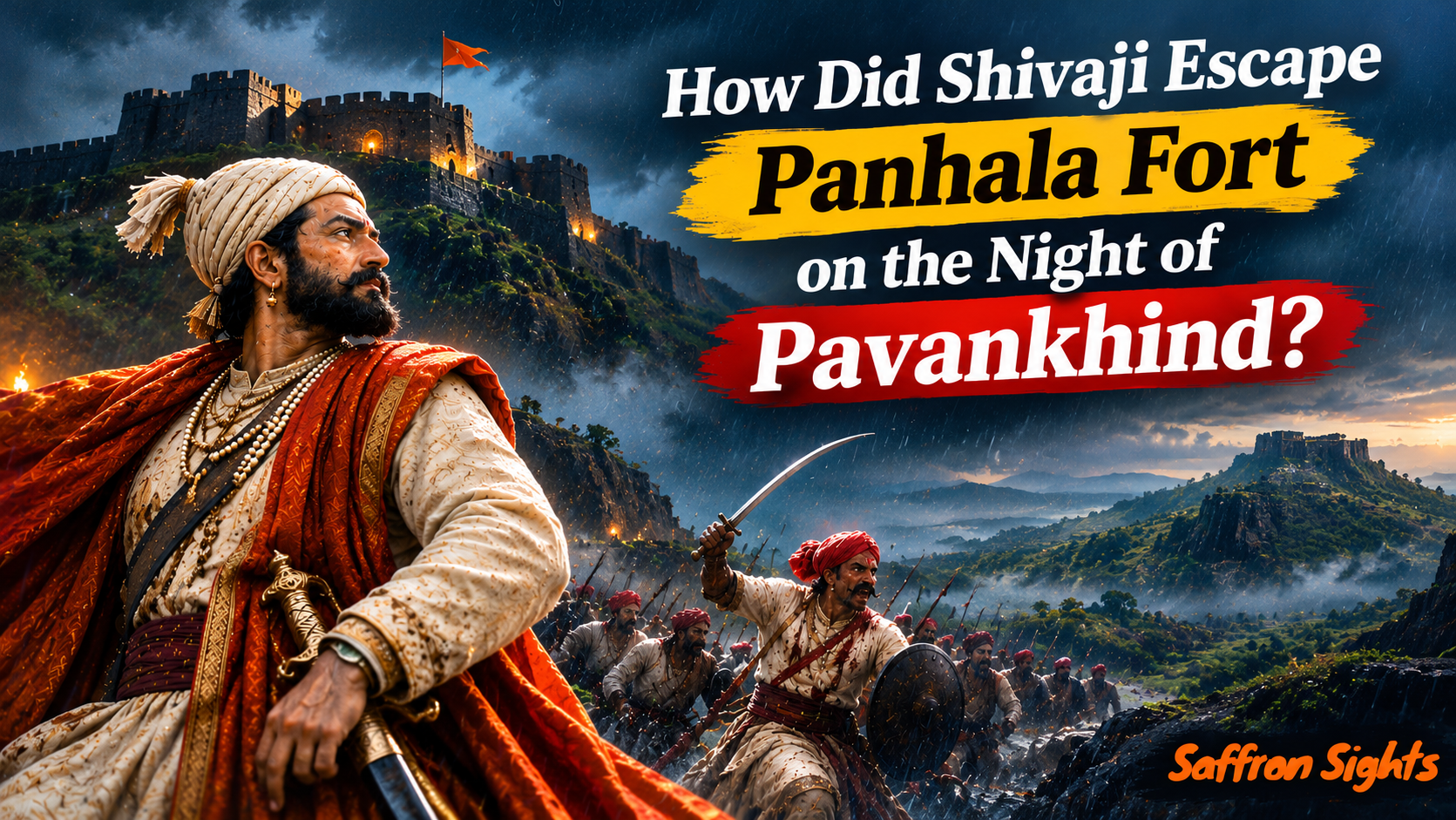

On a rain-lashed night in July 1660, a small column slipped out of a besieged fort, and an even smaller one stayed behind in a narrow pass so that the first could reach safety. That, in a sentence, is the Pavankhind battle story: Chhatrapati Shivaji Maharaj’s breakout from Panhala Fort and the last stand of Baji Prabhu Deshpande. With Shivaji Jayanti on 19 February approaching, and Panhala now on the UNESCO World Heritage list as part of the Maratha Military Landscapes of India (inscribed in 2025), there is no better time to follow the story across the Kolhapur countryside where it happened.
Panhala Fort: Tara Rani, Sajja Kothi, Teen Darwaza
Panhala sits on a hilltop above Kolhapur and is often described as one of the largest forts in the Deccan. Its origins go back to the Shilahara era in the late 12th century, and over the following centuries it passed through the hands of several dynasties before Shivaji brought it into the Maratha fold. Few forts in Maharashtra have seen as many turns of fortune, and three places inside it are the best way to read that history.
Teen Darwaza. The “three gates” entrance is where the old fort begins. Its stone arches and guard chambers were built to slow an attacker down, and walking through them gives you a sense of how hard Panhala was to take by force.
Sajja Kothi. This Adilshahi-era pavilion is associated with Sambhaji Maharaj’s time at Panhala. It is a quiet, atmospheric stop, and a reminder that the fort served as a seat of Maratha politics, not just a place to hold out in a crisis.
Tara Rani’s palace. Tarabai, the widow of Chhatrapati Rajaram, led Maratha resistance against Aurangzeb in the name of her young son. Panhala was one of her bases before Kolhapur emerged as a seat of power, and the palace complex associated with her is the fort’s link to that later chapter.
Together, these three sites show why Panhala mattered. It is the stage on which the 1660 drama played out.
The political story of the Maratha kingdom continued through the Peshwa era, whose rise and influence can be explored through the history of Shaniwar Wada, the famous Peshwa palace in Pune.
Panhala is also one of the twelve forts that make up the Maratha Military Landscapes of India, inscribed on the UNESCO World Heritage List in July 2025 as India’s 44th World Heritage Site. Eleven of the twelve are in Maharashtra, and the twelfth, Gingee, is in Tamil Nadu. For Kolhapur, the listing puts a fort that was already a pilgrimage for history lovers on the world map.
Panhala is part of a wider story of Maratha military architecture, which can also be seen in Raigad Fort, Shivaji Maharaj’s capital, and Sindhudurg Fort, Shivaji’s remarkable sea fortress.
Before you go in, look for the statues of Baji Prabhu Deshpande and Shiva Kashid at Panhala. They honour the two men whose roles in the escape, one at the pass and one in the palanquin, you are about to read about.
The 1660 siege by Siddi Johar
By early 1660, Adilshahi forces under Siddi Johar (also written Siddi Jauhar) had surrounded Panhala. As the months went by, the ring tightened, and by July Shivaji was effectively trapped inside his own fort. The Adilshahi army was far larger than any force he could take out with him, and the monsoon rains made every movement, on either side, slow and miserable.
Staying meant being starved out, and surrender meant giving up everything he had built. Shivaji chose a third option: a night escape to Vishalgad, roughly 60–70 km away through difficult, rain-soaked terrain.
Leaving a besieged fort is never simple. The besiegers watch the gates and the paths down the hillside, and the garrison cannot count on supplies lasting. What Shivaji had on his side was the weather and the land: heavy rain cut visibility and slowed any army on the move, and the hill country between Panhala and Vishalgad rewarded the men who knew it. The plan depended on speed, surprise and the cover of a wet, dark night.
The night escape in the rain
The plan had two parts: a deception and a dash.
The deception was Shiva Kashid, a barber in Shivaji’s service who reportedly resembled him. Dressed in royal clothing and carried in a palanquin along a more visible route, he was meant to draw Siddi Johar’s pursuers away from Shivaji’s actual path. It worked, at least for a while. When the pursuers realised the captured figure was not Shivaji, cavalry was sent after the real escaping party, but by then Shivaji had gained a lead.
The dash was made by a selected body of soldiers, commonly described as around 600 men, accompanied by Baji Prabhu Deshpande. They moved through darkness and heavy rain, on narrow paths and swollen streams. The escape is usually dated to the night of 13 July 1660, though some traditions place the departure on the night of 12–13 July. Dates and numbers vary across accounts, but the broad picture of a small Maratha column escaping under cover of night is consistent.
Shiva Kashid’s role is remembered as a sacrifice in its own right, which is why he is honoured with a statue at Panhala. Whoever sat in that palanquin was taking a serious risk, because the deception only worked for as long as the pursuers believed it. Every hour it held their attention was an hour of distance for the real column, and that distance would be needed before the night was over.
Shivaji Maharaj’s military campaigns produced several other stories of courage and sacrifice, including the famous Battle of Sinhagad and Tanaji Malusare’s 1670 night assault.
Baji Prabhu Deshpande at Ghod Khind
As the party neared Vishalgad, enemy cavalry threatened to overtake it. Shivaji split his force. He pressed on toward the fort with part of the men, while Baji Prabhu remained behind with about 300 soldiers to block the pursuit.
The chosen ground was Ghod Khind (also written Ghodkhind), “the horse’s pass,” a narrow ravine where a small force could hold up a much larger one. Baji Prabhu, his brother Fulaji, and the Maratha rearguard fought for hours to keep the Bijapuri cavalry from reaching Shivaji.
The prearranged signal for safety was cannon fire from Vishalgad. In the traditional account, three shots confirmed that Shivaji had reached the fort, and the mortally wounded Baji Prabhu is said to have held on until he heard them before he died. Some accounts give larger numbers for the rearguard, but 300 is the figure most often cited.
The stand was more than symbolic. It bought the time Shivaji needed to enter Vishalgad, and in memory of the sacrifice the pass came to be known as Pavan Khind, the “sacred pass.”
Tellings differ on how long the stand lasted, but several put it at five to six hours, with Baji Prabhu fighting on despite his wounds. They also differ on the number of cannon shots, with three in this account and five in others. By tradition, the bodies of Baji Prabhu and Fulaji were carried to Vishalgad, where Shivaji was present at their last rites. Today a memorial at the pass, near the village of Gajapur, honours them and the Maratha soldiers who fell with them.
The defence of forts and control of difficult terrain remained central to Maratha strategy. Another example is Daulatabad Fort’s remarkable defensive architecture, where the surrounding landscape played a major role in protecting the stronghold.
Retrace the route: Panhala to Vishalgad
The best way to understand the Pavankhind battle story is to follow it on the ground. Here is a simple way to plan it.
Start at Panhala. Walk through Teen Darwaza, visit Sajja Kothi and the palace associated with Tara Rani, and stand on the ramparts looking out over the hills. This is where the plan was made and the siege was endured.
Head to Pavankhind. Travel toward Vishalgad and stop at the pass where Baji Prabhu and his men made their stand. The memorial there is the emotional centre of the journey.
End at Vishalgad. The fort that Shivaji reached, and where the cannon fired, is the final stop. The full Panhala–Vishalgad distance is roughly 60–70 km, a figure that gives a sense of how far the column had to run on foot in the rain.
By road or on foot. By road, the base of Vishalgad is about 80 km from Kolhapur via Shahuwadi, Pavan Khind and Gajapur. On foot, organised treks from Panhala to Pavankhind cover roughly 50 km, usually over two days with a night in a village, and most are held in the monsoon. These figures start and end at different points, so they will not match the Panhala–Vishalgad distance above.
Practical tips:
- The cooler months from October to February are the most comfortable for a visit, and a good fit with Shivaji Jayanti on 19 February.
- The monsoon is the most atmospheric time, since it matches the season of the escape, but paths and roads can be slippery and visibility poor. Check local road and weather conditions before you go.
- Local trekking groups have traditionally retraced parts of the route around the anniversary in July. If you want to walk it, join an organised group rather than going alone.
- Carry water, rain gear, and sturdy footwear, and start early.
This year, as Shivaji Jayanti approaches and Panhala takes its place among India’s World Heritage forts, the route from Panhala to Vishalgad is a chance to visit the fort as a living story and a reminder of what it cost to hold a narrow pass for a few hours in the rain.
For another way to explore Maharashtra’s fort heritage, read about Diwali Killa and the tradition of building miniature Maratha forts, which keeps the memory of these historic strongholds alive across generations
Frequently Asked Questions (FAQs)
1. How did Shivaji Maharaj escape from Panhala Fort?
Shivaji Maharaj escaped from Panhala Fort during the night of July 1660 while it was under siege by Siddi Johar’s Adilshahi forces. He reportedly used a decoy palanquin carrying Shiva Kashid, who resembled him, to distract the pursuing army. Meanwhile, Shivaji and his selected soldiers travelled towards Vishalgad under the cover of darkness and heavy monsoon rain.
2. Who helped Shivaji Maharaj escape from Panhala Fort?
Baji Prabhu Deshpande, Shiva Kashid and the Maratha soldiers played important roles in the escape. Shiva Kashid helped create a diversion, while Baji Prabhu Deshpande and his soldiers held back the pursuing forces at Ghod Khind, giving Shivaji time to reach Vishalgad.
3. Why is Ghod Khind called Pavankhind?
Ghod Khind was renamed Pavankhind, meaning “Sacred Pass”, in memory of Baji Prabhu Deshpande and the Maratha soldiers who sacrificed their lives while protecting Shivaji Maharaj’s escape route. Their courage made the pass an important symbol of loyalty and sacrifice in Maratha history.
4. Who was Baji Prabhu Deshpande?
Baji Prabhu Deshpande was a brave Maratha military commander and a trusted associate of Shivaji Maharaj. He is remembered for leading the rearguard at Ghod Khind in July 1660, holding back the pursuing Adilshahi forces until Shivaji reached Vishalgad.
5. Who was Shiva Kashid and what was his role in the escape?
Shiva Kashid was a barber in Shivaji Maharaj’s service who reportedly resembled the king. During the escape from Panhala, he dressed like Shivaji and travelled in a decoy palanquin to mislead the pursuing Adilshahi forces. His sacrifice helped the real escaping party gain valuable time.
6. How far is Panhala Fort from Vishalgad Fort?
Panhala Fort and Vishalgad Fort are approximately 60–70 km apart by the historical escape route, although the actual road distance depends on the route and starting points. The journey passes through the region associated with Pavankhind and Ghod Khind.
7. When did the Battle of Pavankhind take place?
The Battle of Pavankhind took place in July 1660 during Shivaji Maharaj’s escape from the siege of Panhala Fort. The escape is commonly dated to the night of 13 July 1660, although historical accounts differ on some details.
8. Can visitors travel from Panhala Fort to Pavankhind?
Yes. Visitors can travel from Panhala towards Pavankhind and Vishalgad by road. Organised trekking groups also retrace parts of the historic route, particularly during the monsoon season. Visitors should check local weather and road conditions before planning the journey.