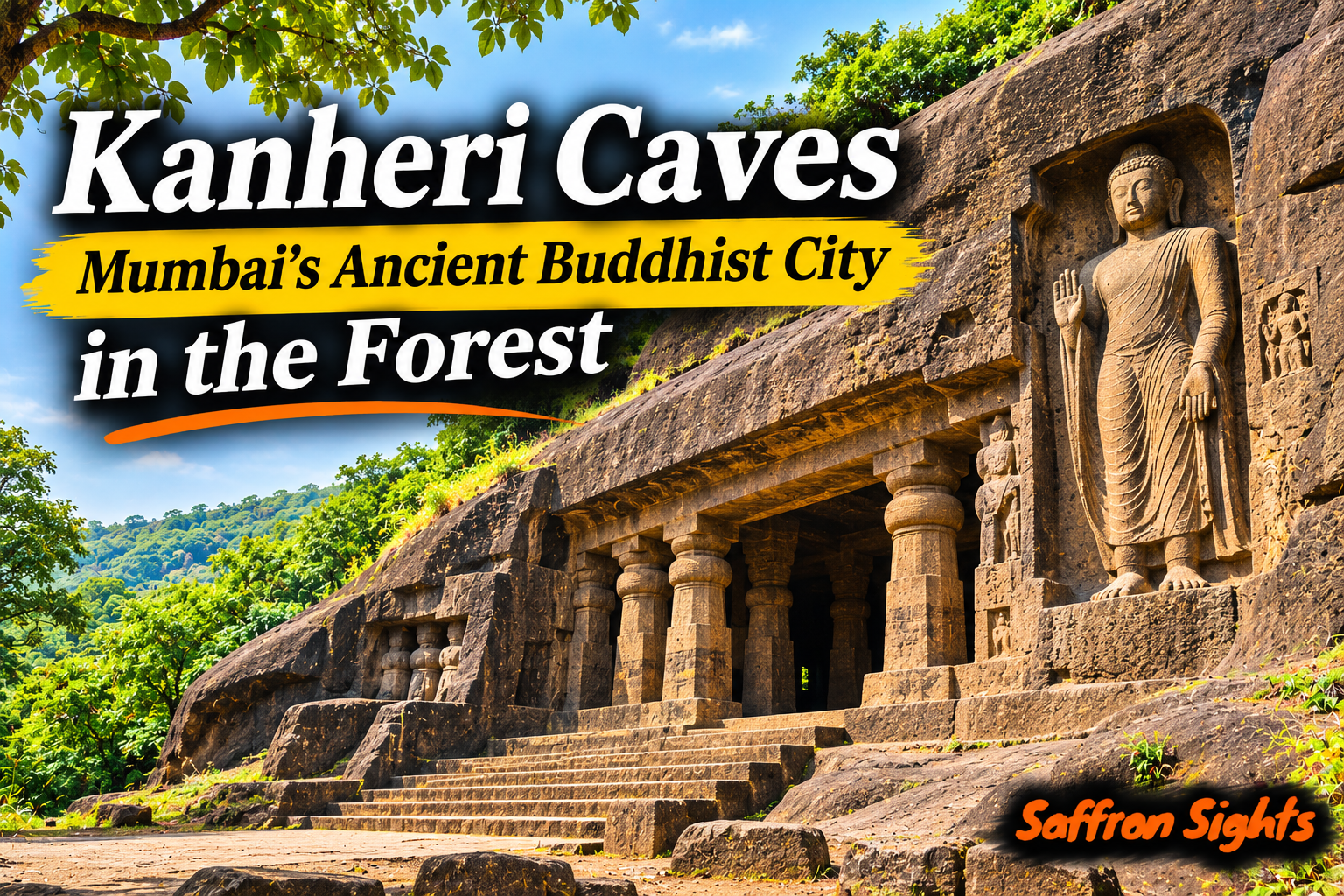

The Kanheri Caves are one of India’s most remarkable yet underappreciated archaeological sites: a complex of 109 rock-cut Buddhist caves carved into a basalt hill inside Mumbai’s Sanjay Gandhi National Park (SGNP). Used from the 1st century BCE to the 10th century CE, Kanheri functioned as a monastery, pilgrimage centre, learning institution, and resting place for merchants travelling along the Konkan coast.
Is Kanheri Caves worth visiting?
Yes, especially if you like history, photography, or walking in nature. Kanheri is often overshadowed by Ajanta and Ellora, yet it offers something distinctive: a vast Buddhist complex embedded within one of the world’s largest metropolitan areas. It is simultaneously an art-historical site, an engineering landmark, a forest sanctuary, and evidence of Mumbai’s deep pre-modern past.
The setting is a big part of the appeal. The caves lie within Sanjay Gandhi National Park at Borivali, so you can move from Mumbai’s dense urban environment into forested hills within a short journey. The approach involves stone steps, rocky paths, and elevated viewpoints, which makes the visit both a historical outing and an outdoor one. The contrast is striking: a city now defined by trains, towers, and traffic once supported a major Buddhist centre where monks carved living quarters, prayer halls, and water systems directly into the hillside.
For travellers, historians, photographers, and anyone interested in ancient India, Kanheri is not merely a day trip. It is a walk through a vanished Buddhist university-city carved into the black hills of Mumbai. Plan on roughly three to four hours, and expect plenty of walking between cave clusters.
What are Kanheri Caves famous for?
A monastic landscape
Unlike a single temple, Kanheri was an entire monastic settlement. Its caves include viharas (residential cells where monks slept, studied, and meditated) as well as prayer halls, cisterns, rock-cut beds, and water channels. The scale and infrastructure show a large, organised Buddhist community rather than an occasional retreat.
The name Kanheri is commonly linked to Krishnagiri, meaning “black mountain,” a reference to the dark Deccan basalt into which the caves were excavated. Located near ancient ports such as Sopara, Vasai, and Kalyan, the complex benefited from trade routes and patronage from merchants, monks, and regional dynasties.
The region has several other remarkable rock-cut monuments, including the Elephanta Caves in Mumbai, known for their impressive sculptures and ancient cave architecture.
A thousand years of Buddhism
Kanheri preserves the evolution of Buddhist belief and art over many centuries. Its earliest excavations belong largely to the Hinayana or Theravada tradition, when the Buddha was often represented through symbols such as stupas and footprints. Later phases introduced Mahayana imagery, including anthropomorphic Buddha and bodhisattva sculptures, and the site also contains evidence associated with Vajrayana Buddhism.
This continuity is rare. The Archaeological Survey of India (ASI) describes Kanheri as a place where Buddhist architecture and faith can be traced in an unbroken sequence from the 2nd century CE to the 9th century CE.
Similar Buddhist artistic traditions can be explored through the Ajanta Caves paintings, which preserve remarkable examples of ancient Buddhist art, religious storytelling, and mural painting.
Cave 3: the Great Chaitya
Cave 3 is Kanheri’s centrepiece and one of the finest rock-cut chaitya-grihas, or prayer halls, in western India. It contains a large central stupa surrounded by columns, with a ceiling carved to imitate wooden architectural forms, a hallmark of early rock-cut architecture in the region.
The hall is associated with an inscription of the Satavahana ruler Yajna Sri Satakarni, dating to around 170 CE, and was founded by the merchant brothers Gajasena and Gajamitra. At roughly 86.5 feet long and nearly 40 feet wide, it is an imposing space even today.
Two colossal standing Buddha figures, about 7 metres (23 feet) high, flank the entrance porch. These later Mahayana-era sculptures show the shift from symbolic worship toward direct devotional images of the Buddha.
Inscriptions and water engineering
Kanheri’s epigraphic record is unusually rich. Scholars have identified 51 inscriptions and 26 epigraphs in Brahmi, Devanagari, and Pahlavi scripts; many record donations of caves, cisterns, land, and funds by kings, ministers, monks, and wealthy merchants. Kanheri was not built by isolated ascetics alone. It was sustained by a broader economy of patronage, with Satavahana, Traikutaka, Vakataka, and Silahara-era connections reflected in its growth.
Equally impressive is the water system. Rock-cut channels directed monsoon rain into cisterns, giving a large monastic population a dependable water supply. The site also shows evidence of ancient dams and sophisticated rainwater harvesting, an engineering achievement as significant as its sculpture.
Another extraordinary example of Maharashtra’s rock-cut architectural heritage is the Ellora Kailasa Temple, carved from a single rock formation and demonstrating the remarkable skills of ancient Indian craftspeople.
Kanheri at a glance
| Feature | Why it matters |
| 109 caves in one basalt hill | One of the largest Buddhist cave complexes in India |
| 1st century BCE to 10th century CE | Nearly a millennium of Buddhist activity |
| Cave 3 Great Chaitya | A major prayer hall with a stupa, colonnade, and colossal Buddha images |
| Inscriptions in multiple scripts | Documents donations, patrons, monks, and cross-cultural visitors |
| Rainwater-harvesting system | Shows advanced adaptation to Mumbai’s monsoon environment |
| Location within a national park | Combines archaeology with forest trails, wildlife, and views over Mumbai |
What is the best time to visit Kanheri Caves?
The best season is November to February, when the weather is cooler and the hiking trails are dry. The monsoon months (roughly June to September) bring lush greenery, but the stone steps and rocky paths can become slippery, so take extra care if you go then.
The caves are open 7:30 AM to 5:00 PM, Tuesday to Sunday, and closed on Mondays. Arriving early is the best way to beat both the heat and the crowds. Some park-run services, such as the shuttle and organised treks, can follow different hours, so check at the SGNP gate on the day.
What to bring: sturdy closed-toe shoes, water, sun protection, and time for walking between cave clusters.
Key caves to prioritise:
- Cave 3 for the Great Chaitya.
- Caves 1 and 2 for early monastic and stupa remains.
- Cave 41 for important bodhisattva imagery.
- Cave 90 for its Pahlavi inscriptions.
What is the entry fee for Kanheri Caves?
There is no single ticket. Visiting Kanheri means paying for the national park at the main gate, a ticket for the caves themselves, and transport between the two (the caves are about 6 km from the gate). Published figures vary from site to site, and rates have been under review, so treat the numbers below as a guide and confirm at the counter.
| Charge | Indian visitors | Foreign visitors |
| SGNP entry (main gate) | ₹85 adults, ₹45 children (5–12), free under 5 | Higher; guides quote anywhere from about ₹287 to ₹510 |
| Kanheri Caves ticket (ASI) | About ₹25 to ₹40, depending on the source | About ₹300 to ₹600, depending on the source |
| Shuttle bus, gate to caves | Small per-person fee | Same |
Several guides say children under 15 enter the caves free. Private vehicles entering the park pay an additional charge.
A note on the shuttle fare. In May 2026, SGNP announced a revised tariff that would have raised the gate-to-caves bus ticket from ₹100 to ₹300, along with other increases. Authorities then deferred the new rates for administrative and technical reasons and said existing charges would continue until further notice. I could not confirm whether the revised fares have since come into force, so check the current rate at the gate.
For a rough budget, an Indian adult should expect about ₹110 to ₹125 for park and cave entry combined, before the shuttle and any private-vehicle charges.
Why it deserves more attention
Kanheri is a place where you can stand inside a prayer hall carved nearly two thousand years ago, read the names of the merchants who paid for it, and then look out over a modern megacity. Few sites in India put ancient and contemporary life so close together.
Its history connects Mumbai with a much wider story of Buddhist architecture, religious traditions, trade, and ancient Indian engineering. For anyone interested in history, architecture, Buddhism, and Maharashtra’s cultural landscape, Kanheri deserves a place on the itinerary.
Frequently asked questions
How many caves are there at Kanheri?
There are 109 rock-cut caves in a single basalt hill. Most are viharas (monks’ residential cells), alongside prayer halls, cisterns, rock-cut beds, and water channels.
When were the Kanheri Caves built?
The earliest excavations date to the 1st century BCE, and the site was used until the 10th century CE. The Cave 3 inscription of the Satavahana ruler Yajna Sri Satakarni dates to around 170 CE.
Who built the caves?
Buddhist monks carved them, supported by kings, ministers, and wealthy merchants who recorded their donations in inscriptions. The Great Chaitya (Cave 3) was founded by the merchant brothers Gajasena and Gajamitra.
What does the name Kanheri mean?
It is commonly linked to Krishnagiri, meaning “black mountain,” after the dark Deccan basalt the caves were cut into.
Is Kanheri a Buddhist or Hindu site?
It is a Buddhist site. Its caves show the shift from early Hinayana or Theravada practice, which used symbols such as stupas, to Mahayana sculpture, with some evidence of Vajrayana as well.
Which is the most important cave?
Cave 3, the Great Chaitya. It has a large central stupa, a colonnade, a ceiling carved to imitate wooden beams, and two colossal standing Buddha figures at the porch.
How long does a visit take?
Allow about three to four hours, including the walk between cave clusters and the shuttle ride from the park gate.
How do I get to Kanheri Caves?
The caves are inside Sanjay Gandhi National Park, Borivali East, about 6 km from the main gate. Borivali is the nearest major railway station; from there, take an auto-rickshaw, taxi, or bus to the park gate, then the park shuttle to the caves.
Is it suitable for children and older visitors?
Yes, with some care. The approach involves stone steps and rocky paths, so wear sturdy closed-toe shoes, carry water, and go slowly, especially after rain.