
Introduction
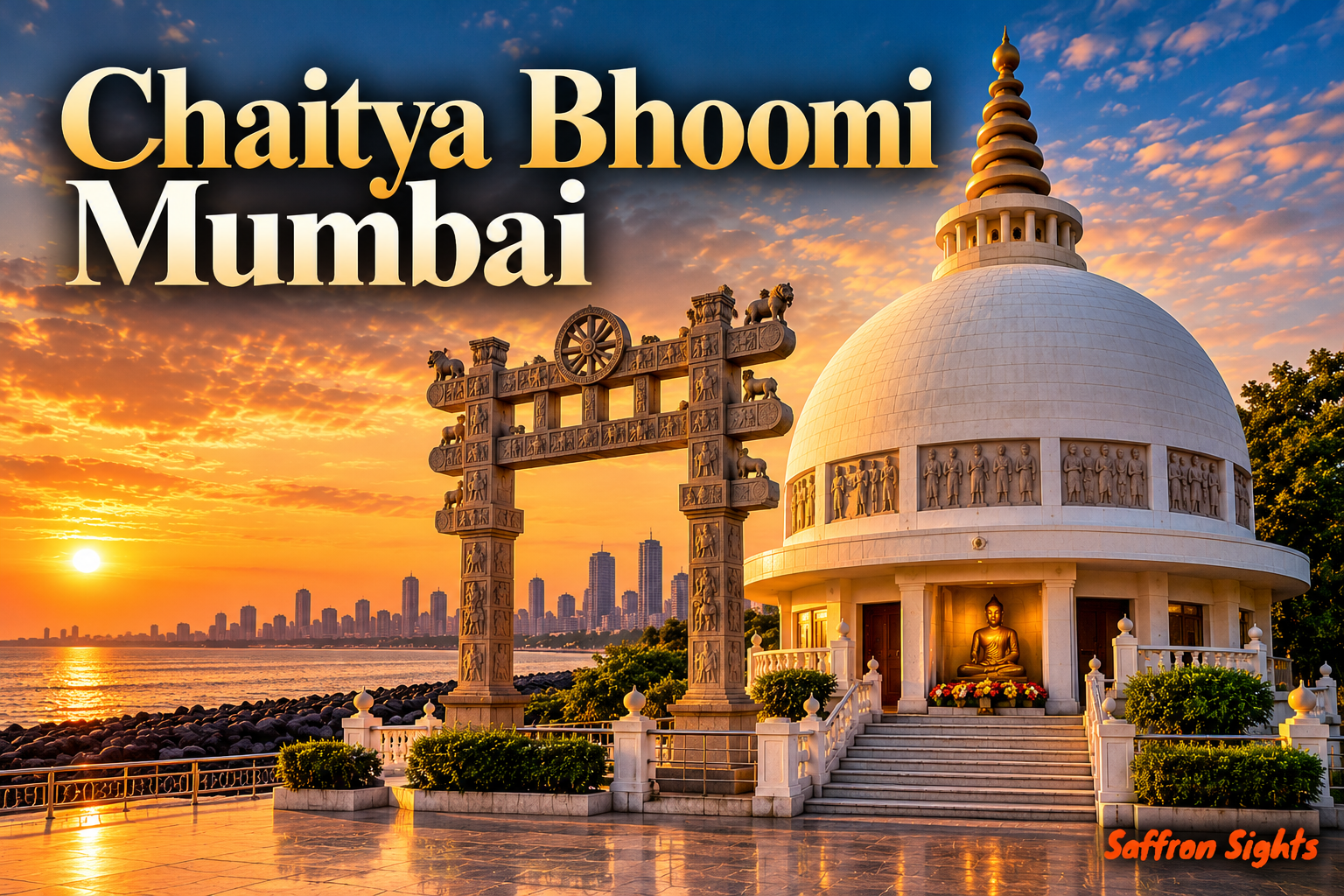
Chaitya Bhoomi Mumbai is the memorial to Dr. Bhimrao Ramji Ambedkar, built at the spot beside Dadar Chowpatty where he was cremated after his death in 1956. It stands in Dadar, in central Mumbai, near Shivaji Park and the sea.
The memorial is a short white structure shaped like a Buddhist stupa. It is quiet and plain compared with the crowds that come to it. On 6 December every year, the anniversary of his death, huge numbers of people arrive, many after travelling for days.
This guide explains who Ambedkar was, why the memorial is in Dadar, what he did for the Constitution, and what his famous message means. It ends with practical tips for visiting, especially on 6 December.
Who Was Dr. B.R. Ambedkar? (In Simple Words)
Dr. B.R. Ambedkar (1891–1956) was an Indian scholar, lawyer, economist and social reformer. He is also remembered as the chairman of the Drafting Committee of the Constitution and as independent India’s first Law Minister. People often call him Babasaheb.
He was born on 14 April 1891 in Mhow, in present-day Madhya Pradesh. His family belonged to the Mahar community, which was treated as “untouchable” under the caste system. As a child he faced discrimination in school and in daily life.
He still went on to study at Elphinstone College in Bombay, Columbia University in New York, the London School of Economics, and Gray’s Inn, where he trained as a barrister. Scholarships and support from reformers helped him along the way.
He spent his life campaigning for the rights of people excluded by caste. He was awarded the Bharat Ratna, India’s highest civilian honour, posthumously in 1990.
Why Is Chaitya Bhoomi at Dadar?
Short answer: Ambedkar died in Delhi on 6 December 1956, and his body was brought to Bombay (now Mumbai). He was cremated by the sea at Dadar, and the memorial was built on that spot.
Mumbai was where much of his public life took place. His followers there were many, and the city was a centre of his movement. The cremation was held with Buddhist rites, because he had embraced Buddhism in Nagpur only weeks earlier, on 14 October 1956.
A date discrepancy worth knowing: Some summaries say he was cremated on 6 December. Ambedkar died in Delhi that day, and the journey to Mumbai took time. Most accounts place the cremation on the evening of 7 December. Check this against an official Ambedkar Foundation source before quoting a cremation date in print.
The memorial was inaugurated on 5 December 1971, according to the research available. The name has a clear meaning. A chaitya is a Buddhist shrine or sacred mound, and bhoomi means land.
What You See at the Memorial
The main building follows the form of a stupa, a dome-shaped Buddhist monument. Reports describe a two-level structure. The ground level holds his relics and a bust of Ambedkar, and a statue of the Buddha is also part of the memorial. An upper level is described as holding a stupa.
The entrance gateway is described as modelled on the toranas of the Great Stupa at Sanchi. Visitors also mention a replica of an Ashokan pillar. Emperor Ashoka’s lion capital is the source of India’s national emblem, and the Dharmachakra (wheel of law) sits at the centre of the national flag.
Tip: The design links two things Ambedkar valued: ancient Indian Buddhist heritage and modern constitutional ideas. Look for that link as you walk around.
His Role in Drafting the Constitution
Short answer: Ambedkar chaired the Drafting Committee of the Constituent Assembly. The Committee prepared the draft that, after debate, became the Constitution.
Here are the key dates:
- 29 August 1947: The Drafting Committee was set up, and Ambedkar was elected its chairman.
- 25 November 1949: He gave his closing speech to the Constituent Assembly.
- 26 November 1949: The Constitution was adopted.
- 26 January 1950: It came into force, now celebrated as Republic Day.
He was one of several important contributors, including members of the Assembly and constitutional adviser B.N. Rau. His chairmanship is why he is called the principal architect.
His 1949 speech is still widely quoted. He warned that India was entering “a life of contradictions”: equality in politics but inequality in social and economic life. He argued that political democracy cannot last without social democracy, which rests on liberty, equality and fraternity.
Those words appear in the Preamble: justice, liberty, equality and fraternity. A visit to Chaitya Bhoomi is a good moment to read the Preamble again.
The Message: Educate, Agitate, Organise
This three-word call is closely associated with Ambedkar. It is often linked to his speeches in the early 1940s, especially at a Scheduled Castes Federation conference in Nagpur in 1942. Check an official collection of his speeches for the exact source before citing it.
Here is what each word means in his thinking:
| Word | Meaning |
|---|---|
| Educate | Learn first. Knowledge gives people confidence, skills and the ability to challenge unfair ideas. |
| Agitate | Demand rights by peaceful, public, lawful means. His 1927 Mahad Satyagraha, for access to a public water tank, is an example. |
| Organise | Build strong groups and institutions so that change lasts beyond any one person. |
Education was the first step, and he acted on it. He founded the People’s Education Society in 1945 to open higher education to disadvantaged communities. Its Siddharth College in Mumbai opened soon after. He also gathered a very large personal library, which is why Rajgruha, his Dadar home, is worth a visit.
Why Books Fill the Streets Around Chaitya Bhoomi
Most pilgrimage sites are known for offerings and flowers. Around Chaitya Bhoomi, especially on 6 December, you also find bookstalls. They line the roads and Shivaji Park, selling titles on law, history, caste, economics, Buddhism and Ambedkar’s own writings.
The reason is simple. His followers honour him by reading. Many visitors are said to spend carefully saved money on books. For a first-time visitor, browsing these stalls is part of understanding the place.
Historical Context: Buddhism and Ambedkar’s Last Months
On 14 October 1956, at Deekshabhoomi in Nagpur, Ambedkar embraced Buddhism with a very large number of followers. He saw it as a path of reason, compassion and equality, and a way out of caste hierarchy. His version is often called Navayana (“new vehicle”) Buddhism.
He died less than two months later. This is why Chaitya Bhoomi is both a memorial to a national figure and a Buddhist site.
Do not confuse the two places:
- Deekshabhoomi, Nagpur: where he took the vow of conversion.
- Chaitya Bhoomi, Mumbai: where he was cremated and where the memorial stands.
Did You Know?
- Ambedkar earned a doctorate from Columbia University and a doctorate in science from the London School of Economics. Official sources give the years differently depending on whether they refer to the degree or the thesis, so check before quoting years.
- The Constitution was adopted on 26 November 1949, but came into force two months later.
- 6 December is observed as Mahaparinirvan Din. Mahaparinirvan is a Buddhist term for the final passing of a great teacher.
- The memorial’s gateway draws on Sanchi, a World Heritage Site built long before Ambedkar’s time.
How to Reach Chaitya Bhoomi Mumbai
Short answer: Chaitya Bhoomi is at Dadar Chowpatty, near Shivaji Park, in Dadar West, Mumbai. The easiest way to reach it is to get off at Dadar railway station and continue by local taxi, auto or bus.
- By air: Chhatrapati Shivaji Maharaj International Airport is the main airport. Expect to travel across the city by taxi or app cab. Travel time varies hugely with traffic, so allow generous time.
- By train: Dadar is a major junction. It is served by both Mumbai’s Western and Central suburban lines, and by many long-distance trains. Dadar West is the side you want for Shivaji Park and the shore.
- By road: Taxis, app cabs and city buses go to Shivaji Park and Dadar Chowpatty. Say “Chaitya Bhoomi” or “Shivaji Park, Dadar” to the driver.
What to Expect on 6 December
In 2026, 6 December falls on a Sunday. The numbers vary by year, so rely on official announcements rather than estimates.
What usually happens:
- Very large crowds arrive from across Maharashtra and other states, including many who travel overnight.
- Roads near Shivaji Park and Dadar Chowpatty may be closed or diverted.
- Volunteers, civic and police staff manage queues. Free food and water are often arranged by community groups.
- Bookstalls, music and public meetings fill the area.
Practical tips:
- Check official notices. Look for Mumbai civic and police announcements and railway advisories a few days ahead. Special trains, road closures and queue arrangements change each year.
- Go early or late. Crowds peak at certain times. Ask volunteers on arrival.
- Travel light. Carry water, a small bag, comfortable footwear and a phone power bank.
- Use trains. Roads near Dadar can be closed, and Dadar station is the practical entry point.
- Keep children close. Agree on a meeting point in case you are separated.
- Dress modestly and quietly. Many visitors wear white. Follow volunteer instructions.
- Photography. Do not photograph people at prayer or in queues without permission.
- Keep valuables safe. Large crowds attract pickpockets anywhere in the world.
If you want a calmer visit: Choose a weekday morning or late afternoon on another date. Confirm opening hours with the memorial’s trust or Mumbai civic authorities, as timings and rules can change.
Etiquette: How to Visit Respectfully
- Keep your voice low. For many visitors this is a place of grief and pride.
- Remove footwear where asked.
- Follow queue and volunteer instructions.
- Do not turn the memorial into a backdrop for casual selfies.
- Listen, and ask politely if you want to learn.
Nearby Places to Combine With Your Visit
- Shivaji Park: Large open ground next to the memorial.
- Rajgruha, Dadar (Hindu Colony): Ambedkar’s heritage residence, associated with his library. Confirm access before going.
- Indu Mill compound: A planned memorial site for Ambedkar in Dadar. Check its current status before including it in an itinerary.
- Dadar Chowpatty: The shoreline itself. Many visitors walk here after paying respects.
Educational Value for Students
For school and college students, this site connects several subjects:
- History: Ambedkar’s life, social reform and the making of modern India.
- Civics: The Preamble, Drafting Committee, and the idea of social democracy.
- Sociology: Caste, collective memory, and how communities keep movements alive.
- Architecture: The stupa form and Sanchi-style gateway.
A simple activity: Read the Preamble before you go. At the memorial, ask yourself which of the four words (justice, liberty, equality, fraternity) you see reflected in the place or in the people around you. Write a short note afterwards.
Teachers should visit on a quieter day and avoid 6 December with school groups, as crowds are very large.