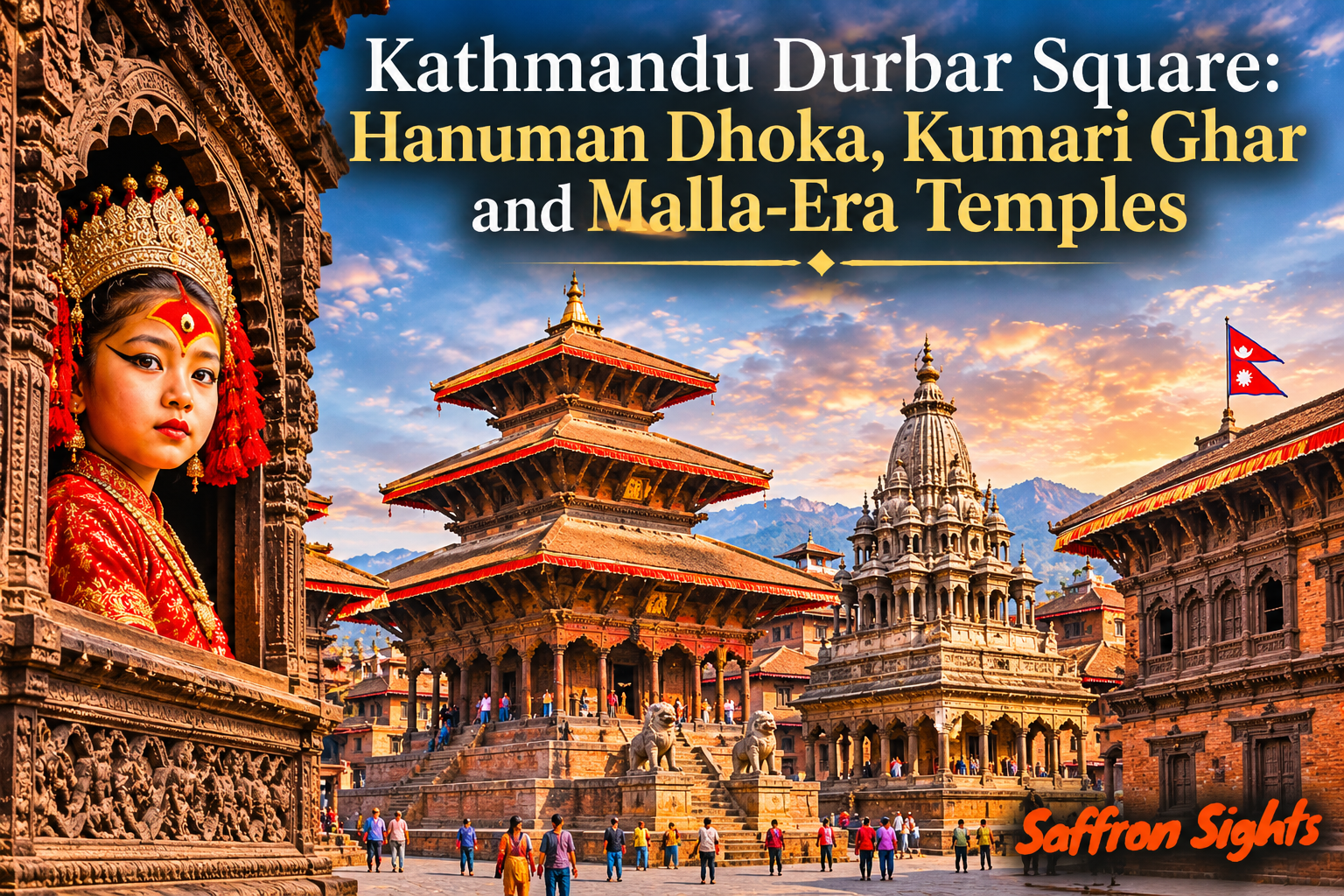

Kathmandu Durbar Square, also called Hanuman Dhoka or Basantapur Durbar Square, is the old royal square of the Malla and Shah kings and one of the seven UNESCO World Heritage monument zones of the Kathmandu Valley (inscribed in 1979). It holds the Hanuman Dhoka palace, the Taleju Temple, the Kumari Ghar (home of the living goddess), the Kasthamandap pavilion and the giant Kaal Bhairav statue. The 25 April 2015 earthquake destroyed Kasthamandap and damaged many other buildings, and rebuilding is ongoing. A July 2026 guide lists the ticket at NPR 1,000 for most foreign visitors and NPR 500 for SAARC nationals. Plan 90 minutes to half a day.
If you read only one place guide before your first day in the Valley, make it this one. The square is compact, but its layers of Hindu and Newar history are easy to miss without a plan. This page gives a walking order, an explanation of the main structures, the 2015 damage and rebuilding picture, and a comparison with an Indian royal complex you may already know, the Shaniwar Wada in Pune. For the wider Valley, go to the Kathmandu Valley UNESCO World Heritage Sites hub.
Introduction: what the square is, where it is and why it matters
Kathmandu Durbar Square, also called Hanuman Dhoka or Basantapur Durbar Square, is the old royal square at the heart of Kathmandu. It was the royal residence of the valley’s kings and became a World Heritage Site in 1979 as part of the Kathmandu Valley listing (reference 121, criteria iii, iv and vi, according to Wikipedia). It matters because it concentrates palaces, temples, courtyards and the home of the living goddess in one walkable place, and because the 2015 earthquake made it a symbol of both loss and reconstruction.
Origin: who built it, and when
The record is uncertain. Wikipedia’s infobox gives the 4th to 8th century as the build period, while its text says construction began in the 3rd century, and it does not name a first builder. What it does say is that the outer complex of temples with carved Newar-style facades was built in the 16th century under the Malla kings, and that Prithvi Narayan Shah later built the nine-storey Nautalle Durbar to commemorate the Unification of Nepal. The Kumari Chowk (Kumari Bahal) is a three-storey structure at the southern edge, built in the Malla era. For individual buildings, such as the Kasthamandap, dates in different sources differ, as the legends section shows.
Purpose and motive: a palace that was also a stage
The square began as a royal residence with multiple courtyards, including Nasal Chowk and Mul Chowk (Wikipedia). It was also the ritual stage of the kingdom: festivals such as Indra Jatra pass through it, and the king traditionally received a tika from the Kumari there each year. Under the Shah dynasty the king bowed before the Kumari at Indra Jatra to reinforce royal legitimacy; since the monarchy was abolished in 2008 the president performs a similar ceremonial role (Wikipedia, Kumari).
Historical context
| Period | What happened | Source |
|---|---|---|
| 3rd to 8th century | Construction begins (sources disagree on the exact range) | Wikipedia |
| 16th century | Outer complex built under Malla kings | Wikipedia |
| Malla and Shah periods | Palace complexes grow around the square; Nautalle Durbar added | Wikipedia |
| 1956 | Ancient Monuments Preservation Act (amended 2013) | Wikipedia |
| 1979 | UNESCO World Heritage listing | Wikipedia |
| 25 April 2015 | Earthquake of about magnitude 7.9 damages the square severely | Wikipedia |
Stories and legends
The Kasthamandap, the pagoda-style wooden pavilion that may have given Kathmandu its name, has the richest legends. Nepal Traveller says it is believed to have been carved from a single tree, the mythical Kalpavriksha, which regrew whenever it was cut. In one tale, the saint Gorakhnath, disguised as a human, joined the Machhindranath chariot parade; a tantric trapped him in the valley, and he bargained for materials to build a wooden temple, which the tantric built from a Sal tree that had sprouted on his property. A second story says the founders pledged to build a pinnacle once the prices of salt and oil were equal, which is why it has none. Nepal Traveller dates the temple to the 12th century under Laxmi Narsinga Malla but says the historical context is uncertain.
The Kumari tradition has its own origin story. Wikipedia gives the most popular legend: the goddess Taleju visited King Jaya Prakash Malla nightly to play dice, on condition that he tell no one; when his daughter discovered her, the goddess vanished, and in a dream she told the king to find a young Shakya girl in whom she would manifest. See Kumari Ghar.
Literary references
Modern references cited for the square include Tom Woodhatch’s Nepal Handbook rather than classical texts. The Kumari tradition is first recorded in a 1280 inscription under King Ananta Malla, according to Wikipedia. For the chronicles (vamshavalis) that recount the Malla period, add a named source before publishing.
Past, present and future
In the past the square was a working palace. Today it is a ticketed heritage site, with a fee of NPR 1,000 for most foreigners and NPR 500 for SAARC and BIMSTEC nationals in the July 2026 guide we used. Reconstruction after 2015 is partial: Nepal Traveller says the Kasthamandap repair was completed by local and government agencies and keeps its historic style, though it gives no completion date. Visitors should expect some scaffolding. The future depends on funding and on community-led conservation.
Educational value: key facts for students and exams
- UNESCO listing: 1979, reference 121, cultural criteria iii, iv and vi, part of the Kathmandu Valley group.
- Nautalle Durbar: nine storeys, built by Prithvi Narayan Shah.
- Kumari Chowk: three storeys.
- The Ancient Monuments Preservation Act dates from 1956 (amended 2013).
- The earthquake of 25 April 2015 had an estimated magnitude of 7.9.
- Alternate names: Hanuman Dhoka, Basantapur Durbar Kshetra.
Fun facts
- The Kasthamandap was reportedly built without metal rivets or nails (Nepal Traveller).
- Four Ganesh statues sit on the Kasthamandap’s second floor, and scriptures from the Ramayana to the Mahabharata are carved on its walls.
- The Royal Kumari’s feet never touch the ground outside her residence; she is carried in a palanquin (Wikipedia).
- Legend says Kathmandu is named after the Kasthamandap, although the sources do not explain the meaning.
Additional insights
The square rewards a slow, ordered walk: begin with the Kasthamandap, move to the Kumari Ghar, then the Kaal Bhairav statue and the Hanuman Dhoka complex, as the Nepal Traveller route suggests. Ask before photographing the Kumari or worshippers, and treat the square as an active religious site, not only a museum.
At a glance
| Fact | Detail |
|---|---|
| Also called | Hanuman Dhoka Durbar Square, Basantapur Durbar Square |
| UNESCO status | Inscribed 1979 as part of the Kathmandu Valley (reference 121, criteria iii, iv and vi) |
| Built by | Malla kings (main temples mostly 16th–17th century); later Shah kings added palace buildings |
| Main sights | Hanuman Dhoka palace, Nasal Chowk, Basantapur Tower, Taleju Temple, Kumari Ghar, Kasthamandap, Kaal Bhairav |
| 2015 earthquake | Kasthamandap reduced to rubble; many other buildings damaged |
| Ticket (July 2026 listing) | Foreign nationals NPR 1,000; SAARC and BIMSTEC nationals NPR 500; children under 10 free; Nepalis free |
| Time needed | About 90 minutes to half a day |
| Best time | Early morning for light and fewer people |
How is the square laid out, and in what order should you walk it?
The square is a cluster of courtyards and temples rather than one open plaza. A simple order that avoids backtracking:
- Enter from Basantapur or New Road side and buy your ticket at the counter.
- Basantapur Tower and Hanuman Dhoka palace. Start with the old royal residence, including Nasal Chowk, the courtyard used for coronations, and the multi-storey tower.
- Kaal Bhairav near the palace gate. Its detail sits in Kaal Bhairav Kathmandu.
- Taleju Temple. The great Malla temple dedicated to the royal goddess Taleju.
- Maju Deval and the temple platforms on the western side.
- Kasthamandap. The pavilion that gave Kathmandu its name, now being rebuilt.
- Kumari Ghar at the south edge, where the living goddess sometimes appears at a window. See Kumari Ghar and the Living Goddess.
- Finish at Freak Street (Jhochhen Tole) and Basantapur for tea and a short walk.
What is Hanuman Dhoka, the royal palace?
The palace complex is the heart of the square. Wikipedia describes a royal residence with multiple courtyards, including Nasal Chowk and Mul Chowk, surrounded by palace complexes from the Malla and Shah periods. The Shah dynasty ruler Prithvi Narayan Shah, who unified Nepal, built the nine-storey Nautalle Durbar (also known as the Basantapur Tower) to commemorate the unification. The palace was the royal residence until the 19th century, when the kings moved to other palaces, but it remained the place of coronations for much longer.
The name “Hanuman Dhoka” comes from the stone statue of Hanuman, the monkey god, at the main gate. The statue is covered with red cloth and vermilion. Hanuman is a deity every Indian visitor knows, which makes this one of the easiest places to feel the shared Hindu heritage between the two countries.
A museum inside the palace tells the royal story, including displays on the Shah kings. Opening times for the museum sections can differ from the square itself, so ask at the ticket counter. The nine-storey tower is popular for views, but check whether upper floors are open on the day because of restoration work.
What is the Taleju Temple?
The Taleju Temple is a large multi-roofed Malla temple dedicated to Taleju Bhawani, a form of the goddess Durga who is the royal deity of the Malla kings. Entry to the inner shrine is restricted to Hindus of certain communities and is allowed only on specific occasions, usually during Dashain. From the outside, it dominates the square with its tiered roofs and carved details. If you are visiting during Dashain, expect crowds; see the Nepal Festivals Calendar.
What was Kasthamandap, and why did its loss matter?
Kasthamandap, “wooden shelter” in Sanskrit, is the pavilion from which Kathmandu takes its name. It was a large, open wooden pavilion on the southern edge of the square and served for centuries as a rest house, a meeting place and a shrine. The 25 April 2015 earthquake reduced it to rubble, and it is the building most often named in accounts of the damage.
Rebuilding has been slow. The Kathmandu Post reported in October 2018 that Kathmandu Metropolitan City had handed over a NPR 50 million cheque toward its reconstruction, and local reporting says rebuilding then began. We did not confirm the current completion status from a primary source, so check the square when you visit and ask the site staff.
What is the Kumari Ghar?
The Kumari Ghar (also called Kumari Bahal) is a three-storey Malla-era building at the southern edge of the square where the Royal Kumari, a young girl worshipped as a living goddess, lives. Newar craftsmen carved its wooden windows, balconies and doors with great detail. Visitors can enter the courtyard and wait for the Kumari to appear at a window, usually in the mid-morning or late afternoon. Photographing the Kumari is prohibited. Detail on the tradition and etiquette is in Kumari Ghar and the Living Goddess.
What other temples and monuments should you look for?
| Structure | What it is | Note |
|---|---|---|
| Maju Deval | Tiered Shiva temple on a stepped platform | Damaged in 2015; its reconstruction was inaugurated by the mayor in October 2018 (Kathmandu Post) |
| Trailokya Mohan | Tall temple dedicated to Vishnu | Check present status on site |
| Shiva-Parvati Temple | Small temple with a window from which painted figures look out | A favourite photo spot |
| Kaal Bhairav | Large stone image of a fierce form of Shiva | See the detail guide |
| Gaddi Baithak | Neo-classical building in the palace area | Added in the Rana era |
| Jagannath Temple | Temple with erotic carvings on the struts | Look closely at the wooden details |
Because several of these were damaged or rebuilt, structures may have scaffolding. The Nepal Traveller July 2026 guide notes that some monuments may be under restoration and warns of uneven paving.
What happened in the 2015 earthquake, and what has been rebuilt?
On 25 April 2015, an earthquake of magnitude 7.8 to 7.9 severely damaged the square. Several buildings were reduced to rubble, most prominently Kasthamandap. The government and international organisations have worked on restoration, and a 2023 Nepal Traveller article says visitors can see the restored Taleju Temple, the Basantapur Tower and the Kumari Palace. The pace has been uneven: an earlier mention from local media indicated that many heritage structures around the Hanuman Dhoka area had not been rebuilt years later.
Practical effect for visitors: some pieces are new, some are old and some are propped up. Do not assume everything in older guidebooks still stands as described. For the story of the Valley’s wider danger-list history, see the hub article on Kathmandu Valley UNESCO World Heritage Sites.
What does the ticket cost, and what are the timings?
A Nepal Traveller guide dated 14 July 2026, attributing the figures to the Nepal Tourism Board, lists:
| Visitor | Fee (NPR) |
|---|---|
| Foreign nationals | 1,000 |
| SAARC and BIMSTEC nationals | 500 |
| Chinese nationals | 1,000 |
| Nepali citizens | Free |
| Children under 10 | Free |
The ticket covers the main complex including the Tribhuvan Museum. Carry your passport or voter ID to claim the SAARC rate, and carry small NPR notes. The guide gives no exact opening hours; ticketed areas generally run from morning to late afternoon, the square itself is open most of the time and museum sections may have their own schedules. Keep your ticket because you may be asked to show it again. Fees can change, so confirm at the counter.
How does it compare with the Shaniwar Wada in Pune?
Indian readers often ask whether the square is “like a Rajput or Maratha fort”. It is not a fortress. Shaniwar Wada in Pune was a Peshwa-era fortified palace of stone and brick whose wooden interiors burned in 1828, while Kathmandu’s square is an open court of temples and palace buildings in brick and carved timber. What they share is a ruling family building a palace beside its temples and living through fire or disaster. If you have visited Shaniwar Wada, see our Shaniwar Wada guide for the comparison.
What is nearby?
- Freak Street (Jhochhen Tole) and Basantapur have cafes and old guesthouses from the 1960s hippie era.
- Asan Bazaar and Indra Chowk are a short walk away for street food and shopping.
- Garden of Dreams and the Narayanhiti Palace Museum can be added on the same day; see the Valley hub.
- Pashupatinath and Boudhanath are best visited on a separate day; see Pashupatinath Temple History and Boudhanath Stupa.
Tips for a smooth visit
- Go early. The light is better, and the tour buses arrive later.
- Hire a licensed guide for at least the palace and temples. Names and legends are hard to follow alone.
- Dress modestly and remove shoes where asked.
- Do not photograph the Kumari.
- Watch your belongings. Crowded corners attract pickpockets.
- Beware of “free” guides who ask for money later. Agree a price first.
- Keep your ticket.
Is a guide worth it?
For a first visit, yes. A good guide will explain the Newar carving, the stories behind the statues and what was rebuilt after 2015. Audio guides and signboards vary in quality. If you prefer to go alone, read the linked child guides first and carry a notebook for questions.
Frequently asked questions
How much is the Kathmandu Durbar Square ticket?
A July 2026 guide listing Nepal Tourism Board rates gives NPR 1,000 for foreign nationals and NPR 500 for SAARC and BIMSTEC nationals, with children under 10 and Nepali citizens free. Carry a passport or voter ID to prove nationality, and check the rate at the counter.
Which temples were damaged in 2015?
The 25 April 2015 earthquake damaged many buildings in the square and reduced Kasthamandap to rubble. Maju Deval and other temples were also damaged, and several have since been rebuilt. Rebuilding status varies by structure, so check on site.
How long does a visit take?
Plan about 90 minutes for the main sights and up to half a day if you visit the museum and climb the tower. Add an hour for Freak Street and nearby bazaars. Early morning is the best time.
Is a guide worth it?
For a first visit, yes. A licensed guide explains the history, legends and 2015 rebuilding, which signboards often skip. Agree the price and duration first. If you go alone, read a guide before you enter.
Can you see the Kumari?
Sometimes. The Kumari may appear at a window of the Kumari Ghar in the mid-morning or late afternoon, but there is no fixed schedule. Photography of the Kumari is prohibited.