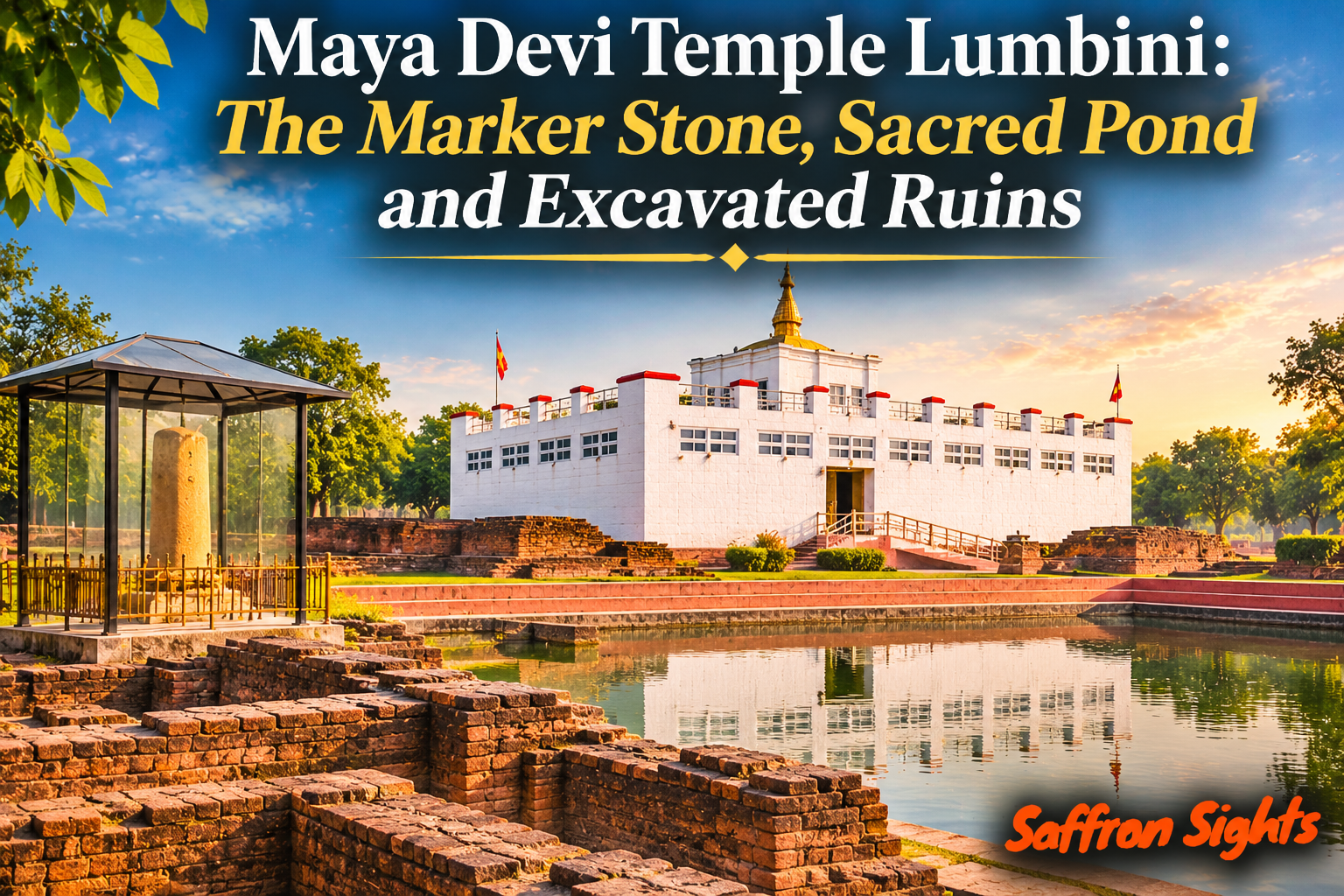

Short answer: Maya Devi Temple is the central shrine of the Lumbini Sacred Garden in Nepal, built beside a sacred pond (Puskarini) at the spot that Buddhist tradition names as the birthplace of the Buddha. Inside, visitors walk on raised platforms above brick ruins and see the marker stone, which is described as the exact spot of the birth. Archaeologists working with UNESCO, Durham University and Nepal’s Department of Archaeology reported in 2013 a timber shrine layout under the brick ruins that radiocarbon dating placed in the 6th century BCE, which is the earliest Buddhist shrine yet found in South Asia. The marker stone is a place of worship and tradition; the excavation is the scientific record.
This page does two jobs at once. It retells the story of Queen Mayadevi’s journey for readers who come from devotion, and it separates what is archaeological evidence from what is tradition for readers who want facts. We label each section “Record” or “Tradition” so you can see which is which. For the whole pilgrimage, with route and stay advice, see the Lumbini Nepal Travel Guide.
Introduction: what it is, where it is and why it matters
The Maya Devi Temple stands in the Sacred Garden at Lumbini, in southern Nepal, and marks the place that Buddhist tradition names as the birthplace of Siddhartha Gautama, around 563 BCE (Wikipedia, Lumbini). Lumbini became a UNESCO World Heritage Site in 1997. It matters to Buddhists because the Buddha himself named it as one of four places pilgrims should commemorate, and it matters to historians because an Ashoka-era inscription found there ties the site to the Buddha in writing.
Origin: who built it, who found it
The oldest dated evidence is Ashoka’s Brahmi inscription of the 3rd century BCE, which says that the emperor visited the spot, worshipped there because the Buddha was born there, erected a pillar and made the village tax-free, with payment reduced to an eighth of the produce (Wikipedia). The pillar was rediscovered in 1896 by Khadga Shamsher Jang Bahadur Rana and Alois Anton Fuhrer, who relied on accounts by the Chinese pilgrims Faxian (early 5th century CE) and Xuanzang (7th century CE). A later inscription on the pillar, by King Ripumalla, dates to the 13th or 14th century CE.
Excavations at the Mayadevi Temple in 2013 found evidence of an older timber structure beneath the brick shrine, suggesting continuous worship and human activity from around 1000 BCE; the same page notes that scholars disagree on whether the site was originally Buddhist.
Purpose and motive
The temple’s purpose is to mark and protect the birth spot. Ashoka’s pillar was meant to commemorate the Buddha’s birth; the later brick shrine and today’s temple preserve the marker stone and the excavated remains. The wider Lumbini Development Zone has a second purpose: it was set aside for monasteries and meditation, with only monasteries allowed and no shops, hotels or restaurants inside (Wikipedia).
Historical context
- Early 5th and 7th centuries CE: Faxian and Xuanzang describe the region.
- 13th to 14th century CE: King Ripumalla’s inscription is added to the pillar.
- 1896: the pillar is rediscovered.
- 1997: UNESCO inscribes Lumbini.
- 2011: a committee is formed to draft a master plan for developing Lumbini as a peaceful tourism area.
- 2013: excavations reveal an older timber structure.
- 2021 to 2023: Bangladesh signs an agreement to build a monastery (2021), India and Nepal jointly lay a foundation (2022), Russia lays a foundation (2023), and UN Secretary-General Antonio Guterres visits (2023).
Stories and legends
Buddhist tradition says Queen Maya, travelling to her parents’ home, gave birth to Siddhartha in a garden. The sources we used describe the Puskarini pond, where Mayadevi is believed to have ritually cleansed herself before the birth and where the Buddha was first bathed. Wikipedia adds that earlier Buddhas are said to have been born, attained enlightenment and passed away at other sites near Lumbini. For many Hindus, who regard the Buddha as an incarnation of Vishnu, Mayadevi is worshipped as Rupa Devi (Wikipedia).
Literary references
The key sources are the Brahmi inscription on the Ashoka Pillar, the travel records of Faxian and Xuanzang, and Buddhist texts and commentaries that place the birth at Lumbini. For the exact wording, consult a published translation of the inscription.
Past, present and future
The past is a pilgrimage site that was lost to memory and rediscovered in 1896. The present is a busy pilgrimage and tourism destination: Wikipedia reports about 1.5 million tourists in 2019 and 17 monasteries and temples built by various countries, with the Russian monastery still under construction in April 2024. The future is shaped by the master plan, new monasteries and a growing number of festival visitors; see Buddha Jayanti in Nepal.
Educational value: key facts for students and exams
- Lumbini: birthplace of Gautama Buddha, around 563 BCE per tradition.
- Ashoka Pillar inscription: Brahmi script, 3rd century BCE.
- Rediscovered in 1896 by Khadga Shamsher Jang Bahadur Rana and Alois Anton Fuhrer.
- UNESCO World Heritage Site since 1997.
- Monastic zone: Theravada monasteries to the east of the central canal, Mahayana and Vajrayana to the west.
- Chinese pilgrims whose accounts helped identify the site: Faxian and Xuanzang.
Fun facts
- Nepal’s central bank issued a 100-rupee note in 2013 featuring Lumbini and a portrait of Mayadevi.
- Buddhist tradition names Lumbini as one of four sites for pilgrims to remember.
- The name is often translated as “the lovely” or “beautiful garden.”
Additional insights
The Indian connection is strong: Lumbini is the first stop on the Buddhist circuit that links Nepal and India. Keep tradition (the birth story) and record (Ashoka’s inscription, the 1896 rediscovery) clearly apart when you plan your visit.
At a glance
| Fact | Detail |
|---|---|
| What it is | Buddhist temple and archaeological site inside the Lumbini Sacred Garden |
| Why it matters | Traditionally the birthplace of Siddhartha Gautama, the Buddha |
| Marker stone | Stone inside the temple marking the traditional birth spot |
| Pond | Puskarini (pushkarani), the sacred pool beside the temple |
| 2013 excavation | Timber shrine of the 6th century BCE found beneath brick structures |
| Ashoka | Emperor Ashoka’s pillar inscription and a brick shrine around 249 BCE |
| Other pilgrimage sites in the set | Bodh Gaya, Sarnath and Kushinagar in India |
Tradition: What is the legend of Queen Mayadevi’s journey?
According to Buddhist tradition, Queen Mayadevi (Maya), wife of King Suddhodana of the Shakya kingdom of Kapilavastu, was travelling to her parents’ home to give birth. On the way she stopped to rest in a grove at Lumbini. While she held the branch of a sal tree, she gave birth to Prince Siddhartha, who became the Buddha. Tradition says the child took seven steps and spoke. Maya died seven days after the birth, and her sister Mahapajapati Gotami raised the boy.
Later accounts give different details (the length of the journey, the omens, the child’s first words), and those differ between texts. We do not treat the miraculous details as historical. For readers, the useful point is that the grove is the focus of the pilgrimage, and the nativity sculpture inside the temple shows Maya holding the sal branch while Mahapajapati supports her. The date given for the birth varies; one encyclopedia entry gives 623 BCE, but scholars debate the Buddha’s dates.
Record: What does the archaeology show?
Lumbini was nearly forgotten for centuries. The key historical anchor is Emperor Ashoka, who visited about 249 BCE and left an inscription on a pillar recording that the Buddha was born here and that the village was freed from some taxes. Details of the pillar inscription are covered in Ashoka Pillar and the Lumbini Inscription. Wikipedia says Ashoka also built a brick temple to protect the marker stone and the nativity sculpture.
The big step forward came with excavations that began in 2010 inside the temple. A team from UNESCO, Durham University, Nepal’s Department of Archaeology and the Lumbini Development Trust, supported by the Government of Japan, dug beneath the brick structures. In 2013 they reported earlier structures: a timber shrine layout of the 6th century BCE, with radiocarbon dating of posthole alignments suggesting the space was first laid out then. The findings were published in the journal Antiquity by R. A. E. Coningham and colleagues. The researchers described these as the earliest Buddhist shrines in South Asia. In plain terms: the sacred space was already in use around the time traditional dates place the Buddha’s life, which is the most significant archaeological support for early veneration of the spot.
What the excavation does not prove: it does not photograph or date a birth. It shows early ritual use of the place, not the event itself.
What is the marker stone?
The marker stone (sometimes called the nativity stone) is a stone inside the temple that is identified as the exact point of the birth. In the current building, visitors see it from raised walkways within a protected, climate-controlled interior. Archaeologists describe it as sitting within a layered sequence of floors and shrines, from the early timber phase through Mauryan brick work to later repairs.
It matters for three reasons:
- Devotion. It is the focal point of the pilgrimage for Buddhists, and many Hindus also pay respects.
- Archaeology. Its position inside a sequence of earlier structures is the reason the excavation could date the site.
- Conservation. The ruins are fragile, so access is limited to platforms.
What is the Puskarini pond?
Puskarini (pushkarani) is the sacred pool beside the temple. Tradition says Maya bathed in it before the birth and that the baby was washed in the same water. Today it is a walled, stepped pool surrounded by trees, and it is part of the walk around the temple. Pilgrims often sit beside it for meditation. Do not enter the water, and follow signs on offerings and photography.
What rules apply inside the temple? (verify on the day)
Rules at religious sites change, and we did not find an official rules page. The common practice, which you should confirm with staff:
- Dress modestly and remove your shoes at the entrance.
- Keep silent or speak softly inside.
- Photography inside the temple is often restricted or banned; ask before you take any photo. The question of photography is a frequent search, and the honest answer is “ask on the day, and follow the sign”.
- Bags, large cameras and phones may need to be left at a counter.
- Do not touch the ruins or the marker stone.
- Follow the one-way walkway and move on when others are waiting.
When should you go: sunrise or midday?
Sunrise and early morning are best. The Sacred Garden is cool and quiet, groups of monks chant, and the light on the white temple and the pond is better. Midday is hot and crowded, especially in the dry season and around Buddha Jayanti (the festival marking the Buddha’s birth, which falls in May by the lunar calendar). Late afternoon is a good second choice.
| Time | What to expect |
|---|---|
| Sunrise to 9 am | Quiet, cool, best for meditation |
| 10 am to 2 pm | Crowds and heat, longer queues |
| 3 pm to closing | Softer light, fewer groups |
Monsoon (June to August) is hot and humid in the Terai, and winter mornings can be foggy. See Best Time to Visit Nepal.
How long should you spend in the Sacred Garden?
Allow two to three hours for the Maya Devi Temple, the pond and the Ashoka Pillar, and half a day if you also walk the monastic zone, where countries have built monasteries and stupas. Lumbini’s wider site is large, so many visitors hire a rickshaw or bicycle. If you are arriving from India, a day at Lumbini can be combined with Ramagrama and Tilaurakot; see our Lumbini Nepal Travel Guide and Lumbini from India.
Is Maya Devi Temple the exact birthplace of the Buddha?
The honest answer has two parts. For the faithful, yes: the marker stone is the spot. For historians, the evidence supports Lumbini as the traditional and early-recognised birthplace, with Ashoka’s inscription as the oldest written record and the 2013 excavation as evidence of very early veneration. No source from the Buddha’s own lifetime survives, and some scholars argue about dates and details. A careful way to say it is that Lumbini is the place identified as the birthplace by the earliest known inscription and by continuous tradition.
What is the Indian connection?
Indian travellers are close to the story. Lumbini is a short distance from the border at Sunauli, and it is one of four major Buddhist pilgrimage places, with Bodh Gaya, Sarnath and Kushinagar in India. The Buddha’s life after the birth unfolded across what is today Uttar Pradesh and Bihar. For an itinerary linking both sides, see the Buddhist Circuit in Nepal and India. If you have visited Nagpur’s Deekshabhoomi, our Deekshabhoomi guide explains how the Buddhist revival there links to this heritage.
Visiting tips for Indian pilgrims
- You need no visa; carry a passport or voter ID. See Do Indians Need a Visa for Nepal?
- Carry small NPR notes for donations and rickshaws.
- Stay in Lumbini or at Bhairahawa; book early around Buddha Jayanti.
- Wear comfortable shoes you can remove easily.
- Bring water and a hat for the garden.
- Visit Janakpur separately if your pilgrimage includes the Ramayana circuit; see Janaki Mandir Janakpur.
Timeline: record versus tradition
| Date | Event | Type |
|---|---|---|
| About 623 BCE (traditional, disputed) | Birth of Siddhartha | Tradition |
| 6th century BCE | Timber shrine layout dated by radiocarbon at the site | Record (2013 excavation) |
| About 249 BCE | Ashoka visits; pillar inscription; brick shrine | Record |
| Centuries of decline | Site forgotten | Record (general history) |
| 1990s | Present protective building constructed | General knowledge; verify |
| 2010 to 2013 | Excavation inside the temple | Record |
Frequently asked questions
What is the marker stone at Maya Devi Temple?
The marker stone is a stone inside the temple identified as the exact spot where the Buddha was born. Visitors see it from raised walkways. It sits within layers of earlier shrines that archaeologists excavated, which helped date early use of the site.
Is photography allowed inside?
Rules vary and may restrict or ban photography inside the temple. Ask staff at the entrance and follow signs. Bags and cameras may need to be left outside. Silence and respectful behaviour are expected.
How long should I spend at the Sacred Garden?
Plan two to three hours for the temple, pond and Ashoka Pillar, and up to half a day if you walk the monastic zone. Go at sunrise for cool weather and fewer crowds.
Is Maya Devi Temple the exact birthplace of Buddha?
For Buddhists, yes. For historians, Ashoka’s inscription of about 249 BCE and a 6th-century BCE shrine layout support Lumbini as the early-recognised birthplace, though no record from the Buddha’s own time survives. The excavation proves early veneration, not the event.
What is Puskarini pond?
Puskarini is the sacred pool beside the temple. Tradition says Queen Maya bathed in it before the birth. Do not enter the water, and follow local signs.