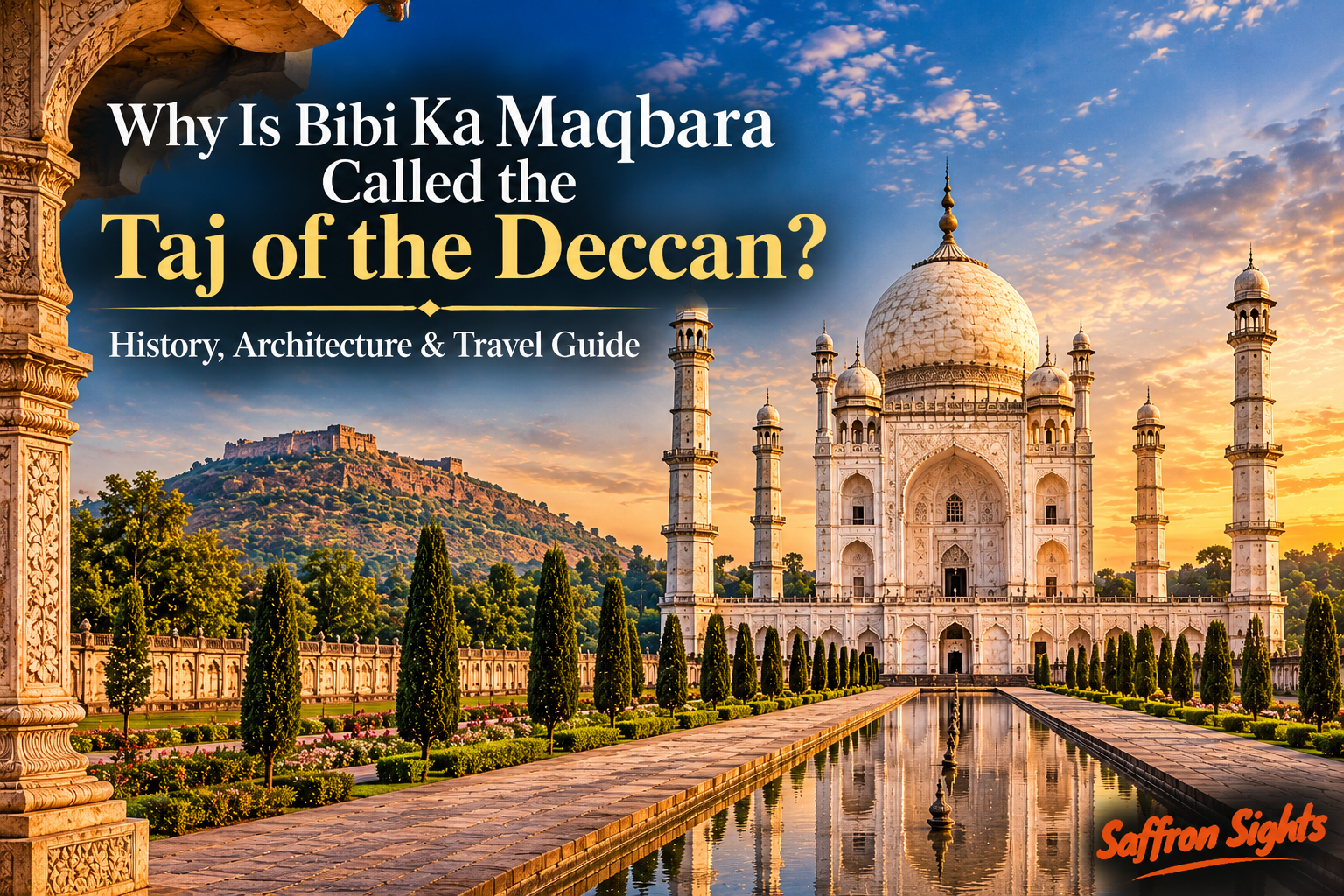

Walk toward Bibi Ka Maqbara along its long axis of water channels and the resemblance is instant: a white domed tomb on a raised platform, four slender minarets at the corners, a formal garden laid out in straight lines. It is easy to see why this monument in Chhatrapati Sambhajinagar, the Maharashtra city long known as Aurangabad, is nicknamed the Taj of the Deccan, or Dakkhani Taj.
The nickname is fair but incomplete. Bibi Ka Maqbara, “Tomb of the Lady”, was designed by the son of the Taj Mahal’s chief architect, yet it was built in Aurangzeb’s austere age, on a far smaller budget and in local Deccan stone. This guide explains who built it and for whom, how it differs from Agra’s masterpiece, and what else in the city belongs on the same itinerary. If you are travelling around Mahashivratri on Saturday, 6 March 2027, it also shows how to fit the tomb into a wider trip to the region.
Who built it and for whom
The tomb commemorates Dilras Banu Begum, Aurangzeb’s first wife and chief consort, who died in 1657 and is known by her posthumous title, Rabia-ud-Daurani, “Rabia of the Age”. She was the mother of Prince Muhammad Azam Shah and, as Shah Jahan’s daughter-in-law, part of the same imperial family that produced the Taj Mahal.
Who commissioned the tomb is less straightforward. The signboard on site credits Azam Shah, but most historians argue that Aurangzeb himself ordered it, with Azam Shah linked to the monument later through supervision or repairs. The dates explain the confusion. The French traveller Jean-Baptiste Tavernier is usually cited for a start around 1653, an inscription on the main gateway gives 1061 AH (1660–61 CE) for completion, and some modern sources place the building work between 1668 and 1669. Azam Shah, born in 1653, was a small child through most of the earlier timeline, which makes him an unlikely original patron. Because the accounts differ, any single construction year is best treated as approximate.
The design credit is much clearer. An inscription on the entrance door names the architect as Ata-ullah (also written Ataullah Rashidi), son of Ustad Ahmad Lahori, the chief designer associated with the Taj Mahal, and the engineer as Hanspat Rai. The Taj’s architectural lineage, in other words, travelled south through its designer’s own family.
Design comparison with the Taj Mahal
Both monuments follow the classic Mughal funerary recipe: a central tomb on a high platform, a large onion dome, four corner minarets, arched recesses, symmetrical facades and a charbagh, the four-part garden divided by paths and water. The differences lie in how that recipe was carried out.
- Materials. The Taj Mahal is clad almost entirely in white marble. At Bibi Ka Maqbara, marble is used mainly for the lower wall (the dado) and the dome, while much of the rest is basaltic trap stone finished in fine lime plaster and stucco.
- Budget. A traditional account, the Tarikh Namah of Ghulam Mustafa, puts the cost at ₹6,68,203, roughly ₹6.7 lakh and a small fraction of what the Taj Mahal is reckoned to have cost.
- Ornament. The Taj is celebrated for polished marble inlay. Bibi Ka Maqbara relies instead on stucco painting, relief work, glazed tile and carved lattice screens.
- Scale and mood. It is smaller and plainer, reflecting both Aurangzeb’s well-known austerity and the practical limits of imperial spending far from Agra.
Dismissing it as a “poor man’s Taj” misses the point. Up close, the monument reads as a Mughal idea translated into Deccan materials, not a failed copy but a regional adaptation, and one of the few monumental Mughal tombs in the Deccan.
Gardens, minarets and marble work
The walled enclosure measures roughly 458 metres by 275 metres, with the tomb at its centre. The garden was originally planted with cypress, pine, palm, mango and ashoka trees and is crossed by axial water channels, fountains, broad walkways and pavilions, creating the long reflecting approach that recalls Agra.
The four minarets are among the monument’s most distinctive features. They are octagonal in section, which gives them a more sculptural look than the smooth round shafts of the Taj, and they rise tall relative to the central dome, a proportion often read as a Deccan tendency.
Inside, the actual grave of Rabia-ud-Daurani lies below ground level, enclosed by an octagonal marble lattice screen, and visitors can descend to see it. On the upper level, pierced marble jalis filter light into the interior, while floral and inscriptional ornament and painted stucco enliven the walls and dome.
Visitor note. Most people need 45–60 minutes for the tomb, gardens and water channels, and early morning or late afternoon gives the best light along the main axis. ASI-reported entry rates are ₹25 for Indian visitors and ₹300 for foreign nationals, and Incredible India lists opening hours of 8 AM to 8 PM. Fees and timings can change, so confirm them before you go.
Aurangabad’s Mughal-era past (Panchakki, Aurangabad Caves)
The tomb makes more sense once you know the city around it. Founded as Khadki in 1610 by Malik Ambar, a minister of the Ahmednagar sultanate, the settlement became a Mughal base in the Deccan and later took its name from Aurangzeb, who spent long years governing and campaigning in the region. He died in 1707 and is buried at Khuldabad, on the plateau outside the city. The hill fortress of Daulatabad, about 15–16 km north-west of the city, belongs to the same story; Saffron Sight’s Daulatabad Fort history traces how Devagiri became a fortress and a capital.
Panchakki shows a more practical side of that era. Built around 1695 within the dargah complex of the Sufi saint Baba Shah Musafir, described in many accounts as Aurangzeb’s spiritual guide, this water mill used an underground channel to bring water from a spring several kilometres away and drop it into a cistern with enough force to turn its grinding stones. The flour fed pilgrims and soldiers. Accounts differ on exactly who built it, but the engineering, which relies on gravity rather than any machine, is the real attraction.
Older still are the Aurangabad Caves, twelve rock-cut Buddhist shrines carved into a basalt hillside about two kilometres north of the tomb. Most are dated to the 6th and 7th centuries CE, with a few earlier excavations, and their carvings range from early chaitya and stupa forms to goddess figures influenced by later Tantric Buddhism. They predate Bibi Ka Maqbara by roughly a thousand years, a reminder that this landscape was settled and sacred long before the Mughals arrived. For a far larger Buddhist cave complex, see Saffron Sight’s guide to Kanheri Caves near Mumbai, which has 109 rock-cut caves.
Planning around Mahashivratri. The festival falls on Saturday, 6 March 2027, with the main night observances running into 7 March. The Grishneshwar Jyotirlinga temple at Verul, about 30 km from the city beside the Ellora Caves, is traditionally counted as the twelfth Jyotirlinga and draws very large crowds, although Jyotirlinga lists vary slightly by tradition; Saffron Sight’s guide to Maharashtra’s five Jyotirlingas places it in the wider pilgrimage circuit. Redevelopment work with a long closure was reported at the temple in October 2026, and traffic restrictions around Ellora have been used on past festival days, so check the latest status before you plan around a darshan. A sensible split is to keep Bibi Ka Maqbara, Panchakki and the Aurangabad Caves for one day in the city and to give Ellora and Verul a separate day, starting with the Kailasa Temple (Cave 16), covered in this Ellora Kailasa Temple guide.
Name note: city is now Chhatrapati Sambhajinagar
The city’s name has changed. The Government of India approved the renaming of Aurangabad as Chhatrapati Sambhajinagar in February 2023, the revenue division was renamed in September 2023, and the railway station was officially renamed in October 2025. Many guidebooks, older maps and listings still say Aurangabad, as do monument names such as the Aurangabad Caves, so try both names when you search or book.
The monument’s own name is unchanged. However you search for it, Bibi Ka Maqbara is best understood as a conversation with the Taj Mahal rather than a copy of it: the same Mughal language of symmetry, domes, minarets and water, spoken with Deccan stone, lime plaster and a quieter, more restrained voice.
Frequently asked questions
Why is Bibi Ka Maqbara called the Taj of the Deccan?
Because it follows the Taj Mahal’s plan, with a domed tomb on a raised platform, four minarets and a charbagh garden with water channels. Its architect, Ata-ullah, was also the son of the Taj’s chief designer, Ustad Ahmad Lahori, and the tomb stands on the Deccan plateau.
Who built Bibi Ka Maqbara?
Most historians credit Aurangzeb with commissioning it for his wife, Dilras Banu Begum. Ata-ullah designed it and Hanspat Rai was the engineer. Prince Azam Shah is credited on the site signboard and is linked to later supervision or repairs.
Is Bibi Ka Maqbara made entirely of marble?
No. Marble is used mainly for the lower wall and the dome, while most of the structure is basaltic trap stone finished in lime plaster and stucco.
Is Aurangzeb buried at Bibi Ka Maqbara?
No. The tomb holds Dilras Banu Begum. Aurangzeb is buried at Khuldabad, outside the city.
How long does a visit take, and what does it cost?
Allow 45–60 minutes. ASI-reported tickets are ₹25 for Indian visitors and ₹300 for foreign nationals, but confirm the current fee and opening hours before you go.
What can I see near Bibi Ka Maqbara?
Far far away, behind the word mountains, far from the countries Vokalia and Consonantia, there live the blind texts. Separated they live in Bookmarksgrove right at the coast of the Semantics, a large language ocean.
Is Aurangabad the same as Chhatrapati Sambhajinagar?
Yes. The Centre approved the renaming in February 2023, but many maps and guides still say Aurangabad, so search under both names.