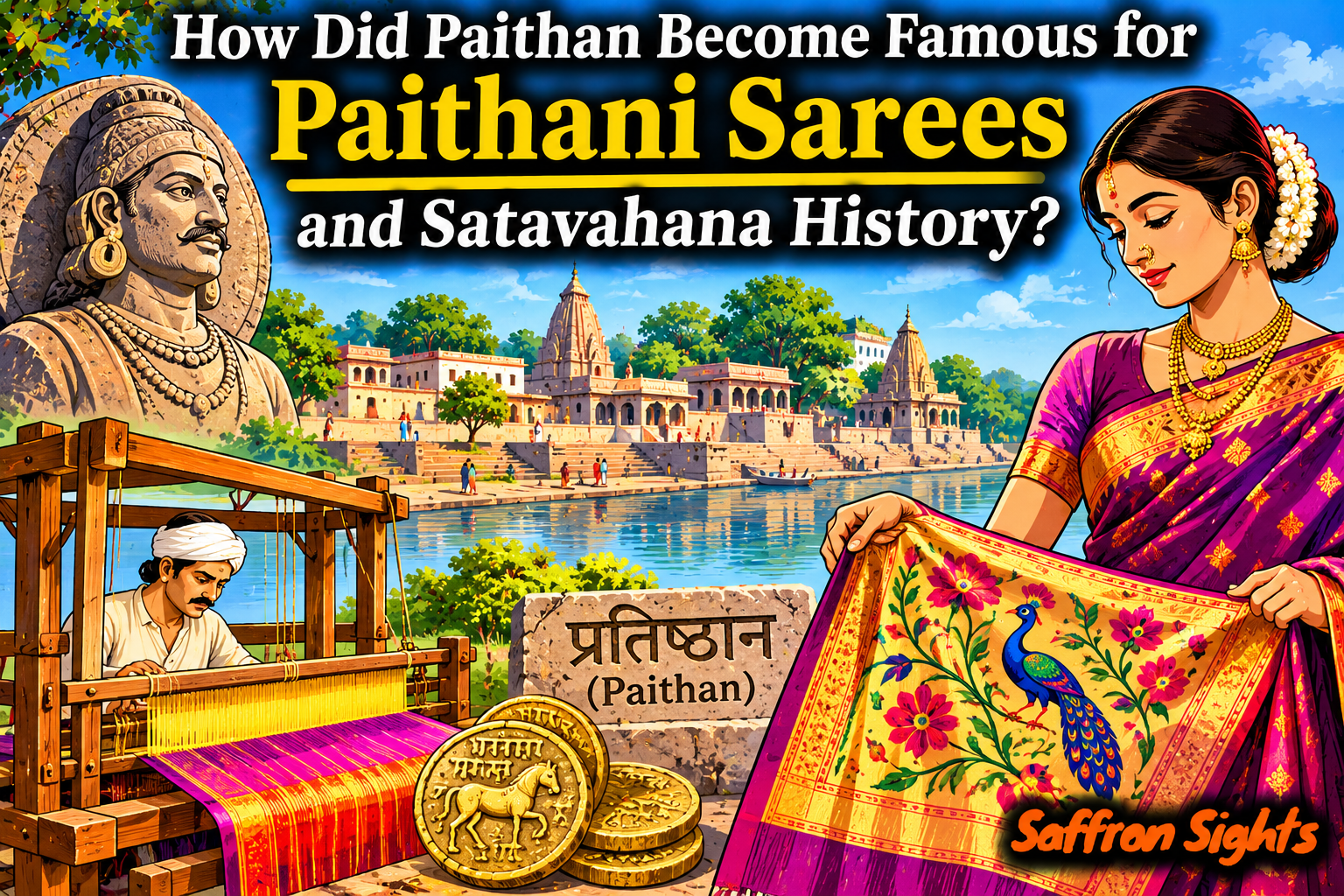

An ancient capital on the Godavari, a trading town that reached Rome, and a handloom that is still woven by hand today. Here is what the evidence supports, and what is tradition.
1. Paithan as Pratishthana, Satavahana capital
Paithan lies on the Godavari River, about 56 km south of Chhatrapati Sambhajinagar. In antiquity it was Pratishthana, a major political and commercial centre of the Deccan.
The Satavahana dynasty ruled much of the Deccan from roughly the 2nd century BCE to the 2nd century CE. Its administrative centres shifted over time, but Pratishthana remained a principal seat of authority and a key node in regional trade. The Maharashtra tourism department dates the town’s Satavahana-era fort to the 2nd century BCE, and finds in the region, including coins, sculpture, terracotta and everyday objects, record a long urban history.
Staying in the city? Read our guides to Bibi Ka Maqbara, the Taj of the Deccan, Daulatabad Fort and the Ellora Kailasa Temple. For other early rock-cut Buddhist sites in Maharashtra, see Karla and Bhaja Caves.
| Claim | What the evidence supports |
|---|---|
| Paithan was a Satavahana capital | Strongly supported. |
| It was a trade hub linked to Roman commerce | Supported by classical references and Indo-Roman trade evidence. |
| Today’s Paithani began in exactly its present form under the Satavahanas | Not securely proven. The tradition is ancient, but an unchanged 2,000-year-old saree should be treated cautiously. |
2. Ancient trade and Greek/Roman links
The Godavari gave Paithan access to inland routes and helped make it prosperous. A Government of India handloom study says the town exported cotton and silk to the Roman Empire and was an important textile centre under Satavahana patronage. It cites Pliny and Ptolemy as classical sources for the period.
Ptolemy’s mention of Baithana is often quoted as praise for the town’s fabrics. The safe reading is that Paithan was known for fine textiles and took part in wider Indo-Roman trade.
Careful with the legend. The popular line that Paithani sarees were sold in Rome for gold is not firmly established. Nor do references to weaving and embroidery in the Gatha Sattasai, a Satavahana-era text linked to King Hala, prove that the modern Paithani existed then. They show that textile craft mattered in the culture.
3. How a Paithani saree is woven
A Paithani is a handwoven silk saree with ornamental borders and pallu motifs, often worked in gold or silver zari. Its defining technique is tapestry-like: coloured silk and metallic threads are interlocked in the weft so the motifs are part of the cloth and appear on both faces. Nothing is printed or embroidered on top.
Traditional motifs include:
- Asawali, a flowering vine
- Peacock and parrot, often in the pallu
- Lotus, woven into borders and the body
A single saree can take weeks or months to complete, which is why authentic pieces are valued as heirlooms and for Maharashtrian weddings and ceremonies.
Later history shaped the craft. Popular accounts credit Mughal-era patronage, including “Aurangzebi” designs, though this is less securely documented. The Peshwas are consistently linked with renewed support and with the rise of Yeola in Nashik district, now a leading production hub. The Nizam’s court also patronised Paithani. So the craft has ancient roots, but its present form was refined over many centuries. “Queen of Silks” is a modern marketing phrase, not an ancient title.
To follow the Peshwa story to its capital, read Shaniwar Wada: the Peshwa palace, a murder and a legend.
4. Sant Eknath Maharaj Samadhi
Paithan is just as important as a Warkari pilgrimage town. Sant Eknath Maharaj (16th century), a revered Marathi saint-poet, lived and taught here, and his samadhi stands on the bank of the Godavari. Pilgrims visit throughout the year, with the largest gathering at the annual Nath Shashthi festival in the Hindu month of Phalguna, usually in February or March.
Sant Eknath belongs to the Warkari tradition. To see how that tradition moves today, read Ashadhi Wari Pandharpur: why lakhs walk to Vitthal’s temple.
Pair the samadhi with a walk along the river ghats and the old town, and you cover both the sacred and the historical sides of Paithan in one visit.
The Godavari also shapes another sacred city upstream: see what makes Nashik sacred ahead of the 2027 Simhastha Kumbh Mela. For more pilgrimage stops, use our guide to Maharashtra’s five Jyotirlingas.
Spring weekend trip. Late winter into spring is a comfortable time to visit before the Deccan heat builds. Check the Nath Shashthi date for the year if you want to join the festival, and expect crowds if you do.
5. Where to buy genuine Paithani
Buy from weaving workshops and cooperative or state-supported handloom outlets in Paithan itself, or from established weavers in Yeola. Paithani has Geographical Indication (GI) status, which exists to protect the name.
- Ask to see the loom or the weaver. Reputable sellers will usually show you.
- Check both sides. Woven motifs should look finished on the back as well as the front, unlike printed or embroidered imitations.
- Look for certification. Ask about the Handloom Mark or GI authentication, and get a proper bill.
- Expect time and a price to match. A very cheap “Paithani” is likely power-loom or a copy.
The bottom line
Paithan’s fame rests on two connected legacies: Pratishthana, a Satavahana political and trade centre, and the later Paithani silk-weaving tradition. The strongest historical case is for an ancient textile culture and Satavahana-era trade. The strongest cultural case is for Paithani as a living handloom craft, refined over centuries rather than invented intact in antiquity.
Frequently asked questions
Why is Paithan famous?
Paithan is famous for two reasons: its role as a Satavahana capital and trade centre, and the Paithani silk saree tradition associated with it. It is also a pilgrimage town because of Sant Eknath Maharaj’s samadhi.
Is the Paithani saree really 2,000 years old?
Not in its present form, as far as the evidence shows. Paithan had an ancient textile and trade reputation, but today’s Paithani was refined over many centuries through later patronage and technique.
What makes a Paithani different from other silk sarees?
Its motifs are woven into the cloth with interlocked coloured silk and zari threads in the weft, so they appear on both faces. Nothing is printed or embroidered on top. Classic motifs include asawali, peacock, parrot and lotus.
How can I tell if a Paithani is genuine?
Ask to see the loom or the weaver, check that the motifs look finished on the back, and ask about Handloom Mark or GI authentication. Get a proper bill. A very cheap “Paithani” is likely power-loom or a copy.
When is the best time to visit Paithan?
Late winter into spring is comfortable, before the Deccan heat builds. The Nath Shashthi festival falls in Phalguna, usually February or March, so expect crowds if you travel then. Confirm dates locally before you go.