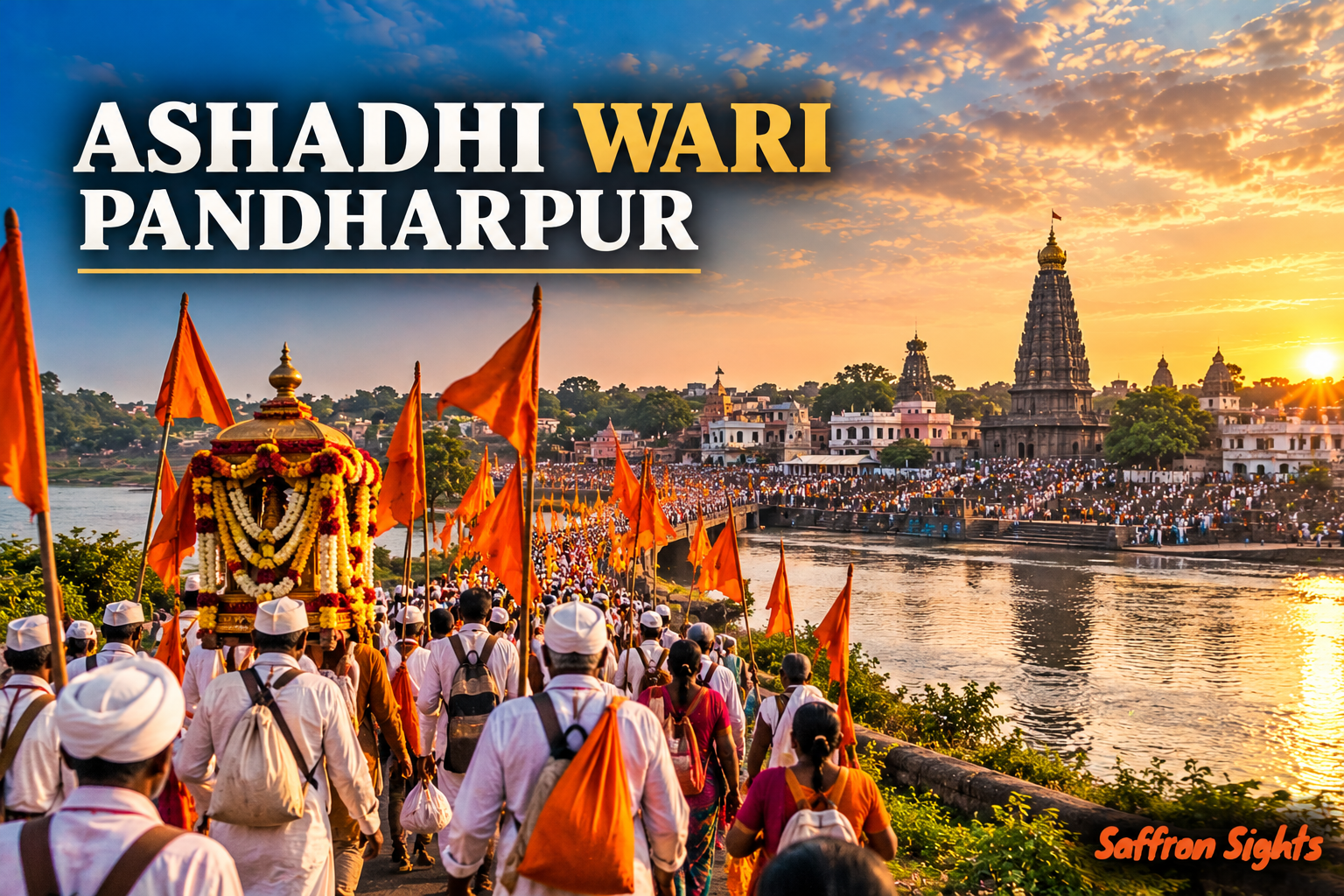

When the monsoon arrives in Maharashtra, thousands of saffron flags begin moving along the roads leading towards Pandharpur. Devotees walk barefoot or in simple footwear, carry tulsi plants, sing devotional songs and chant the name of Vitthal. Some travel with their families, while others join groups that have followed the same pilgrimage route for generations.
This is the Ashadhi Wari, one of Maharashtra’s most important religious and cultural traditions. Every year, lakhs of devotees, known as Warkaris, travel towards the Shri Vitthal-Rukmini Temple in Pandharpur to celebrate Ashadhi Ekadashi.
But why do so many people choose to walk for days or even weeks? The answer goes beyond religious belief. The Wari brings together faith, community, music, service and a shared cultural identity that has shaped Maharashtra for centuries.
In this guide, discover the history of the Ashadhi Wari, the significance of Vitthal, the palkhi routes, the saints who influenced the tradition and the best way to visit Pandharpur.
What Is the Ashadhi Wari in Pandharpur?
The Ashadhi Wari is an annual pilgrimage in which devotees walk to Pandharpur during the Hindu month of Ashadh, generally falling in June or July. The journey culminates around Ashadhi Ekadashi, the eleventh day of the bright fortnight of Ashadh.
The word Wari refers to a recurring pilgrimage, while the devotees who participate are called Warkaris. Many travel behind palkhis carrying the padukas, or sacred footwear, associated with revered saints.
The main processions begin at Alandi, associated with Sant Dnyaneshwar, and Dehu, associated with Sant Tukaram. Along the way, the pilgrims pass through villages and towns where residents offer food, drinking water, shelter and medical assistance.
| Detail | Information |
|---|---|
| Festival | Ashadhi Wari |
| Destination | Shri Vitthal-Rukmini Temple, Pandharpur |
| District | Solapur, Maharashtra |
| Main pilgrimage month | Ashadh, usually June–July |
| Main starting points | Alandi and Dehu |
| Duration | Commonly around three weeks for the main processions |
| Main festival day | Ashadhi Ekadashi |
Pilgrimages to Pandharpur take place at other times of the year as well, including during Kartiki Ekadashi. However, the Ashadhi Wari is particularly famous for its enormous processions and the arrival of the palkhis during the monsoon.
The tradition is often described as being 700 to 800 years old, although the precise beginning of the organised pilgrimage cannot be established with certainty.
Who Is Vitthal, the God Worshipped at Pandharpur?
Vitthal, also known as Vithoba or Panduranga, is a beloved deity worshipped particularly in Maharashtra. He is commonly associated with Vishnu and Krishna.
The principal image at Pandharpur depicts the deity standing on a brick with both hands resting on his hips. Rukmini, also known as Rakhumai, is worshipped in the temple complex.
For Warkaris, Vitthal is not simply a deity to visit during a festival. He represents a personal relationship built through devotion, humility, remembrance and service.
The story of Pundalik and the brick
According to a popular devotional legend, Pundalik was deeply devoted to serving his parents. When Krishna arrived to meet him, Pundalik was occupied with their care. He offered the visitor a brick to stand on and continued his service.
Krishna waited on the brick, and this image became closely associated with Vitthal.
For devotees, the story conveys an important message: sincere service and responsibility towards one’s parents can themselves be expressions of devotion. It is a religious tradition rather than a historically documented event.
What does history tell us about the Vitthal Temple?
The history of the temple provides evidence of an established Vitthal shrine in medieval Maharashtra. An inscription dated 1189 records the setting up of a small Vithoba shrine, while another inscription from 1237 reflects royal patronage during the following century.
The origins of Vitthal worship remain a subject of scholarly discussion. Researchers have explored connections between local religious traditions and the broader worship of Vishnu and Krishna.
The temple’s history therefore reflects both the continuing faith of devotees and the development of religious traditions over time.
How Did the Palkhi Tradition Begin?
The palkhi is one of the most recognisable features of the Ashadhi Wari. A palkhi is a palanquin that carries sacred objects associated with a saint, particularly the saint’s padukas.
Although devotees travelled to Pandharpur long before the present processions took shape, the organised palkhi tradition developed over time.
Tradition credits Narayan Maharaj, the youngest son of Sant Tukaram, with beginning the practice of carrying the saints’ padukas in a palkhi in 1685. Later developments, particularly in the early nineteenth century, helped organise the processions and the dindi system.
Haibatrao Baba Arphalkar is widely associated with organising the Dnyaneshwar palkhi and strengthening the procession’s structure. Tukaram’s descendants also contributed to changes in the tradition.
These details should be understood in the context of traditional accounts and later historical descriptions, rather than as a completely settled chronology.
The Palkhi Routes: From Alandi and Dehu to Pandharpur
The Ashadhi Wari is not a single procession following one road. Several palkhis travel from different places, bringing together devotees from across Maharashtra.
Two of the best-known processions are associated with Sant Dnyaneshwar and Sant Tukaram.
Sant Dnyaneshwar Palkhi from Alandi
Alandi, near Pune, is associated with Sant Dnyaneshwar, the thirteenth-century saint and author of the Dnyaneshwari, a Marathi commentary on the Bhagavad Gita.
The Dnyaneshwar palkhi traditionally begins at Alandi and travels through places including Pune, Saswad, Jejuri, Lonand, Phaltan, Natepute and Malshiras before reaching the Pandharpur area.
Sant Tukaram Palkhi from Dehu
Dehu, also near Pune, is closely associated with Sant Tukaram, one of Maharashtra’s most influential devotional poets.
The Tukaram palkhi follows a separate route, passing through areas including Akurdi, Pune, Loni Kalbhor, Baramati, Indapur and Akluj.
Both processions head towards Pandharpur, with Wakhari serving as an important gathering point near the town.
Exact routes, halts and schedules can vary from year to year. Smaller palkhis also join from other towns, making the Wari a much wider pilgrimage network.
What Are Dindis, Ringan and Seva?
The Wari is organised through a range of practices that help thousands of people travel together.
Dindis: Groups of Warkaris
A dindi is an organised group of pilgrims, often connected by village, community or shared devotional practice. Members walk together under a flag, sing abhangs and share responsibilities during the journey.
The dindi system gives the procession structure and helps pilgrims maintain a sense of community.
Ringan: A devotional horse run
Ringan is a distinctive event held at designated places along the pilgrimage route. Warkaris gather around an open ground or form lines as a horse runs along a clear path.
Many devotees associate the horse with the presence of a saint and regard the dust it raises as sacred. Traditional games and celebrations may follow, depending on the location.
Seva: Service to fellow pilgrims
Seva, or selfless service, is central to the Wari.
Residents, volunteers and organisations distribute food and water, provide resting places and help arrange medical assistance. Many people who offer these services do not undertake the entire pilgrimage themselves.
Their contribution demonstrates that the Wari depends not only on those who walk but also on those who support them.
Three Saints Who Shaped the Warkari Tradition
The Warkari movement grew through the teachings, poetry and devotional practices of several saints. Their ideas helped make spiritual teachings accessible to ordinary people through the Marathi language.
Sant Dnyaneshwar
Sant Dnyaneshwar was a thirteenth-century saint associated with Alandi. His best-known work, the Dnyaneshwari, explains the Bhagavad Gita in Marathi.
Tradition holds that he took samadhi at Alandi in 1296. His teachings continue to influence the devotional culture surrounding the Wari.
To explore more about Maharashtra’s medieval history, read our guide to Daulatabad Fort and the history of Devagiri.
Sant Namdev
Sant Namdev is remembered for his devotion to Vitthal and his contribution to devotional poetry. His life dates and birthplace remain subjects of historical discussion.
Some hymns attributed to Namdev appear in the Guru Granth Sahib, demonstrating the wider reach of his devotional legacy.
At Pandharpur, Namdev Payari, the first step at the temple entrance, is traditionally associated with him.
Sant Tukaram
Sant Tukaram lived in the seventeenth century and was associated with Dehu. His abhangs, or devotional verses, often question pride, hypocrisy and empty ritual.
His direct language made spiritual ideas accessible to people beyond learned religious circles. The familiar chant “Dnyanba Tukaram” brings together the names of Dnyaneshwar and Tukaram during devotional gatherings.
Other important figures in this wider tradition include Sant Eknath, Janabai, Chokhamela and Gora Kumbhar. Their varied backgrounds are an important part of the Warkari tradition’s emphasis on shared spiritual dignity.
Abhangs and the Warkari Way of Life
An abhang is a Marathi devotional verse commonly sung during kirtan and pilgrimage. The word is often explained as meaning something unbroken.
During the Wari, pilgrims sing abhangs, repeat Vitthal’s name and accompany their journey with cymbals and other traditional instruments.
These songs are not merely musical expressions. They communicate teachings about humility, honest living, devotion and service in language that people can understand and remember.
Traditional Warkari practices commonly include:
- Wearing a tulsi-bead necklace.
- Fasting on Ekadashi.
- Following a disciplined devotional life.
- Avoiding meat and intoxicants as part of traditional observance.
- Greeting fellow devotees with the word Mauli, an affectionate term associated with a mother.
The Wari brings together farmers, workers, professionals, families and people from different social backgrounds. Although it does not erase every social difference, it expresses an ideal of shared dignity and devotion.
People join for different reasons: family tradition, gratitude, personal vows, spiritual discipline or the simple desire to follow a path walked by earlier generations.
Why Do Lakhs of People Walk to Pandharpur Every Year?
The scale of the Ashadhi Wari is remarkable, but its significance cannot be measured by numbers alone.
Faith and devotion
For many Warkaris, reaching Vitthal’s temple is an important expression of devotion. The journey becomes a period of prayer, discipline and reflection.
A connection with saints and ancestors
Many pilgrims participate because their parents, grandparents and community members have done so for generations. Walking the route connects them with a shared religious and cultural memory.
Community and equality
The dindis bring people together through shared routines, meals, songs and responsibilities. The tradition encourages participants to recognise one another as fellow devotees.
Music and collective celebration
Abhangs and devotional chants accompany the long walk. Music makes the pilgrimage a collective experience in which spiritual teaching, performance and everyday life come together.
Seva and compassion
The food, water, shelter and assistance offered along the route are essential to the Wari. For many participants, serving fellow pilgrims is as meaningful as walking themselves.
Together, these elements help explain why the Wari continues to attract such large numbers of devotees in a changing world.
Ashadhi Ekadashi: The Arrival in Pandharpur
As Ashadhi Ekadashi approaches, the palkhis gather near Pandharpur before entering the town. Wakhari becomes an important gathering point, and the roads and streets fill with pilgrims.
Devotees visit the Vitthal-Rukmini Temple, offer prayers and seek darshan. Many also visit the Chandrabhaga river, the local name for this stretch of the Bhima river.
The temple queues can become extremely long during the festival. Some devotees may have to wait for hours, while others pray from outside the main shrine.
Ashadhi Ekadashi is also known as Devshayani Ekadashi. In Hindu tradition, it marks the beginning of Vishnu’s four-month cosmic rest.
The celebrations continue beyond the main arrival, and the palkhis subsequently begin their return journeys.
Visiting Pandharpur Outside the Wari Season
You do not have to join the Ashadhi Wari to experience Pandharpur. Visiting outside the main pilgrimage period can provide more time to explore the temple and nearby heritage sites.
October to February is often suggested for relatively comfortable weather, although conditions vary. If you prefer smaller crowds, avoid Ashadhi and Kartiki pilgrimage periods and choose a weekday that is not an Ekadashi.
How to reach Pandharpur
- By rail: Pandharpur has a railway station approximately 2 km from the temple.
- By air: Solapur and Pune are possible arrival points, depending on available flight connections. Check current routes before travelling.
- By road: Pandharpur is connected by road to cities including Pune, Mumbai and Solapur. Check current bus schedules and journey times.
Places to visit in Pandharpur
Vitthal-Rukmini Temple: The principal destination for pilgrims, with shrines dedicated to Vitthal and Rukmini.
Namdev Payari: A temple entrance step traditionally associated with Sant Namdev.
Chandrabhaga river ghat: A prominent place where pilgrims gather, particularly during major religious occasions.
Pundalik’s shrine: A shrine associated with the devotional legend of Pundalik stands near the river.
If you enjoy exploring Maharashtra’s sacred architecture, you can also read our guide to the Mahalakshmi Temple in Kolhapur.
Darshan and visitor etiquette
Before travelling, check the official Vitthal-Rukmini Temple website for current darshan arrangements, timings and booking information.
Visitors should dress respectfully, follow temple instructions and leave footwear in the designated areas. Photography rules may vary, so follow posted guidance and instructions from temple staff.
If you photograph pilgrims during the Wari, ask permission where appropriate and avoid obstructing the procession.
Most visitors can explore the temple and riverfront in a day. Staying overnight may allow time for early-morning rituals, subject to current temple schedules.
Please help keep the river and surrounding areas clean by disposing of waste responsibly.
For another perspective on Maharashtra’s religious and cultural heritage, explore our guide to the Elephanta Caves near Mumbai.
The Ashadhi Wari Today: Tradition and Modern Challenges
The Wari remains a major expression of Maharashtra’s living cultural heritage. At the same time, bringing large numbers of people together creates practical challenges.
Road congestion, sanitation, waste management, drinking water and medical support require careful planning. Government departments, local authorities, community groups and volunteers help manage these needs along the route and in Pandharpur.
Cleanliness initiatives, public awareness campaigns and organised assistance have become important parts of managing the pilgrimage.
The continued participation of volunteers shows how an old devotional tradition adapts to modern circumstances while retaining its emphasis on faith and collective responsibility.
Conclusion: More Than a Pilgrimage
The Ashadhi Wari is much more than a long walk to a temple. It is a living tradition through which Maharashtra remembers its saints, preserves its devotional poetry and brings communities together.
The palkhis connect Alandi and Dehu with Pandharpur. The dindis provide companionship, the abhangs give voice to devotion, and seva ensures that pilgrims can continue their journey with support from others.
Historical records help us understand the development of Vitthal worship, while legends and devotional practices explain what the pilgrimage means to its participants.
For the Warkaris, the journey is ultimately about faith, humility, service and the desire to reach Vitthal. Every monsoon, as saffron flags move towards Pandharpur, the Wari renews a tradition that remains deeply rooted in Maharashtra’s cultural life.
Frequently Asked Questions
1. What is the Ashadhi Wari in Pandharpur?
The Ashadhi Wari is an annual pilgrimage in Maharashtra during which Warkaris walk towards the Vitthal-Rukmini Temple in Pandharpur, arriving around Ashadhi Ekadashi in June or July.
2. Why do lakhs of people participate in the Ashadhi Wari?
People participate for religious devotion, family tradition, spiritual discipline, community, gratitude and a connection with Maharashtra’s saint-poets.
3. Where do the main palkhis start?
The Sant Dnyaneshwar palkhi starts at Alandi, while the Sant Tukaram palkhi starts at Dehu. Both places are near Pune.
4. How long does the Ashadhi Wari take?
The main palkhi processions are commonly described as taking around three weeks. The exact duration depends on the procession, route and schedule.
5. Who is Vitthal of Pandharpur?
Vitthal, also known as Vithoba or Panduranga, is a deity worshipped particularly in Maharashtra and commonly associated with Vishnu and Krishna.
6. What is the significance of Ashadhi Ekadashi?
Ashadhi Ekadashi is the main festival day associated with the Wari’s arrival in Pandharpur. In Hindu tradition, it marks the beginning of Vishnu’s four-month cosmic rest.
7. What is a palkhi?
A palkhi is a palanquin used in religious processions. During the Wari, it commonly carries the padukas associated with a revered saint.
8. What is a dindi in the Ashadhi Wari?
A dindi is an organised group of Warkaris who walk together, sing devotional songs and share responsibilities during the pilgrimage.
9. Can people who are not Warkaris watch the procession?
Generally, visitors can observe the Wari respectfully. They should follow organisers’ instructions, keep the procession route clear and ask permission before photographing individuals.
10. When is the best time to visit Pandharpur outside the Wari?
October to February is often suggested for comfortable weather. For a quieter visit, consider a weekday outside the major pilgrimage periods and avoid Ekadashi days when possible.
11. Can visitors book darshan online?
The temple’s official website provides information about darshan arrangements and booking. Check the latest availability and rules before travelling.