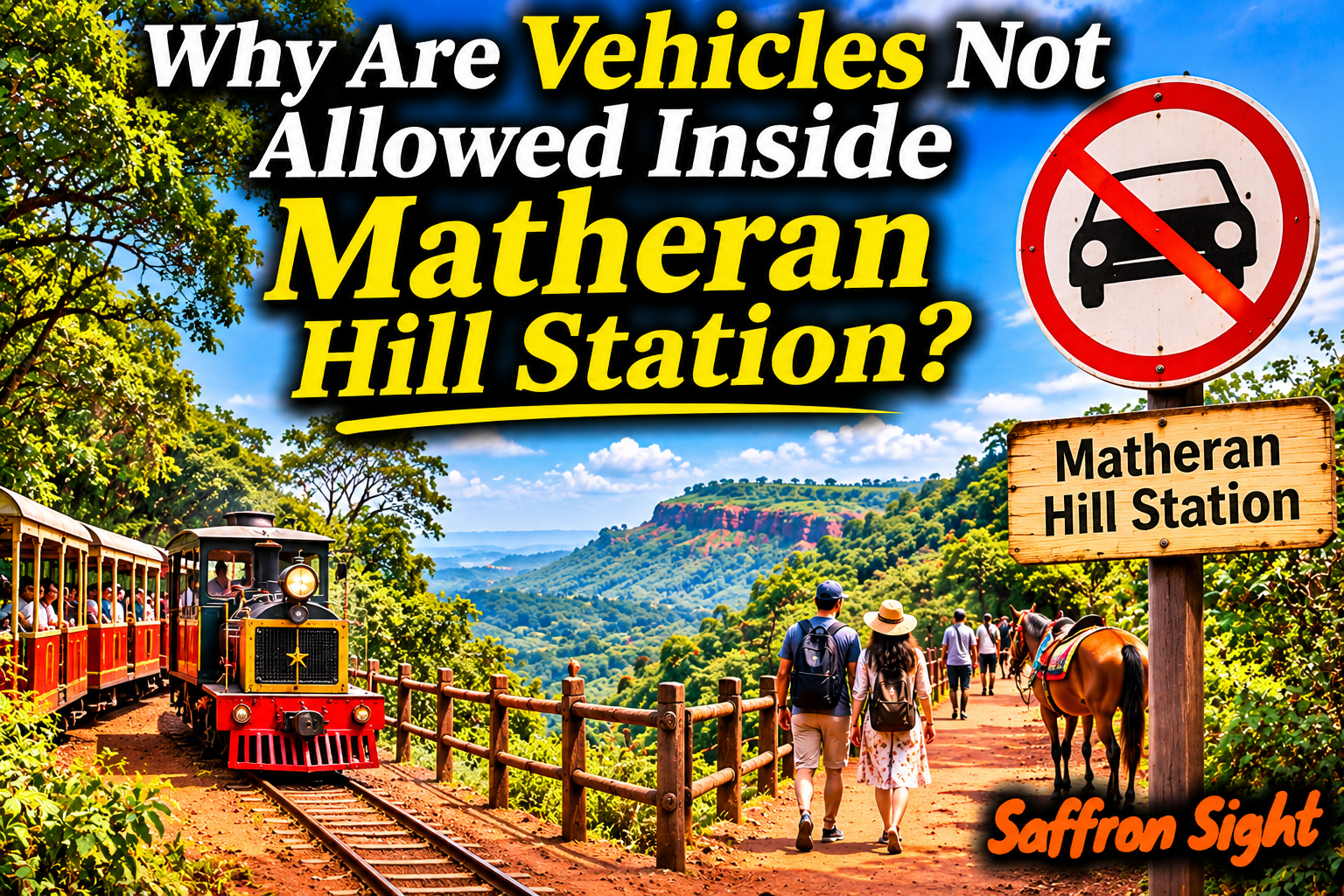

Short answer: The Matheran no vehicles rule exists because the hill station is a legally protected eco-sensitive zone. Its red-earth paths, steep slopes and dense forest cannot take motor traffic. A 2003 government notification bars vehicles inside the town limits, with a few emergency and waste-handling exceptions. Cars stop at Dasturi Naka, and you go on by foot, horse or toy train.
Matheran sits on a small plateau in the Sahyadri hills of Raigad district, about 100 km from Mumbai. For many visitors, the first surprise is that the road simply ends. There are no cars, no bikes and no traffic noise inside the town. This guide explains why, in simple words, and then helps you plan a summer trip around the rule.
| Detail | Summary |
|---|---|
| Place | Matheran, Raigad district, Maharashtra |
| Height | About 800 m (roughly 2,600 ft) |
| Found as a hill station | May 1850, by Hugh Poyntz Malet |
| Eco-sensitive zone | Notified in 2003, amended in 2021 |
| Toy train opened | 1907 |
| Last stop for vehicles | Dasturi Naka |
Matheran’s History: Discovery and Colonial Use
The name Matheran is often explained as “forest on the forehead” of the mountains. Local people knew these hills long before the British came. The colonial story, though, begins in May 1850. Hugh Poyntz Malet, then Collector of Thane, was camping at Chauk, at the foot of the hill. He decided to walk up, and he loved what he found: cool air, thick evergreen forest and wide valley views. He soon built a house here. Records say the first home was ready around 1854.
Malet’s find became a real hill station because of Lord Elphinstone, the Governor of Bombay. He saw how close the plateau was to the city and helped open it up. The British used it as a cool retreat from the summer heat. Early visitors climbed on foot, and Mrs Malet is said to have been carried up in a chair tied to bamboo poles. Wealthy Bombay families, including many Parsi merchants, later built bungalows, and many of those old houses still stand.
This history explains a lot. Matheran grew around footpaths, ponies and a narrow railway, not roads for cars. Some writers say the early British also kept motor cars off the hill. The early record of any ban is hard to prove. What is certain is that today’s rule does not rest on habit. It rests on law.
Eco-Sensitive Zone Rules: The Law Behind Matheran’s No-Vehicle Rule
In 2003, the Union environment ministry declared Matheran and the area around it an eco-sensitive zone. The notification was amended in 2021. Its traffic rule is simple: no vehicular traffic inside Matheran municipal limits. Only a few vehicles are allowed: ambulances, fire engines and tractors that carry solid waste.
The ban has clear reasons.
- Fragile ground. The red laterite paths and steep slopes wear away easily. Regular traffic, wider roads and heavy building would add more damage.
- Forest and wildlife. Maharashtra Tourism lists evergreen forest, medicinal plants, rare birds, leopards, barking deer and giant squirrels here.
- Clean air and quiet. Fumes and noise would spoil the calm that draws visitors in the first place.
Protecting forest near a big city is not unusual. The Kanheri Caves in Mumbai also sit inside a protected forest, within Sanjay Gandhi National Park. Matheran follows the same basic idea: keep pressure on nature low so that heritage and landscape can last.
You may read that Matheran is “Asia’s only automobile-free hill station.” That is a popular tourism phrase, not a checked world record. The safer description is this: ordinary vehicles are banned within the municipal limits, with the exceptions above.
Neral–Matheran Toy Train
If cars cannot climb, a train can. The Neral–Matheran Hill Railway is a 21 km narrow-gauge line, only two feet wide, that winds up the hill through forest with tight curves. It was planned around 1900, construction began in 1904, and it opened in 1907. The philanthropist Abdul Hussein Adamjee Peerbhoy is credited with bringing it to life.
The ride from Neral takes about two and a half hours. In recent timetables, two trains leave Neral each morning, at 8:50 am and 10:25 am, and two return from Matheran in the afternoon, at 2:45 pm and 4:00 pm. Timings can change, so check the latest schedule with Central Railway before you travel.
The train stops for the monsoon each year, usually from June to mid-October, because of landslide risk. In 2026 it restarted on 30 October after a break of about four months. During the break, a short shuttle still runs between Aman Lodge and Matheran. For a summer trip, this means the full Neral–Matheran service is normally running.
The train also fits the no-vehicle idea well. It brings people to the town centre without adding a single car to the road.
Point-to-Point Walking and Horse Rides
If you come by road, your journey changes at Dasturi Naka. It is the last place private vehicles can reach. You park there and go on. The market area is roughly a 30–40 minute walk from Dasturi Naka, and it will take longer with children or heavy bags.
Walking. The top of the plateau is fairly flat, so walking is the best way to enjoy Matheran. Paths link the famous viewpoints, such as Rambagh Point, Shivaji Ladder, One Tree Hill Point, Porcupine Point and Louisa Point. Wear shoes with a good grip, because red mud gets slippery.
Horse rides. Horses and ponies have long carried visitors here. Ask for the fare before you start, and ask your hotel which routes and rates are normal.
Rickshaws and e-rickshaws. For decades, hand-pulled rickshaws were also part of Matheran’s transport. In August 2025, the Supreme Court called the practice “inhuman” and told Maharashtra to phase it out within six months. It also ordered a plan to help the pullers earn a living, with priority for e-rickshaw licences. Battery e-rickshaws began as a limited trial in 2022, with the number capped at 20. The change is still being rolled out, so ask your hotel what transport is available when you travel.
Summer Travel Tips
Summer, from March to May, is a popular time for a Matheran trip. Thick forest keeps the plateau cooler than the plains, but afternoon walks can still be tiring. These tips help.
- Start early. Plan viewpoints for sunrise or late afternoon, and rest in the shade at midday.
- Avoid weekends if you can. Weekdays are calmer, and the walking paths are less crowded.
- Pack light. You may carry your own bag from Dasturi Naka. Bring water, a cap, sunscreen and sturdy shoes.
- Book early. Stays near the market can fill up fast on holiday weekends.
- Check the train. Confirm timings and plan to reach Neral early.
- Respect the zone. Do not litter, avoid single-use plastic and keep food away from monkeys.
Make it a heritage trip too. In July 2025, UNESCO added the Maratha Military Landscapes of India to its World Heritage List. The 12 forts include Raigad Fort, Shivaji Maharaj’s capital, in this same district, and Pratapgad near Mahabaleshwar in Satara district. Raigad district also has the island fort of Murud-Janjira, known for never being taken by force. If you travel from the Pune side, the Karla and Bhaja Caves near Lonavala make an easy add-on. Plan each one as a separate stop, because they are not next door to Matheran.
Frequently Asked Questions
Can I take my car or bike into Matheran?
No. Private vehicles must stop at Dasturi Naka. Park there and go on foot, by horse or by other permitted transport. Only ambulances, fire engines and waste-carrying tractors are allowed inside the municipal limits.
How far is the walk from Dasturi Naka to the market?
It is roughly 30–40 minutes on foot. Allow more time if you have children, bags or rain.
Are hand-pulled rickshaws still allowed in Matheran?
The Supreme Court ordered them phased out in August 2025 and asked the state to help the pullers move to e-rickshaws. The rollout is still in progress, so check with your hotel what is running during your visit.
Does the toy train run in summer?
Yes. It normally runs outside the monsoon break, which is roughly June to mid-October. A shuttle between Aman Lodge and Matheran runs during the rains. Check the latest timetable before you go.
Is Matheran really Asia’s only car-free hill station?
That is a popular description, not a verified record. What is certain is that ordinary vehicles are banned inside the town limits under the eco-sensitive zone rules.